






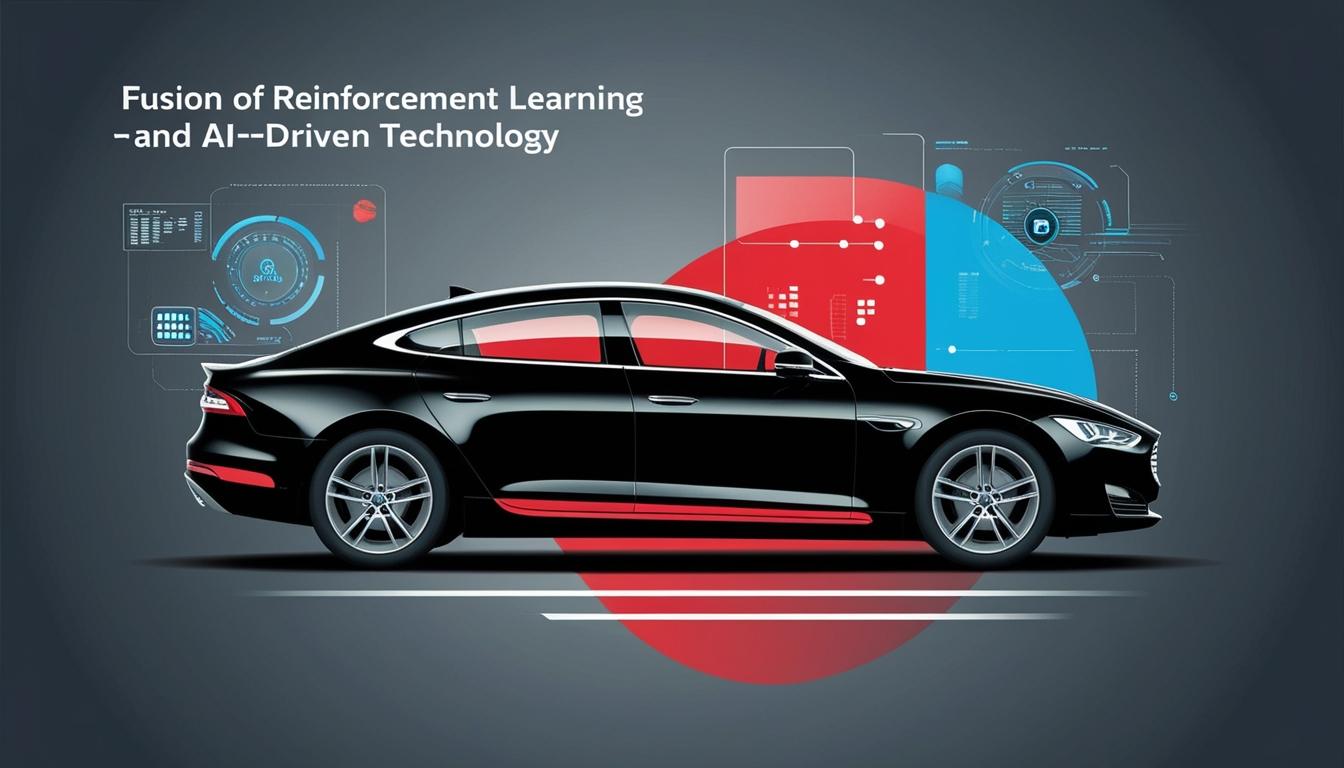

Reinforcement Learning is making waves in both self-driving cars and innovative lab setups, offering new solutions to complex challenges in technology and science.
Reinforcement Learning (RL), a concept derived from training animals through rewards and penalties, is increasingly gaining traction in both autonomous vehicle technology and laboratory automation. The potential applications of RL in these domains are vast, especially in relation to the development of self-driving cars and so-called ‘self-driving labs’. These advancements suggest a future where RL not only enhances operational capabilities but also addresses scientific challenges in experimental validation.
In the realm of self-driving cars, RL is being recognised as a compelling method for developing sophisticated driving algorithms. Alex Kendall, a prominent researcher in this field, has demonstrated that RL can effectively teach a vehicle to drive autonomously using simply a couple of cameras and a large neural network. Kendall’s approach departs from traditional methods that typically break down driving into several subproblems, instead employing an end-to-end learning strategy. This strategy allows one algorithm to handle the entirety of the decision-making process, crucially easing the complex interdependencies that can arise in multi-algorithm setups.
Kendall’s work conceptualises driving as a Markov Decision Problem (MDP), where the goal is to optimise decisions based on dynamic states, actions, and anticipated rewards. The defining components include the agent (the vehicle itself), the environment (everything the vehicle interacts with), the current state (the vehicle’s position and condition), and actions (manoeuvres such as turning or accelerating). Using an iterative learning process, the agent can refine its decision-making through trial and error, improving its driving capabilities over time.
Through simulations run in Unreal Engine 4, Kendall’s team was able to fine-tune hyper-parameters before moving to real-world tests. This preliminary simulation stage enabled their RL model to learn various driving scenarios without the risks associated with physical testing. The outcomes of such projects hint at a scalable approach to autonomous driving, as the reliance on sophisticated sensor suites, like LIDAR, is minimal.
Despite the advancements, challenges such as sparse and delayed rewards as well as high dimensionality remain prominent. These issues illustrate the difficulties RL faces when translating its successes from simulated environments to complex real-world applications, especially in the context of lane following, where rewards may be infrequent.
In parallel to developments in autonomous driving, the concept of ‘self-driving labs’ is emerging as a transformative force in scientific experimentation. The project, AlphaFlow, aims to apply RL techniques to optimise multi-step chemical processes, particularly in the synthesis of core-shell semiconductor nanoparticles. This innovative approach leverages the properties of chemical reactions, characterised by variability and complexity, which inherently aligns with the principles of MDPs.
AlphaFlow’s RL strategy successfully navigates the challenges of exploring a vast parameter space—potentially involving up to 40 dimensions—allowing researchers to identify and optimise reaction routes more efficiently than traditional methods. The automated experimental setup involves a combination of reinforcement learning algorithms and multi-step reactions that are finely controlled, thus reducing time and resources typically associated with experimental work.
Similar to Kendall’s team, AlphaFlow employs digital twin structures for pre-training, using simulated experiments to anticipate performance before physical trials. This methodology showcases how RL can effectively tackle chemical synthesis challenges, increasing throughput in the experimental process and potentially accelerating advancements in various industries such as solar energy and biomedical applications.
Both self-driving cars and self-driving labs exemplify current trends in AI automation that reveal important intersections between technology and scientific inquiry. The promising applications of reinforcement learning in these areas point towards a future where tasks ranging from driving to chemical experimentation can be autonomously managed, thus reshaping business practices across multiple sectors. As such technologies continue to evolve, understanding and optimising their applications will remain a focal point for research and development.
Source: Noah Wire Services
- https://waymo.com/research/imitation-is-not-enough-robustifying-imitation-with-reinforcement-learning/ – This article supports the claim that reinforcement learning (RL) is being used to enhance autonomous driving by combining it with imitation learning, improving safety and reliability in driving policies.
- https://arxiv.org/abs/2305.04412 – This paper discusses an efficient reinforcement learning algorithm for autonomous driving, leveraging motion skills and expert priors, which aligns with the concept of using RL for developing sophisticated driving algorithms.
- https://www.larksuite.com/en_us/topics/ai-glossary/reinforcement-learning-theory – This article explains the fundamental components of reinforcement learning theory, including the agent, environment, and reward signal, which is relevant to the discussion of RL in autonomous vehicles and laboratory automation.
- https://link.springer.com/article/10.1007/s10994-021-05961-4 – This work identifies and formalizes challenges in real-world reinforcement learning, such as sparse and delayed rewards and high dimensionality, which are mentioned as difficulties in translating RL successes from simulated to real-world applications.
- https://www.scientistlive.com/content/benefits-and-challenges-lab-automation – Although this article does not specifically mention reinforcement learning, it discusses the benefits and challenges of lab automation, which is relevant to the concept of ‘self-driving labs’ and the optimization of experimental processes.
- https://waymo.com/research/imitation-is-not-enough-robustifying-imitation-with-reinforcement-learning/ – This article also supports the idea that RL can handle complex driving scenarios by leveraging large amounts of real-world data, which is crucial for the development of autonomous vehicles.
- https://arxiv.org/abs/2305.04412 – This paper further explains how RL can be used to navigate high-dimensional state and action spaces, which is a challenge mentioned in the context of both autonomous driving and laboratory automation.
- https://www.larksuite.com/en_us/topics/ai-glossary/reinforcement-learning-theory – This article provides a general overview of RL, including its application in sequential decision-making and learning from interactions, which is applicable to both autonomous vehicles and laboratory automation.
- https://link.springer.com/article/10.1007/s10994-021-05961-4 – This work highlights the importance of addressing real-world challenges in RL, such as system constraints and operational costs, which are relevant to the practical implementation of RL in various domains.
- https://arxiv.org/abs/2305.04412 – This paper discusses the use of digital twin structures and expert priors in RL, similar to the pre-training methods used by Kendall’s team and AlphaFlow, to anticipate performance before physical trials.







