






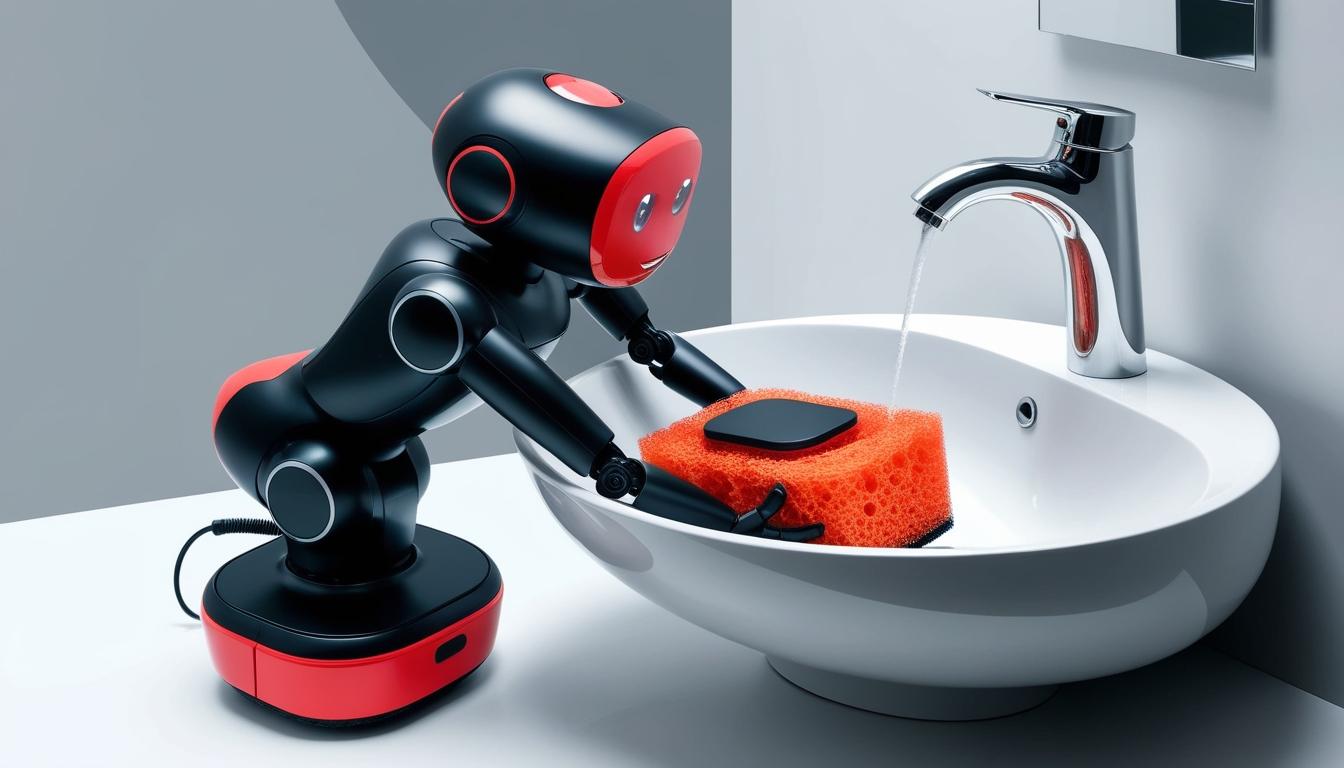

Researchers at TU Wien have developed innovative techniques allowing robots to learn cleaning tasks directly from human demonstrations, marking a significant leap in robotic capabilities.
Robots have reached a significant milestone in their ability to perform complex cleaning tasks, such as maintaining wash hand basins by learning directly from human actions. This advancement is the result of innovative data-processing techniques developed by a research team at TU Wien, which enable robots to observe and adapt their cleaning methods based on human demonstrations.
Traditionally, researchers faced significant challenges in enabling robots to effectively navigate and clean intricate structures, given the variability of different surfaces. For instance, as outlined by the researchers, determining the precise movements needed for a robot arm to access every area of a washbasin—especially those with uniquely curved edges—has been particularly complex. As these complexities emerged, the researchers expressed the impracticalities of crafting fixed rules and predefined mathematical formulas. “It would be highly time-consuming to precisely encode all these parameters in fixed rules and predefined mathematical formulas,” they stated.
Instead of relying on rigid programming, the team developed an approach where a human directly shows the robot how to clean. Initially, a specially-prepared sponge is utilised by a person to clean the edge of a sink. By closely observing these actions, the robot learns the process, enabling it to apply its newfound knowledge to varied tasks and surfaces once it has been trained on a single edge.
PhD student Christoph Unger from the Industrial Robotics group elaborated on this technique, saying, “The robot learns that you need to hold the sponge differently depending on the shape of the surface and that you have to apply a different amount of force on a tightly curved area than on a flat surface.” The implications of this technology are expansive, as it can extend to other tasks beyond cleaning, including wood sanding, repainting vehicles, and welding metal parts.
In a promising look towards the future, researchers indicate that robots equipped with this learning capability could potentially share knowledge with each other, thereby enhancing their operational efficiency across various domains. This innovative approach not only signifies a leap forward in robotics and automation but also highlights the potential for broader applications in business practices across multiple industries.
Source: Noah Wire Services
- https://www.theinternational.at/tu-researchers-develop-smart-cleaning-robot-using-ai/ – Corroborates the development of an AI-powered robotic system by researchers at TU Wien for cleaning tasks and the recognition of their work at the IROS conference.
- https://www.reemanrobot.com/news/researchers-develop-self-learning-robot-that-c-82410108.html – Supports the idea that the robot learns by human demonstration and haptic data, and highlights the applicability of this learning approach to various tasks beyond cleaning.
- https://www.sciencedaily.com/releases/2024/11/241107193009.htm – Details the use of a specially equipped sponge with force sensors and tracking markers to generate data for training the robot, and the potential for federated learning among robots.
- https://www.heise.de/en/news/Robot-learns-to-clean-by-demonstration-10012108.html – Explains the process of the robot learning by imitation and experience, and the challenges of cleaning complex surfaces like washbasins.
- https://www.theinternational.at/tu-researchers-develop-smart-cleaning-robot-using-ai/ – Highlights the challenges of traditional robot programming for complex surfaces and the innovative approach of learning from human demonstrations.
- https://www.reemanrobot.com/news/researchers-develop-self-learning-robot-that-c-82410108.html – Discusses the impracticalities of crafting fixed rules and predefined mathematical formulas for robot movements on complex surfaces.
- https://www.sciencedaily.com/releases/2024/11/241107193009.htm – Describes how the robot learns to apply different forces and angles based on the shape of the surface, as explained by PhD student Christoph Unger.
- https://www.heise.de/en/news/Robot-learns-to-clean-by-demonstration-10012108.html – Details the potential applications of this technology beyond cleaning, such as sanding, painting, and other industrial tasks.
- https://www.sciencedaily.com/releases/2024/11/241107193009.htm – Explains the concept of federated learning where robots can share their knowledge with each other to enhance operational efficiency.
- https://www.heise.de/en/news/Robot-learns-to-clean-by-demonstration-10012108.html – Highlights the future potential of mobile robots working in smaller areas and sharing their accumulated experience through federated learning.
- https://www.theinternational.at/tu-researchers-develop-smart-cleaning-robot-using-ai/ – Mentions the recognition of the research team’s work at the IROS conference, indicating the significance of their innovation in the field of robotics.







