






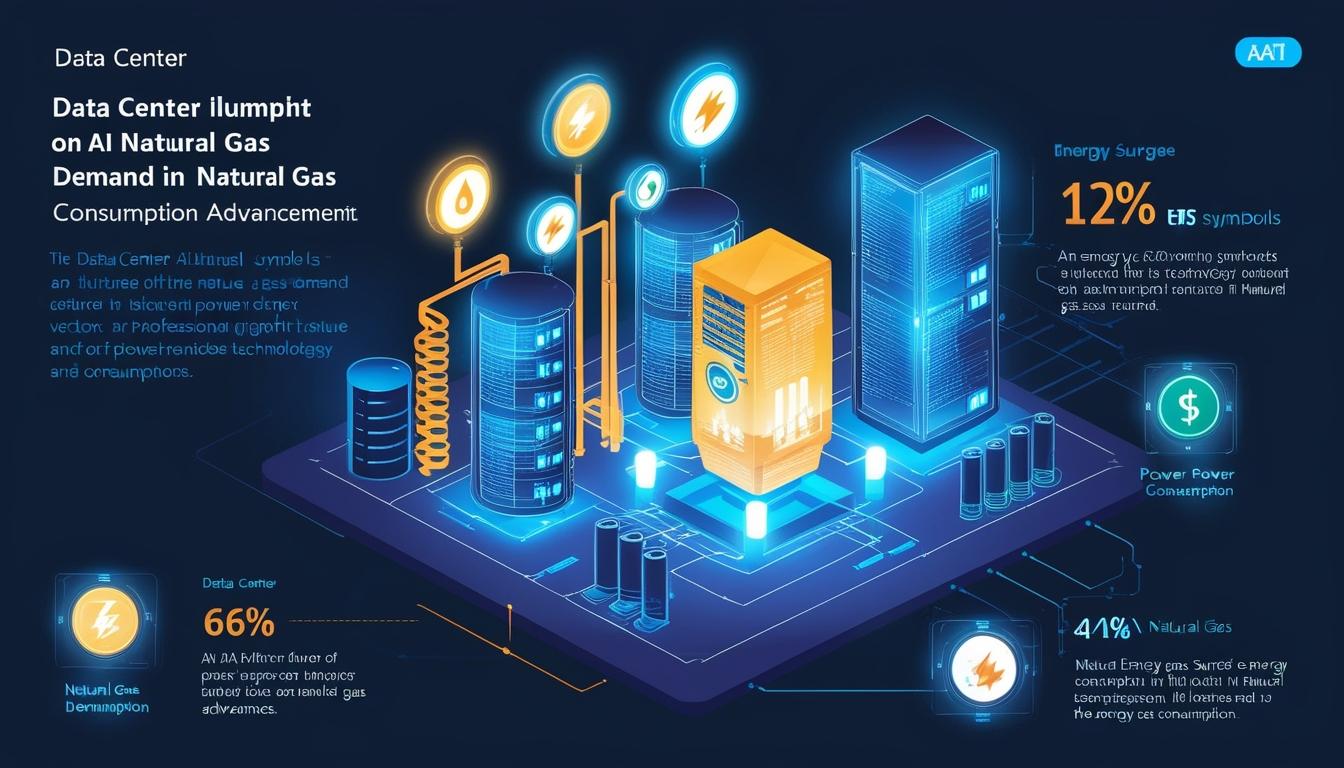

Market analysts warn that the increasing power demand from AI technology in data centres could significantly impact natural gas prices and supply dynamics in the coming years.
Potential Surge in Natural Gas Demand Linked to AI-Driven Power Needs
Recent discussions among market analysts have revealed that future trends in natural gas prices might not yet account for the increasing power demand driven by advancements in artificial intelligence (AI). This topic was a focal point at the Northeast Energy Summit held in Pittsburgh, where industry experts examined the implications of AI on energy consumption and natural gas markets.
Dennis Kissler, Senior Vice President of Trading for BOK Financial, indicated that the surge in AI power demand is not fully comprehended or factored into current natural gas pricing structures. Specifically, futures prices for January 2026 and January 2030 posted at $4.07/MMBtu and $4.29/MMBtu respectively on October 22, 2023, don’t reflect the potential exponential growth in demand linked to data centres.
Data centres are substantial power consumers, presently accounting for approximately 3.5% of the power drawn from the U.S. grid. As these centres increasingly deploy AI technology, their power needs are projected to rise significantly. According to the Federal Energy Regulatory Commission, power demand in this sector is expected to nearly double from 19 gigawatts (GW) in 2023 to 35 GW by 2030. Meanwhile, S&P Global Research suggests this could reach 61 GW as early as 2028.

This growing demand will likely necessitate more gas-fired power generation. Data centres require a consistent and reliable power supply, and despite the potential contributions from wind and solar energy, natural gas and potentially future nuclear power are anticipated to be primary sources.
The anticipated increase in gas demand coincides with potential changes in power supply dynamics. New regulations from the Environmental Protection Agency are predicted to reduce the net energy output on the grid by about a third, further underscoring the importance of natural gas.
Market analysts, like Matt Stephani from Cavanal Hill Investment Management, concur that the futures market is still grappling with fully understanding the potential rise in gas demand versus supply growth. He noted that estimating the exact impact of data centres on natural gas demand remains challenging until more natural gas-fueled power plants are operational.
As an example of movements in this sector, tech giant Microsoft has announced plans to restart Unit 1 of the Three Mile Island nuclear plant, which previously produced about 837 megawatts before its 2019 shutdown. However, industry leaders like Toby Rice of EQT Corp. argue that reopening dormant nuclear reactors, 18 of which have not been fully decommissioned, provides only a limited increase in power capacity.
The Appalachian Basin’s gas production, currently constrained by infrastructure limitations, may play a role in addressing the predicted power needs of AI data centres, particularly in regions like Northern Virginia, which boasts favourable conditions for data centre operations.
As tech companies continue negotiating power needs amidst rising AI demands, the growing global desire for AI-enhanced applications is expected to substantially increase power consumption. Simple AI-enhanced searches could see a 25-fold increase in power requirements, and more complex operations, such as training AI language models for specialised software like Expedia, entail substantial energy investment.
In conclusion, while natural gas remains poised as a pivotal energy source to meet burgeoning AI-driven power demands, the strategic implications for tech giants are significant. The race to secure sufficient power resources may determine the leading players in future technological landscapes, emphasising the high stakes involved in achieving dominance in rapidly evolving AI markets.
Source: Noah Wire Services







