






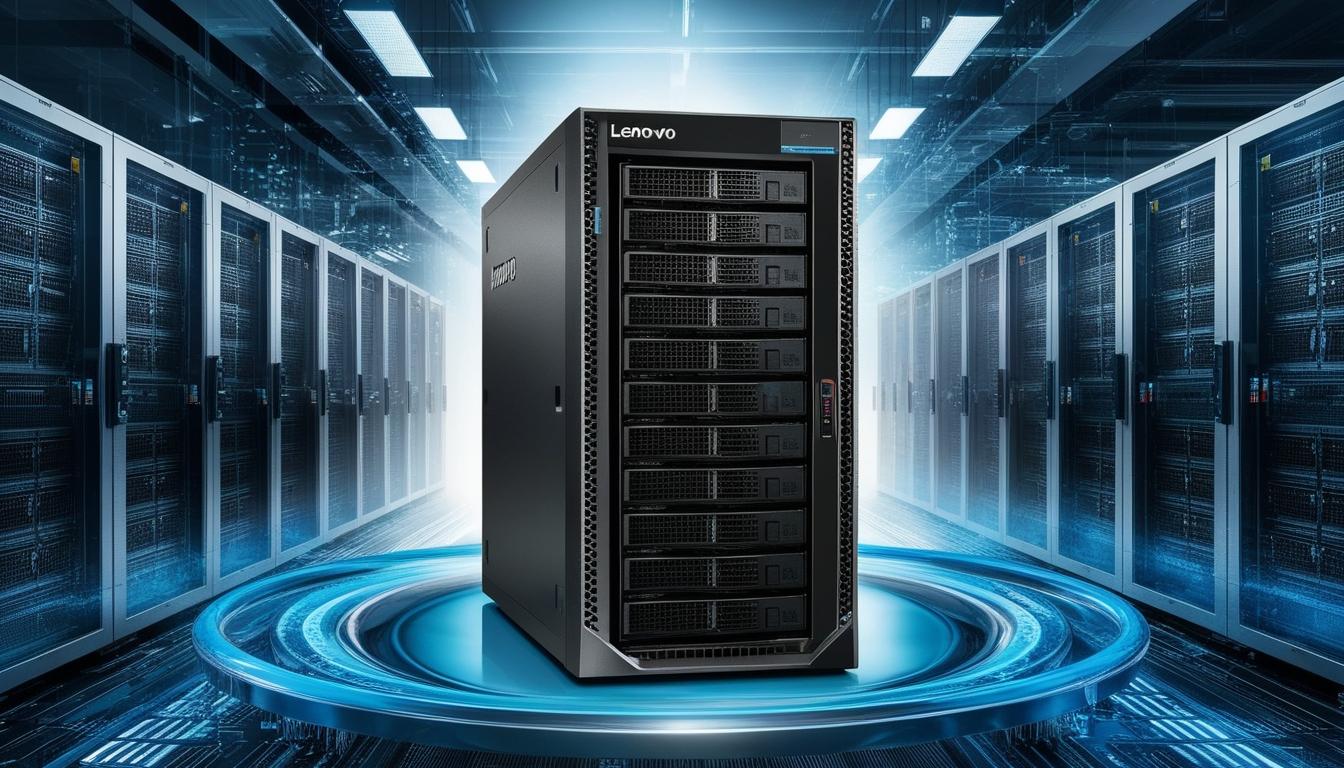

Lenovo has upgraded its ThinkSystem server range by incorporating AMD’s EPYC 9005 Series processors, significantly advancing capabilities for enterprise workloads and AI applications.
Lenovo has recently expanded its ThinkSystem server lineup by incorporating AMD’s latest technology, marking a significant advancement in its server offerings. Initially launched in June 2024 with servers powered by Xeon 6 processors, Lenovo’s ThinkSystem portfolio was geared towards meeting demanding enterprise workloads, including artificial intelligence (AI), cloud computing, and data analytics. Now, Lenovo has announced an upgrade to its server range, integrating AMD’s EPYC 9005 Series processors and Instinct MI325X accelerators.
These enhancements are backed by Lenovo’s assertion of achieving 225 world-record performance benchmarks for tasks that span from edge computing to cloud applications. This update signifies another triumph for AMD, following previous successes with customers such as Vultr and Oracle, where AMD hardware played a crucial role in Oracle’s new OCI Compute Supercluster.
Lenovo’s ThinkSystem, with its new AMD processors, offers impressive specifications. The EPYC 9005 Series boasts up to 192 “Zen 5” or “Zen 5c” cores with a total of 384 threads. The processors are designed with advanced support for DDR5 memory and PCIe 5.0, ensuring rapid data processing capabilities alongside substantial bandwidth. Complementing these processors, the AMD Instinct MI325X accelerators are tailored to enhance performance, particularly in AI training and inferencing scenarios.
In terms of cooling, Lenovo employs its 6th generation Neptune liquid-cooling technology, which features open-loop warm water cooling. This method not only effectively manages heat but also reduces energy consumption by as much as 40% compared to conventional air-cooling systems, providing an environmentally friendly alternative.
Vlad Rozanovich, Senior Vice President of Lenovo Infrastructure Solutions Group, articulated the company’s goal of aiding businesses across industries in achieving AI-driven transformations. He emphasised the importance of delivering exceptional performance and a balanced solution mix that optimises AI economics, ultimately benefiting the customers’ operational value and efficiency.
Together with Lenovo, AMD’s Executive Vice President Forrest Norrod highlighted their joint efforts in accelerating AI transformation. He underscored the robustness, flexibility, and reliability of their solutions, aimed squarely at improving data centre operations for enterprises.
The AMD EPYC series has seen notable developments, such as the “Bergamo” EPYC 9754 processor launched in June 2023. This model from the EPYC 9004 series featured 128 Zen 4c cores and was originally priced at $11,900. However, the market dynamics have shifted dramatically, as evidenced by its current availability on platforms like eBay for a mere $3,525, reflecting a significant discount.
The EPYC 9754, targeted at high-performance server applications, is compatible with SP5 sockets and supports both single and dual-socket configurations. It was initially aimed at cloud-native workloads, with AMD claiming performance improvements of up to 160% compared to its nearest competitors.
However, potential buyers are advised to be cautious when considering significantly discounted processors from online marketplaces. These may originate from grey market sources or represent surplus inventory, and often come without adequate warranties or support.
Overall, both Lenovo and AMD appear steadfast in their commitment to advancing server technology, offering customers enhanced capabilities to tackle modern computational challenges, particularly in AI and related areas.
Source: Noah Wire Services







