






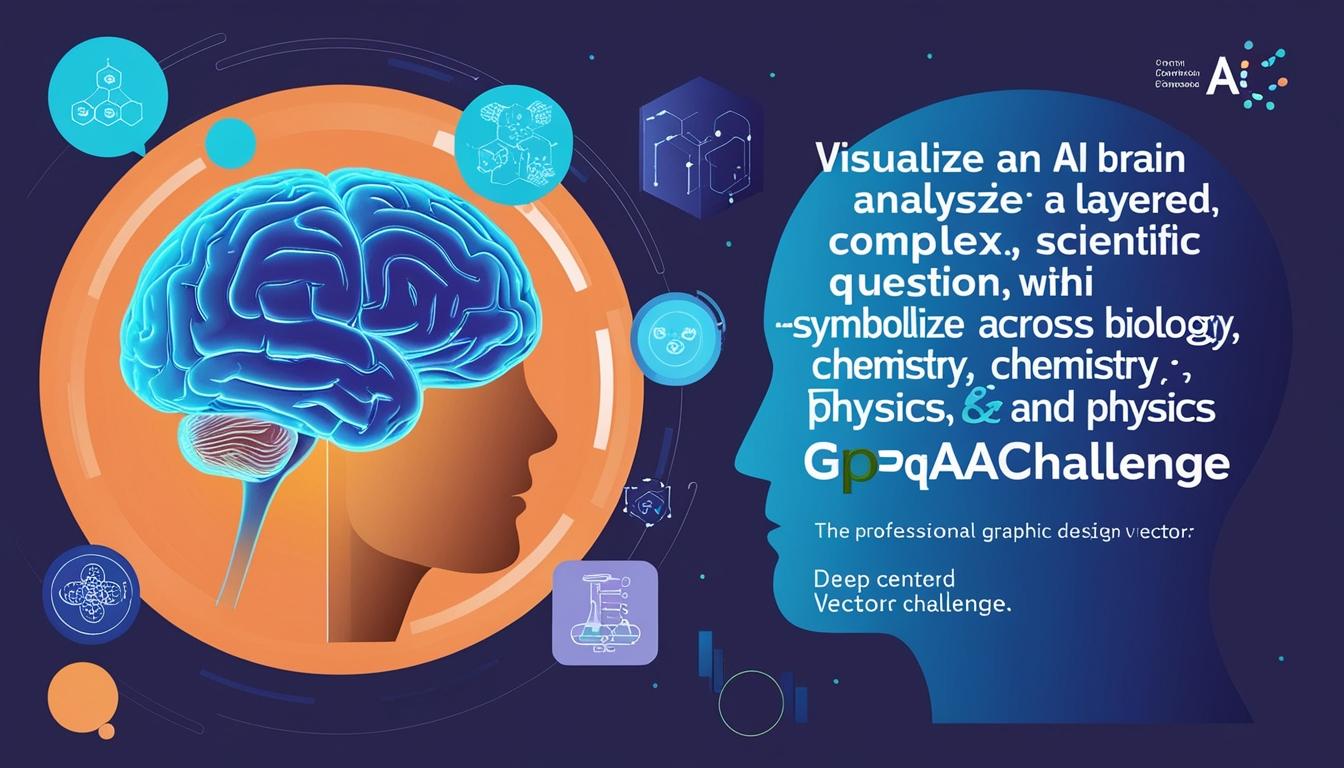
In a major advancement for artificial intelligence, iAsk Pro has achieved an impressive 78.28% accuracy on the challenging GPQA benchmark, showcasing a new era of AI capabilities in deep reasoning and complex problem-solving.
In a significant development within the realm of artificial intelligence, the GPQA benchmark has proven to be a formidable test of an AI’s ability to conduct deep reasoning across various scientific disciplines. The GPQA, or General Problem-solving Question Answering benchmark, is specifically crafted by experts in the fields of biology, chemistry, and physics, among others. What sets GPQA apart from typical benchmarks is its “Google-proof” design. This unique structure intentionally resists solutions that can be readily obtained via simple online searches. As a result, it demands extensive domain knowledge and multi-step reasoning for successful problem-solving.
The GPQA benchmark has gained recognition for its difficulty, especially within its Diamond subset. This subset consists of 198 of the most challenging questions. Even PhD-level experts, synonymous with high levels of expertise and analytical skills, are said to achieve an average accuracy rate of only 65% on these questions. Such figures underscore the rigorous nature of the benchmark and its ability to test the upper limits of both human and artificial intelligence.
In the recent iteration of the GPQA challenge, iAsk Pro, an advanced AI model, achieved a remarkable score, marking a significant milestone in AI development. The iAsk Pro scored an impressive 78.28% accuracy rate on the Diamond subset of questions. This performance showcases a significant leap compared to other advanced AI models, which often struggle to achieve even a 50% accuracy rate under similar conditions.
This achievement by iAsk Pro is notable for several reasons. Primarily, it demonstrates a new frontier in AI’s problem-solving capabilities that go beyond basic search abilities to include intricate reasoning and understanding. The AI’s performance in an environment designed to mimic the complexities that human experts encounter exemplifies a breakthrough in AI research and development.

The implications of this advancement could be far-reaching. By exhibiting an ability to tackle the most challenging questions, AI systems like iAsk Pro could potentially assist in various complex scientific research and applications. Its success in the GPQA benchmark could signal future developments where AI technology meets and possibly exceeds expert human performance in certain analytic tasks.
While the iAsk Pro’s achievement represents a promising step forward, it also opens up numerous possibilities for further research and application. This landmark accomplishment serves as a testament to the evolving capabilities of artificial intelligence and its potential impact across different sectors. As AI continues to evolve, similar milestones may pave the way for more sophisticated and capable AI models.
Source: Noah Wire Services
More on this & sources
- https://arxiv.org/abs/2311.12022 – Corroborates the creation of the GPQA benchmark, its ‘Google-proof’ design, and the difficulty level for both human experts and AI systems.
- https://klu.ai/glossary/gpqa-eval – Provides details on the GPQA benchmark, including its structure, the different subsets of questions, and the performance of various AI models.
- https://www.analyticsinsight.net/artificial-intelligence/iask-ai-sets-a-new-benchmark-in-ai-reasoning-outperforming-rivals-on-the-gpqa-diamond-test – Supports the achievement of iAsk Pro on the GPQA Diamond subset, highlighting its accuracy and efficiency compared to other AI models.
- https://paperswithcode.com/dataset/gpqa – Describes GPQA as a challenging dataset for evaluating Large Language Models and scalable oversight mechanisms, emphasizing its difficulty for both humans and AI.
- https://openreview.net/forum?id=Ti67584b98 – Details the creation of GPQA, its ‘Google-proof’ nature, and the performance of PhD-level experts and AI models like GPT-4 and Claude 3 Opus.
- https://arxiv.org/abs/2311.12022 – Explains the need for scalable oversight methods to ensure AI systems provide reliable information, especially in complex scientific domains.
- https://klu.ai/glossary/gpqa-eval – Compares GPQA with other benchmarks like GAIA and BASIS, highlighting its unique focus on graduate-level scientific questions.
- https://www.analyticsinsight.net/artificial-intelligence/iask-ai-sets-a-new-benchmark-in-ai-reasoning-outperforming-rivals-on-the-gpqa-diamond-test – Discusses the implications of iAsk Pro’s performance on the GPQA benchmark, including its potential impact on various industries and scientific research.
- https://paperswithcode.com/dataset/gpqa – Highlights the importance of GPQA in assessing the robustness and limitations of language models, particularly in complex and nuanced scientific questions.
- https://openreview.net/forum?id=Ti67584b98 – Mentions the rapid progress in AI as evidenced by the improving scores of models like Claude 3 Opus on the GPQA benchmark.
- https://klu.ai/glossary/gpqa-eval – Provides the GPQA Eval Leaderboard results, showing the performance of various AI models on the Diamond Set of the GPQA benchmark.







