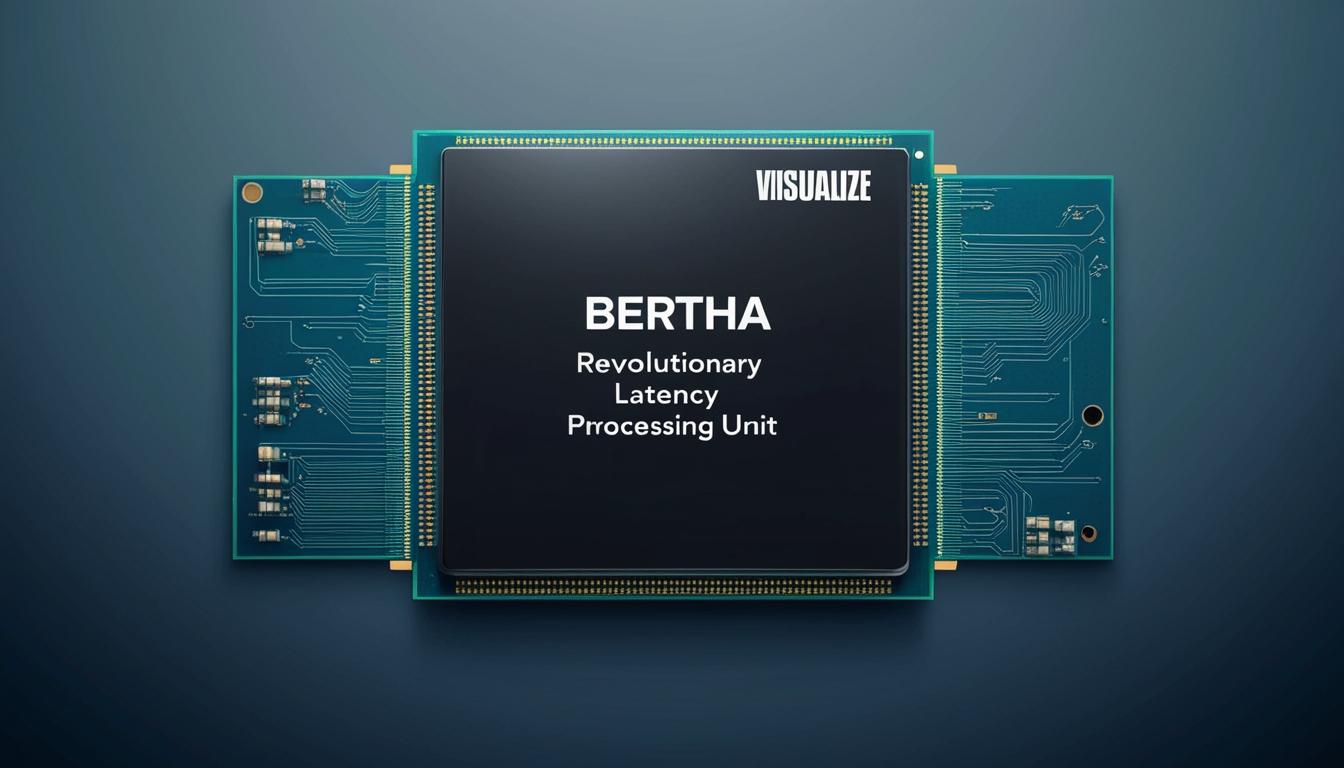

South Korean startup HyperAccel has announced the completion of its Bertha Latency Processing Unit, aiming to offer a cost-effective, high-performance alternative to traditional GPUs for large language model inference.
In an ambitious move to reshape the landscape of AI implementation, South Korean AI startup HyperAccel has announced the completion of its Bertha Latency Processing Unit (LPU), developed in collaboration with established platform-based SoC and ASIC designer, SEMIFIVE. This partnership, initially formed in January 2024, seeks to introduce an alternative to the currently dominant GPU technology, aimed specifically at large language model (LLM) inference.
Bertha, engineered via advanced 4nm technology, promises to offer a blend of low cost, low latency, and domain-specific features. Its design is optimised to cater to both low-power and high-performance requirements, potentially serving as a more efficient replacement for the high-cost, low-efficiency GPUs typically used for LLM tasks. HyperAccel and SEMIFIVE are optimistic about the mass production of Bertha starting early 2026.
Joo-Young Kim, CEO of HyperAccel, underscored the significance of this collaboration, stating, “Our work with SEMIFIVE ensures that Bertha is positioned to provide AI semiconductors with enhanced cost-efficiency and power effectiveness compared to traditional GPU systems. This development could substantially cut data centre operational costs and widen our business scope into industries heavily reliant on LLMs.”
HyperAccel is positioning Bertha as a formidable competitor, claiming it can achieve performance levels double that of conventional supercomputers, accompanied by a remarkable 19-fold increase in price-to-performance ratio. However, the endeavour faces stiff competition from established market players like Nvidia, whose GPUs maintain a stronghold in the industry.

The global AI infrastructure market makes for a challenging arena. While Nvidia’s entrenched position presents a hurdle, HyperAccel’s tailored approach focuses on efficiency, which could appeal to enterprises seeking to optimise operational expenses in data-heavy environments.
Brandon Cho, CEO and co-founder of SEMIFIVE, expressed his confidence in Bertha’s market potential: “The demand for LLM computation is increasing rapidly, and with HyperAccel’s scalable and efficient LPU technology, there is ample opportunity for them to emerge as a significant contender on the global stage.”
An additional challenge emerges from Silicon Valley-based Groq, an AI company helmed by former Google engineer and CEO Jonathan Ross. Groq has already established a substantial market presence through its own LPU product, launched in February, which serves over 525,000 developers. This development highlights the competitive backdrop against which HyperAccel seeks to introduce Bertha.
The introduction of Bertha by HyperAccel marks a pivotal development in the AI processor field. While the journey forward may entail navigating through a crowded marketplace, the unique attributes of Bertha position it as a potentially disruptive force in processing technology for large language models. However, as HyperAccel moves towards mass production, the firm’s ability to carve out a niche or potentially dominate a segment of the market remains to be seen.
Source: Noah Wire Services