






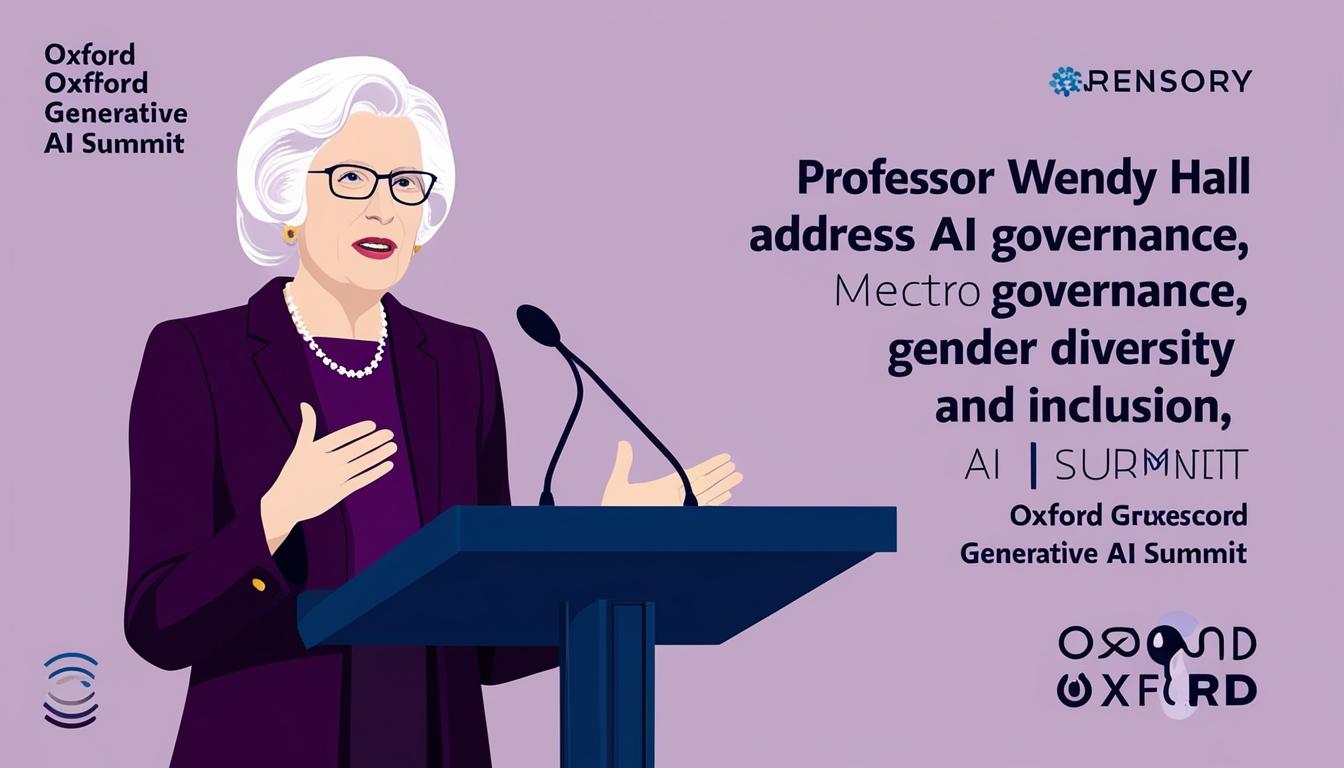

Professor Dame Wendy Hall criticises the dominance of male figures in AI governance, urging for greater inclusion and representation in policymaking.
In a prominent critique of the current direction of artificial intelligence (AI) policymaking, Professor Dame Wendy Hall, a significant figure in AI governance, has expressed her concerns about the dominance of male figures in the decision-making process. This development, which she described as a “tech bro takeover,” has followed the dissolution of the UK government’s AI Council last year. Dame Hall, formerly the UK’s AI Skills Champion and the chair of the Ada Lovelace Institute, raised these issues during her speech at the Oxford Generative AI Summit.
Dame Hall criticised the lack of diversity and inclusion in AI governance, noting that the government’s AI Safety Summit at Bletchley Park in November was predominantly attended by industry executives and government figures, with minimal representation from women and academic circles. She expressed her dismay at the exclusion of diverse societal voices from key discussions on AI, stating, “It was so exclusive in terms of attendance. There were so many people excluded.”
The government’s AI Council, which once had significant female leadership with 9 of its 19 members being women, including the chair, was disbanded last year. It has been succeeded by an AI Safety Institute, where all senior roles, including the chair, director, and three research directors, are held by men. These developments have led Dame Hall to lament that the conversation around AI has been monopolised by a narrow demographic, emphasising the necessity for a diverse set of voices to shape AI’s future.
Echoing Hall’s sentiments, Exeter MP Steve Race voiced similar concerns about the effectiveness of the AI Safety Summit. Speaking at the 2024 Labour Party Conference, Race described the summit as a “damp squib” that failed to achieve substantial progress. He argued that the UK’s potential to lead global AI policy discussions was undermined by the lack of tangible outcomes from the summit, despite the nation’s strong regulatory reputation.

Race’s comments were supported by Casey Calista, chair of Labour Digital, during the conference’s technology panel. Calista criticised the previous Conservative government’s handling of AI regulation, specifically their oversight in integrating civil society into their framework. She highlighted the Labour party’s intention to implement a “whole of society approach,” ensuring diverse voices are part of the AI regulatory conversation.
These discussions point to a broader debate on the direction of AI policymaking in the UK, with calls for greater inclusion and representation across various sectors of society. The shift from a more inclusive advisory structure to one perceived as homogeneous has raised concerns about the future approach to AI governance and the UK’s position in global AI policy leadership.
Source: Noah Wire Services







