

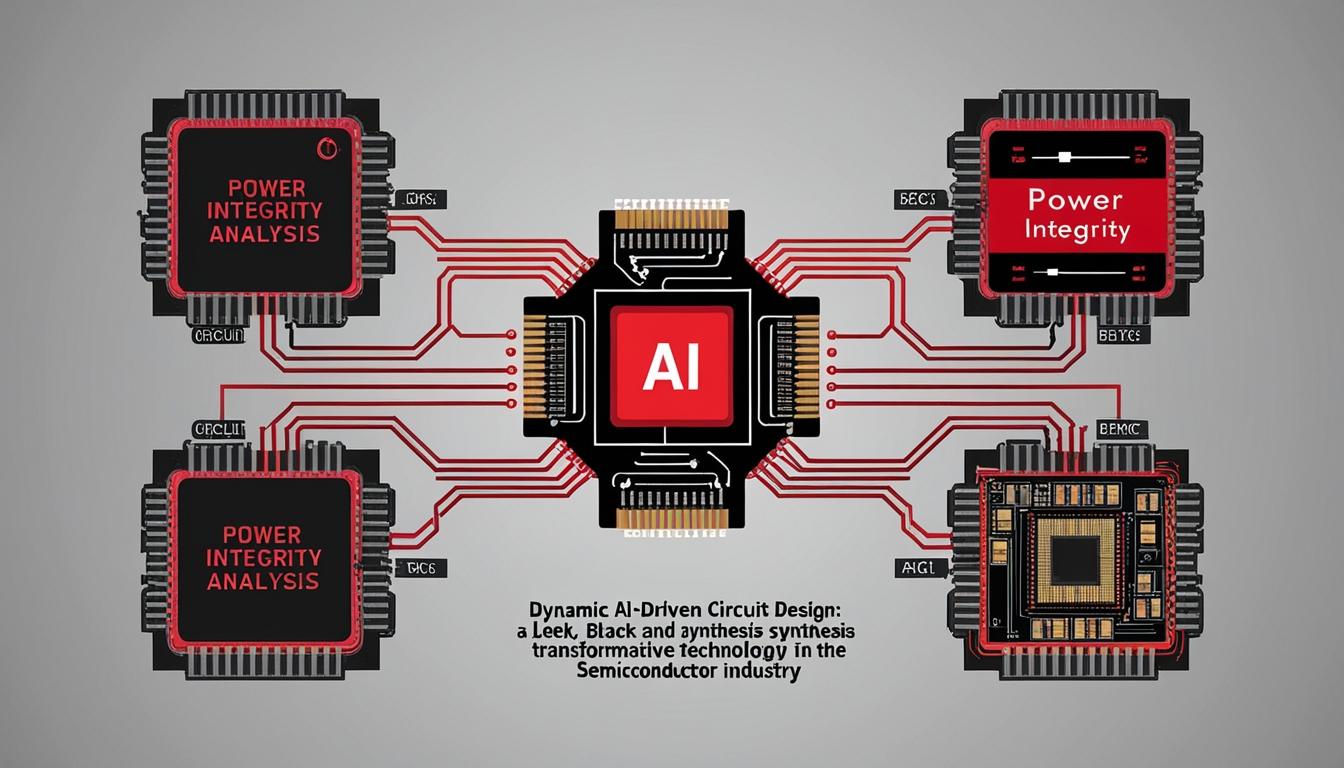

The introduction of Voltus InsightAI marks a pivotal shift in tackling power integrity challenges, optimising the design process for advanced integrated circuits.
The rapid evolution of artificial intelligence (AI) is driving significant changes in the semiconductor industry, particularly in the design and architecture of integrated circuits (ICs). As businesses adopt increasingly advanced AI functionalities, chip designers encounter mounting challenges in developing devices that are smaller, faster, and consume less power. This shift brings with it a greater emphasis on managing power, performance, and area (PPA) effectively.
One of the foremost challenges in this landscape is ensuring power integrity, which has become increasingly complex alongside the trend of miniaturising processes. As Albert Zeng, Senior Software Engineering Group Director at Cadence, noted during a recent interview with EE Times Asia, designers often face numerous electromigration (EM) and IR drop violations during the sign-off stage, necessitating early intervention in the design process to mitigate these issues.
The complexities of advanced node designs—especially those below 5nm—are compounded by the high density of transistors packed into smaller areas. In the past, designers managed hundreds of thousands of IR violations manually; however, at smaller nodes, this figure can escalate to millions, making automated solutions essential for successful implementation. To combat these challenges, Cadence has introduced Voltus InsightAI, a generative AI tool designed to predict and resolve EM-IR drop violations proactively.
Zeng explains that Voltus InsightAI is unique in the electronic design automation (EDA) space, being the first product to leverage AI for incremental analysis and root cause identification in power integrity. “Voltus InsightAI is the industry’s first EDA product that uses AI to effectively predict root cause and resolve IR drop issues in the design implementation phase,” Zeng stated. This innovative tool enables users to correct up to 95% of violations before sign-off, enhancing productivity significantly in EM-IR closure.

Integrating with the Cadence Innovus Implementation System, Voltus InsightAI facilitates a more efficient power delivery network (PDN) design, allowing designers to alleviate IR drop issues with minimal impact on overall performance. The solution showcases key features, including a rapid IR inferencing engine and a multi-method fixing approach, which collectively advance engineering efficiency.
Essentially, Voltus InsightAI transforms how chip designers address power integrity issues, making it the only solution that integrates tightly within an EDA framework. This has garnered recognition, culminating in the Innovation R&D Award at EE Awards Asia 2024. “It is really an honour for us to receive this award,” said Zeng, highlighting the collaborative efforts that contributed to the development of this technology.
Since its announcement in November 2023, Voltus InsightAI has found traction within the industry, with seven customers employing it for their tape-out projects and over 35 actively deploying the tool across various advanced nodes. Zeng emphasises that the development process included extensive engagement with leading-edge customers, allowing the team to refine their algorithms based on feedback and real-world design contexts.
Looking ahead, Zeng is optimistic about the future of AI within the EDA landscape and plans to continue enhancing Voltus InsightAI’s capabilities. “AI will have a transformative impact on the overall EDA industry,” he remarked, noting the potential for AI to improve design exploration, optimisation, and simulation processes. By integrating AI-derived insights, designers—especially those new to the field—can make informed decisions during design and fix implementations, ultimately raising productivity levels across the sector.
Source: Noah Wire Services
- https://www.acldigital.com/blogs/how-ai-transforming-semiconductor-industry-2024-and-beyond – This article discusses how AI is transforming the semiconductor industry, particularly in enhancing chip design processes, streamlining time-to-market, and reducing costs, which aligns with the challenges and solutions mentioned in the article.
- https://www.mckinsey.com/industries/semiconductors/our-insights/scaling-ai-in-the-sector-that-enables-it-lessons-for-semiconductor-device-makers – This article highlights AI/ML use cases in semiconductor manufacturing and chip design, including optimizing portfolios, improving efficiency, and reducing costs, which supports the discussion on managing power, performance, and area (PPA).
- https://www.aws.amazon.com/blogs/industries/generativeaisemiconductor/ – This article explains how generative AI can improve design efficiency, enhance manufacturing quality, and accelerate time-to-market in the semiconductor industry, mirroring the benefits of AI in chip design and manufacturing mentioned in the article.
- https://www.acldigital.com/blogs/how-ai-transforming-semiconductor-industry-2024-and-beyond – This article details how AI-driven simulation tools and machine-learning capabilities help in identifying potential weaknesses in chip designs and improving reliability, which is relevant to the power integrity and EM-IR drop issues discussed.
- https://www.mckinsey.com/industries/semiconductors/our-insights/scaling-ai-in-the-sector-that-enables-it-lessons-for-semiconductor-device-makers – This article discusses how AI/ML algorithms can identify patterns in component failures and propose optimal layouts to improve yield, supporting the idea of using AI for proactive issue resolution in chip design.
- https://www.aws.amazon.com/blogs/industries/generativeaisemiconductor/ – This article mentions how generative AI can explore vast design spaces to converge on optimized semiconductor architectures, which aligns with the need for managing power, performance, and area effectively in advanced node designs.
- https://www.acldigital.com/blogs/how-ai-transforming-semiconductor-industry-2024-and-beyond – This article emphasizes the role of AI in optimizing production processes, predicting maintenance needs, and contributing to increased efficiency and reduced costs in fabrication plants, which is consistent with the benefits of AI in semiconductor manufacturing.
- https://www.mckinsey.com/industries/semiconductors/our-insights/scaling-ai-in-the-sector-that-enables-it-lessons-for-semiconductor-device-makers – This article highlights the potential of AI/ML to reduce manufacturing costs and improve yields, which supports the discussion on the economic and operational benefits of AI in the semiconductor industry.
- https://www.aws.amazon.com/blogs/industries/generativeaisemiconductor/ – This article explains how generative AI can automate complex manual tasks, accelerate product development, and enhance quality control, all of which are crucial for addressing the challenges in advanced node designs.
- https://www.acldigital.com/blogs/how-ai-transforming-semiconductor-industry-2024-and-beyond – This article discusses the future trends in AI and semiconductor chip design, including the collaboration between human ingenuity and AI methodologies, which aligns with the optimistic outlook on AI’s impact in the EDA landscape.