









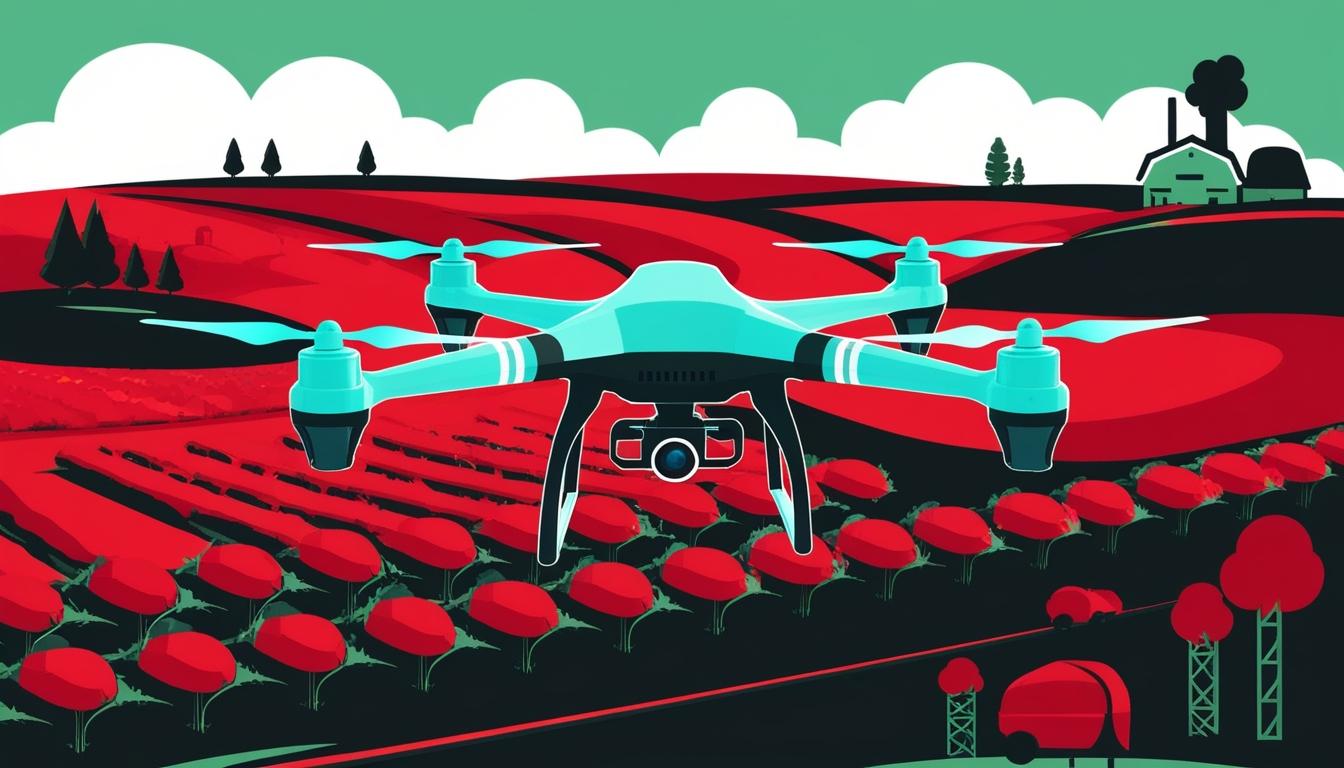
Innovative advancements in agricultural technology, such as drones and robotics, are transforming the sector and addressing global labour shortages while promoting sustainability.
Agricultural technology, or ag-tech, is increasingly becoming a pivotal solution to the ongoing labour shortages faced by the global agriculture sector. This transformation is largely driven by innovative advancements such as drones and robotics, which automate repetitive and physically demanding tasks, thereby freeing up human resources for more skilled roles, including data analysis and farm management.
Countries worldwide are recognising the necessity of adopting these ag-tech solutions to enhance productivity and meet increasing food demands. Government policies play a significant role in this transition; for instance, the United States Department of Agriculture’s (USDA) Farm Bill and the European Union’s (EU) Common Agricultural Policy (CAP) offer funding incentives. These financial supports allow farmers to modernise their operations and improve labour efficiency through the adoption of technology. As a result, companies like CNH Industrial are enabling farmers to align with government initiatives through scalable precision farming solutions that enhance efficiency and sustainability.
During an interview, Chad Biegler, Precision Product Manager for Crop Protection at CNH, highlighted the wide-ranging applications of ag-tech in addressing labour shortages. Automation not only creates new job opportunities in technical fields but also contributes to environmental sustainability by minimising chemical overuse, optimising water usage, and reducing soil disturbance. For example, in Latin America, CNH has partnered with XAG to deploy drone solutions for aerial applications, tailored for difficult terrains, thereby addressing both labour challenges and resource management.
Investment in ag-tech research and development (R&D) is evident across various countries. In Australia, partnerships with tech companies are fostering automation solutions tailored for broadacre farming. Similarly, Canada’s Agri-Food Immigration Pilot aims to educate workers regarding technology use. In the U.S., initiatives like the Broadband ReConnect Program are enhancing connectivity, a fundamental aspect for data-driven agricultural tools. The EU’s Green Deal and the U.K.’s Agriculture Act also reflect a commitment to promoting precision agriculture and sustainable technologies.
Despite its advantages, the widespread adoption of ag-tech solutions presents several challenges. Initial capital costs can be prohibitive, particularly in developing nations where access to financing is limited. Smaller farms in more developed regions may find the costs of high-tech solutions outweigh their immediate benefits. Furthermore, a shortage of skilled technicians to service and maintain these advanced tools presents additional barriers to implementation. Economic uncertainty, driven by fluctuating commodity prices and changing trade policies, often impedes farmers’ willingness to invest in new technologies, even when they could significantly enhance long-term efficiency.
Biegler underscored CNH’s aim to help customers navigate these challenges by creating an accessible and user-friendly ecosystem to support farmers in modernising their practices. The company provides technologies that help farmers comply with regulatory sustainability requirements while concurrently driving productivity.
Advancements in drones and precision farming technology are also making a measurable impact on crop yield and operational efficiency. Variable Rate Application (VRA) techniques allow for the application of resources such as fertilisers, pesticides, and nutrients at precise quantities and locations, thus preventing over-application, reducing costs, and enhancing overall crop efficiency. In particular, CNH’s Sense and Act technology is designed to utilise real-time data to optimise application rates dynamically, contributing to more significant crop yield increases.
The integration of modern technologies with traditional farming practices is emerging globally as countries seek to enhance both productivity and sustainability. This hybrid model supports farmers in modernising their operations while preserving the essential elements of traditional agriculture, allowing for informed decision-making based on both modern techniques and historical farming knowledge.
Cultural attitudes towards agricultural technology vary widely. In industrialised nations, there is generally an embrace of technology to improve efficiency and sustainability. In contrast, countries with strong agricultural traditions may be more cautious of technology adoption, often prioritising the preservation of heritage and concerns about job losses. However, regions facing acute environmental challenges increasingly recognise the importance of technology for tackling issues related to climate change.
Specific agricultural sectors are reaping substantial benefits from these technological advancements. Large-scale row crops, which require precise input management, are particularly well-suited for ag-tech applications. Such precision farming and data-driven strategies are proving instrumental in enhancing yields while addressing issues related to water scarcity and labour shortages.
As ag-tech continues to evolve and expand, the agricultural landscape stands at a crossroads, where emerging technologies are not only poised to reshape productivity but also the entire framework of global food systems. Through ongoing innovation and supportive measures, the industry is navigating a path that promises to enhance both efficiency and sustainability in agriculture.
Source: Noah Wire Services
- https://www.escatec.com/blog/4-ways-agtech-is-solving-labour-shortages-in-the-farming-industry – This article discusses how agtech, including drones and robotics, automates repetitive and physically demanding tasks, freeing up human resources for more skilled roles.
- https://www.challenge.org/resources/agtech-for-labor-shortage/ – It highlights that agtech requires monitoring, control, repair, and supervision by humans, creating new job opportunities in technical fields.
- https://www.croptracker.com/blog/agricultural-automation-are-robots-the-answer-to-farm-labor-shortages.html – This source explains how automation in agriculture reduces labor costs and increases productivity, and the need for upskilling the workforce to manage new technologies.
- https://www.edengreen.com/blog-collection/farm-labor-crisis – The article discusses technological solutions such as robots and AI for planting, tending, and harvesting crops, making farms more efficient and less reliant on human labor.
- https://www.precisionfarmingdealer.com/articles/6176-self-driving-tractors-look-to-fill-agricultures-labor-shortage – It mentions how self-driving tractors and autonomous technologies fill labor gaps and create new job pathways in agriculture.
- https://www.escatec.com/blog/4-ways-agtech-is-solving-labour-shortages-in-the-farming-industry – The article details government policies and funding incentives that support the adoption of ag-tech solutions to enhance productivity and labor efficiency.
- https://www.croptracker.com/blog/agricultural-automation-are-robots-the-answer-to-farm-labor-shortages.html – It discusses investments in ag-tech R&D across various countries, including partnerships and initiatives to educate workers about technology use.
- https://www.edengreen.com/blog-collection/farm-labor-crisis – The source highlights the challenges of high initial capital costs and the shortage of skilled technicians, particularly in developing nations and smaller farms.
- https://www.precisionfarmingdealer.com/articles/6176-self-driving-tractors-look-to-fill-agricultures-labor-shortage – The article explains how companies like CNH Industrial are enabling farmers to adopt precision farming solutions, enhancing efficiency and sustainability.
- https://www.escatec.com/blog/4-ways-agtech-is-solving-labour-shortages-in-the-farming-industry – It describes the use of Variable Rate Application (VRA) techniques and real-time data to optimise resource application, contributing to increased crop yields and operational efficiency.
- https://www.croptracker.com/blog/agricultural-automation-are-robots-the-answer-to-farm-labor-shortages.html – The integration of modern technologies with traditional farming practices is discussed, supporting farmers in modernising operations while preserving traditional elements.






