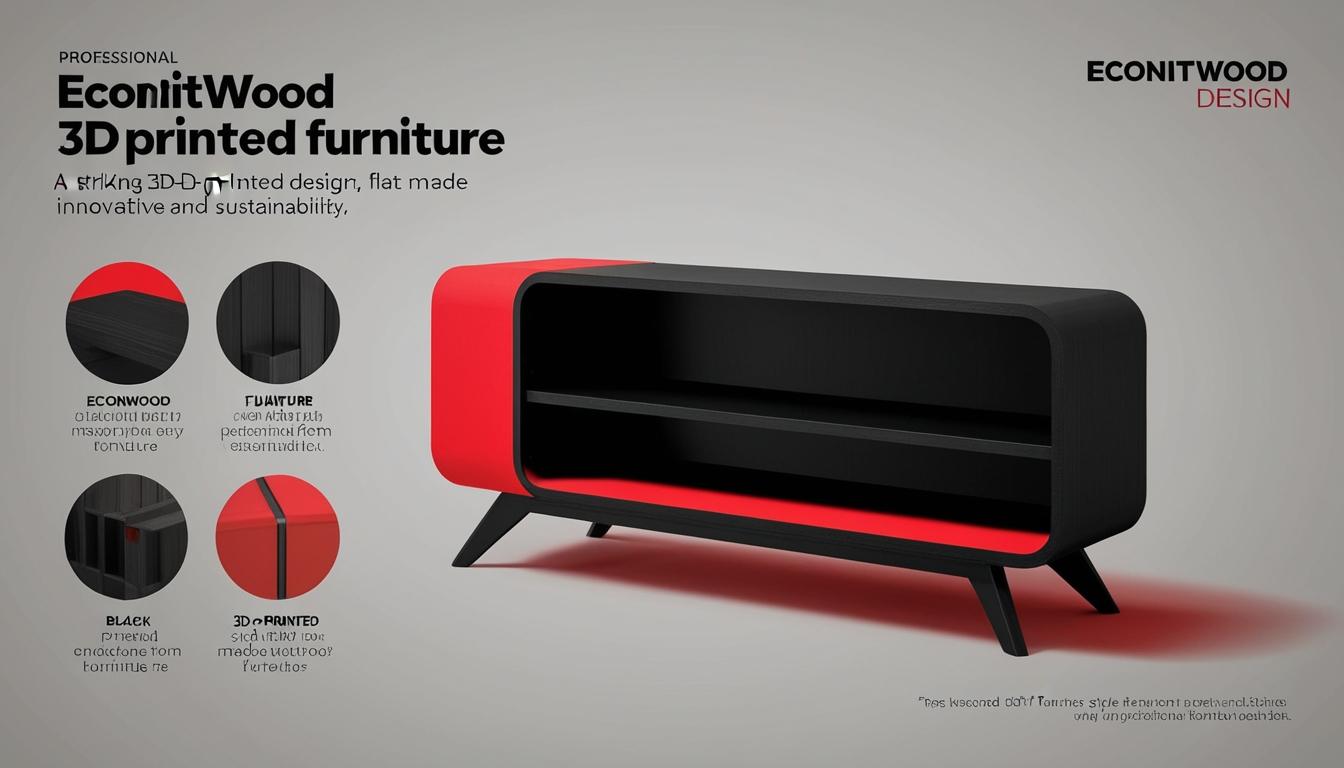

A collaborative project by designers employs EconitWood, a groundbreaking material crafted from repurposed wood, to create unique furniture pieces, showcasing a new era in sustainable manufacturing.
In an innovative project, a team of designers—Esmée Willemsen, Janek Beau, Friedrich Gerlach, and Julia Huhnholz—has collaborated to create four unique design pieces utilising EconitWood, a pioneering material made from repurposed wood. This sustainable material, developed by Additive Tectonics, combines leftover wood sourced from sawmills and timber harvesting with natural and flame-retardant magnesium carbonate to create a binding agent. The result is a remarkable approach to 3D printing that not only minimises waste but also opens up new avenues for design intricacies in the furniture industry.
The designers have taken advantage of the unique characteristics of this 3D printing technology. Gerlach elaborated on this approach in an interview with Dezeen, stating, “I focused on one key characteristic of this 3D printer: it doesn’t really matter if it’s printing a single small object or an entire large block in one job—both take roughly the same amount of time. Because of this, I decided to design an object that could be efficiently stacked within the printer’s build volume, thereby increasing its overall printing efficiency.” This strategy is expected to enhance the attractiveness of the process to businesses, as increased efficiency can lead to reduced production costs. Furthermore, Gerlach aimed to exemplify the printer’s capacity by demonstrating that it can produce large-scale furniture pieces without encountering significant challenges.
The implications of utilising EconitWood and similar sustainable materials extend significantly across various sectors. The use of eco-friendly components indicates a potential turning point in the materials industry, providing a pathway toward sustainable production practices that comply with functionality and safety standards. In conjunction, the 3D printing process warrants broader adoption by industries that are seeking efficiency and scalability in manufacturing.
Key trends emerging from this initiative include a pronounced shift towards sustainable material innovation, which reduces the environmental impact typically associated with traditional manufacturing processes. Additionally, optimising 3D printing for both small and large projects functions as a means to minimise production costs—an attractive prospect for companies looking to enhance their operational effectiveness. The capability for complex geometric design facilitated by this technology further allows for unprecedented architectural and aesthetic possibilities in furniture design.

Overall, the team’s work with EconitWood presents a significant advancement in the integration of sustainability with manufacturing processes, heralding a new era for the furniture industry and potentially influencing other sectors that value innovation and ecological considerations.
Source: Noah Wire Services
- https://www.furnituredesignindia.com/articles/80837/econitwood-transforms-sawdust-into-innovative-sustainable-design-materials – Corroborates the development of EconitWood, a sustainable material made from repurposed wood, and its applications in reducing waste and enhancing design possibilities.
- https://www.furnituredesignindia.com/articles/80837/econitwood-transforms-sawdust-into-innovative-sustainable-design-materials – Details the use of wood residues and by-products, and the integration of eco-friendly adhesives and energy recovery systems in the EconitWood process.
- https://ndion.de/en/naturally-3d-printed/ – Explains the 3D printing process using wood particles mixed with magnesium, and the fire-retardant properties of the resulting material.
- https://ndion.de/en/naturally-3d-printed/ – Discusses the efficiency and material optimization in 3D wood printing, aligning with the strategy of increasing printing efficiency by stacking objects.
- https://www.econit.info/econitwood_guideline/ – Highlights the zero-waste philosophy, use of residual wood particles, and the benefits of EconitWood, including design freedom, structural robustness, and fire resistance.
- https://www.econit.info/econitwood_guideline/ – Details the advantages of EconitWood, such as its acoustic performance, lightweight material, and digital design-to-production pipeline.
- https://www.harrythaler.it/work/b-printed-nature – Showcases the ‘Printed Nature’ project, which utilizes EconitWood for 3D-printed furniture, emphasizing the material’s sound-absorbing, thermal insulation, and fire-resistant qualities.
- https://www.harrythaler.it/work/b-printed-nature – Corroborates the collaboration with Additive Tectonics and the use of wood waste from sawmills and timber harvesting in the EconitWood process.
- https://www.furnituredesignindia.com/articles/80837/econitwood-transforms-sawdust-into-innovative-sustainable-design-materials – Discusses the broader applications of EconitWood in construction and packaging, highlighting its potential impact across various sectors.
- https://ndion.de/en/naturally-3d-printed/ – Mentions the interest in 3D wood printing among designers and architects, and the collaborative efforts to build the market for sustainable materials.
- https://www.econit.info/econitwood_guideline/ – Emphasizes the ecological responsibility and regional sourcing of EconitWood, aligning with the trend towards sustainable material innovation.