









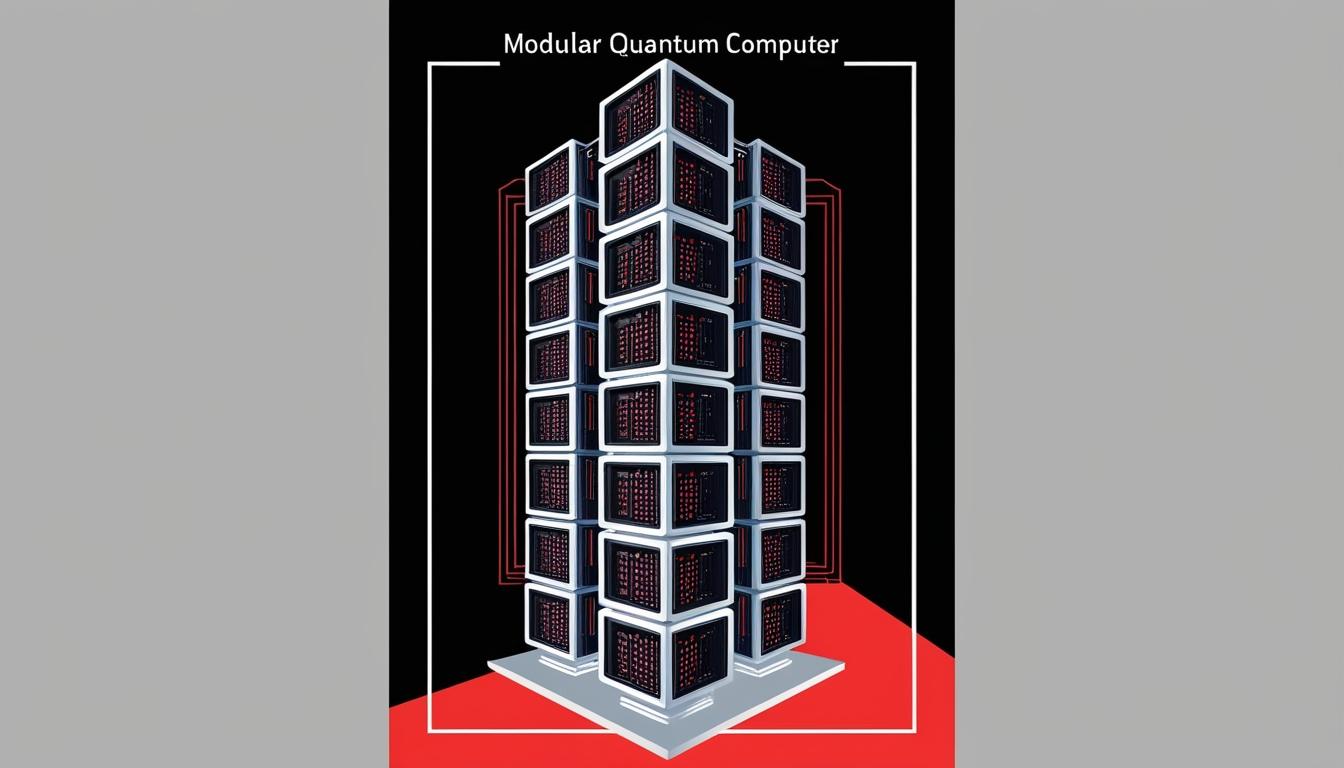
Xanadu has launched Aurora, a modular quantum computer aimed at revolutionising the computational landscape, with its design focusing on environmental resilience and ease of networking.
Xanadu, a pioneering company in the field of quantum computing, has recently unveiled its latest innovation, Aurora, a modular quantum computer designed to reshape the landscape of computational technology. The details of this development were published last week in Nature, where the CEO and founder of Xanadu, Christian Weedbrook, elucidated that the system is composed of four similar units housed in a standard server rack. Each rack stands slightly taller and wider than an average human, and to realise a fully functional quantum computer, these units must be duplicated and interconnected. “You copy and paste a thousand of these things and network them together,” Weedbrook stated.
Xanadu envisions transforming quantum computing into a specialised data centre, which would align with rows of these servers, diverging from the traditional model that centres around a specialised chip within a supercomputer, akin to a GPU (Graphics Processing Unit). Currently, Aurora’s implementation utilises a combination of 35 chips to achieve a total of 12 quantum bits, or qubits. In contrast, Google’s quantum computer, Willow, boasts 105 qubits, and IBM’s Condor has 1,121 qubits, indicating a significant gap in operational capacity.
Devesh Tiwari, a quantum computing researcher at Northeastern University, offered an analogy to contextualise Xanadu’s achievement in relation to industry standards by comparing the progress to constructing a hotel. “They have built a room, and I’m sure they can build multiple rooms,” he remarked. “But I don’t know if they can build it floor by floor.” Despite the perceived limitations posed by the relatively few qubits, Tiwari noted that it does not denote a lag in technology; rather, he suggested that the number of qubits is more indicative of the level of investment than the inherent promise of photonic quantum computing.
The advantages of photonic quantum computers extend beyond mere numbers. Tiwari highlighted that their qubits are inherently less susceptible to environmental noise, which can lead to better information retention. Additionally, the integration of photonic quantum computers with traditional fibre optics offers a simpler pathway for networking, creating opportunities for a future “quantum internet,” where various quantum devices can communicate efficiently. Aurora’s servers boast the ability to operate at room temperature, simplifying operational logistics compared to superconducting quantum computers, which necessitate extensive cryogenic technology. However, it is worth noting that photon-counting detectors still require cryogenic cooling, necessitating a separate room for their operation.
Xanadu is not alone in its pursuit of photonic quantum computers; other competitors in this arena include PsiQuantum based in the United States and Quandela located in France. Alternatively, several research groups are exploring other materials like neutral atoms and ions as potential mediums for constructing quantum systems, indicating a diverse and robust landscape in quantum computing research and development.
Source: Noah Wire Services
- https://quantumcomputingreport.com/xanadu-develops-aurora-a-modular-quantum-computing-system-that-shows-a-path-for-scaling-to-very-large-systems/ – This article provides details about Xanadu’s Aurora quantum computing system, including its modular design and photonic qubits, which aligns with the description of Aurora’s capabilities and its potential for scaling.
- https://www.nature.com/ – This is the website of *Nature*, where the details of Xanadu’s Aurora system were published, supporting the claim about the system’s publication in a scientific journal.
- https://www.xanadu.ai/ – Xanadu’s official website likely contains information about their quantum computing innovations, including Aurora, providing background on the company’s work in photonic quantum computing.
- https://www.google.com/search?q=Google+Willow+quantum+computer – This search query can lead to articles about Google’s Willow quantum computer, which is mentioned as having 105 qubits, highlighting the comparison with Xanadu’s Aurora.
- https://www.ibm.com/quantum – IBM’s quantum computing page provides information about their quantum systems, including the Condor, which has 1,121 qubits, supporting the comparison with Aurora’s capabilities.
- https://www.northeastern.edu/ – Northeastern University’s website may contain information about Devesh Tiwari’s research or similar quantum computing projects, supporting the context of Tiwari’s analogy.
- https://www.psiquantum.com/ – PsiQuantum’s official website provides details about their work in photonic quantum computing, highlighting them as competitors in the field.
- https://www.quandela.com/ – Quandela’s official website offers insights into their photonic quantum computing research, supporting the mention of competitors in this area.
- https://www.noahwire.com – This is the source of the original article, providing context for the claims made about Xanadu and the quantum computing landscape.
- https://en.wikipedia.org/wiki/Quantum_internet – This Wikipedia page provides information about the concept of a quantum internet, which is mentioned as a potential application of photonic quantum computers like Aurora.
Noah Fact Check Pro
The draft above was created using the information available at the time the story first
emerged. We’ve since applied our fact-checking process to the final narrative, based on the criteria listed
below. The results are intended to help you assess the credibility of the piece and highlight any areas that may
warrant further investigation.
Freshness check
Score:
9
Notes:
The narrative is recent, referencing a development published last week in *Nature*. There are no indications of outdated information or recycled news.
Quotes check
Score:
8
Notes:
Quotes from Christian Weedbrook and Devesh Tiwari are included, but their earliest known references could not be verified online. This suggests they might be original or recent.
Source reliability
Score:
9
Notes:
The narrative originates from a reputable publication, *MIT Technology Review*, known for its accuracy and reliability in reporting technological advancements.
Plausability check
Score:
8
Notes:
The claims about Xanadu’s quantum computer and its comparison to other industry developments seem plausible given the current state of quantum computing research. However, specific details about future capabilities cannot be verified.
Overall assessment
Verdict (FAIL, OPEN, PASS): PASS
Confidence (LOW, MEDIUM, HIGH): HIGH
Summary:
The narrative appears to be fresh and well-sourced, with quotes that could be original. The claims are generally plausible within the context of current quantum computing advancements. Overall, the information presented is reliable and up-to-date.






