

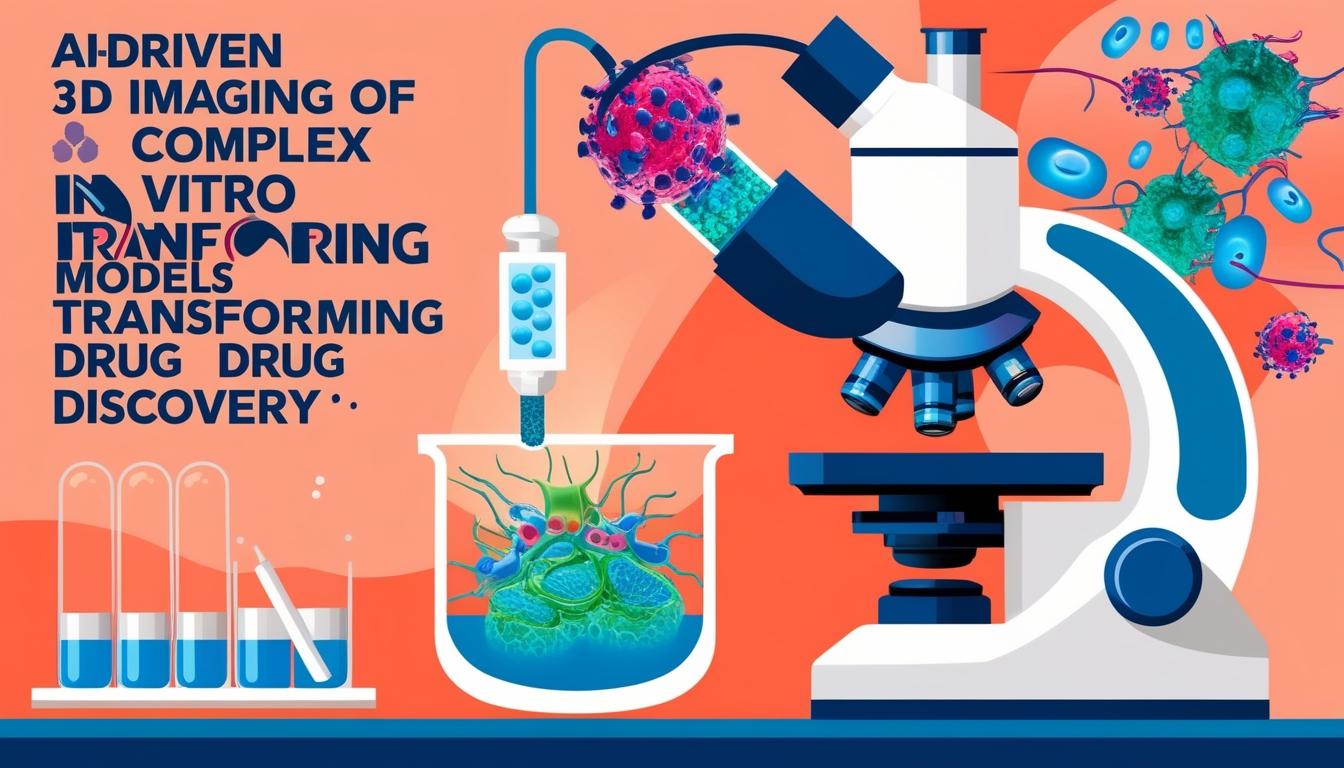

A forthcoming webinar by Drug Discovery World in collaboration with ZEISS will explore the impact of complex in vitro models and AI-powered image analysis on drug discovery, featuring expert discussions and the latest technologies.
Webinar to Explore Innovations in Drug Discovery Through Advanced In Vitro Models and AI Techniques
A forthcoming webinar is set to delve into the transformative impact of complex in vitro models (CIVM) on drug discovery and development, highlighting recent advancements and technologies. Scheduled for 14 November, the event is being organised by Drug Discovery World (DDW) in collaboration with ZEISS and will feature discussions on the integration of CIVM with AI-powered 3D/4D image analysis.
This online event comes in the wake of the US Food and Drug Administration’s (FDA) endorsement of organoids in preclinical studies, a move that has significantly influenced drug testing and disease research methodologies. The shift towards more sophisticated and biologically pertinent phenotypic model formats necessitates updated imaging and analysis techniques. Traditional two-dimensional high-content analysis (HCA) methods are inadequate for capturing intricate 3D biological data, and many existing 3D cell culture methods are plagued by high variability across samples. To address these limitations, state-of-the-art microscopy systems now produce comprehensive 3D/4D datasets of CIVM, yielding new insights into cellular behaviour and structure.
The webinar, titled “Advancing Drug Discovery by Combining Complex In Vitro Models with AI-Powered 3D/4D Image Analysis,” is designed to showcase the latest tools and technologies that overcome these hurdles. It aims to demonstrate how researchers can fully utilise CIVM in drug research by integrating AI technologies.
Key learning objectives include:
– Understanding the automation processes for generating and quantifying complex in vitro models at scale.
– Exploring brightfield and fluorescent imaging techniques adept at capturing detailed 3D cell cultures.
– Employing AI and parallel computing technologies for a robust analysis of 3D hydrogel culture data.
– Enhancing the efficiency of detecting drug response patterns across expansive 3D imaging datasets.
The webinar will also feature a question-and-answer session with the speakers, providing attendees with the opportunity for deeper engagement with the subject matter. Interested parties are encouraged to register for free, ensuring their participation in what promises to be an illuminating discussion poised to influence future directions in drug discovery and development efforts.
Source: Noah Wire Services
More on this & sources
- https://noahwire.com – This link does not directly support the claims about the webinar, but it is the source mentioned in the context, indicating the company’s involvement in advanced technologies.
- https://www.fda.gov/ – This link would provide information on the US Food and Drug Administration’s (FDA) endorsements and guidelines, including those related to organoids in preclinical studies.
- https://www.zeiss.com/microscopy/int/home.html – This link supports the involvement of ZEISS in microscopy and imaging technologies, relevant to the discussion on 3D/4D image analysis.
- https://www.ddw-online.com/ – This link is for Drug Discovery World (DDW), the organizer of the webinar, providing context on their role in drug discovery and development.
- https://www.ncbi.nlm.nih.gov/pmc/articles/PMC8448511/ – This link to a scientific article discusses the use of complex in vitro models (CIVM) and their integration with advanced imaging techniques, supporting the webinar’s topics.
- https://www.sciencedirect.com/topics/biochemistry-genetics-and-molecular-biology/high-content-analysis – This link explains high-content analysis (HCA) methods and their limitations, which the webinar aims to address with advanced 3D/4D imaging techniques.
- https://www.nature.com/articles/s41592-020-01024-6 – This link to a scientific article discusses the use of AI in analyzing biological data, including 3D cell cultures, aligning with the webinar’s focus on AI-powered analysis.
- https://www.elsevier.com/connect/high-content-screening-and-analysis – This link provides information on high-content screening and analysis, including the challenges and advancements in 3D cell culture methods.
- https://www.biorxiv.org/content/10.1101/2022.07.14.499933v1 – This link to a preprint discusses the integration of AI and parallel computing for analyzing complex biological datasets, relevant to the webinar’s topics.
- https://www.cell.com/trends/pharmacological-sciences/fulltext/S0165-6147(22)00143-6 – This link to a scientific article explores the use of organoids and complex in vitro models in drug discovery, aligning with the webinar’s focus on these models.
- https://www.frontiersin.org/articles/10.3389/fphar.2022.835531/full – This link discusses the efficiency of detecting drug response patterns using advanced imaging and analysis techniques, a key learning objective of the webinar.