






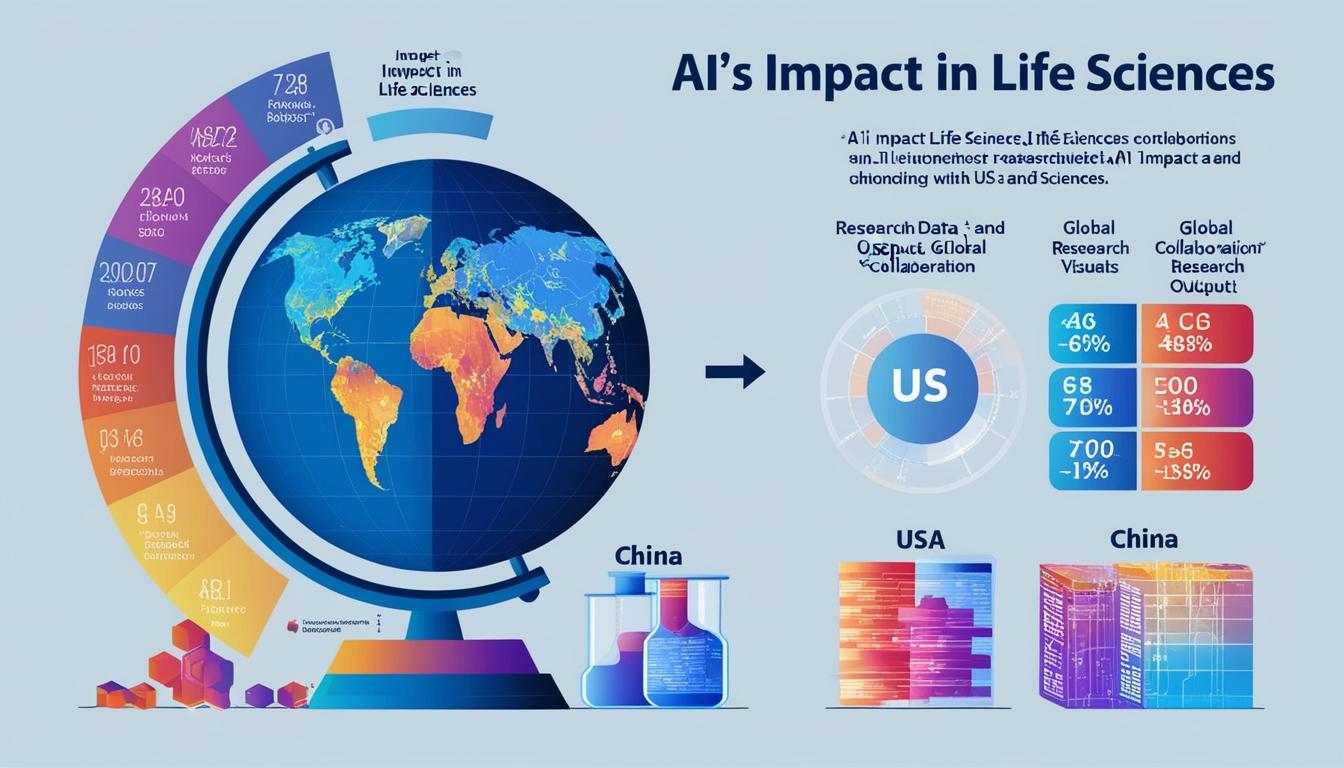

A new study indicates that the US and China contribute nearly half of global AI research output in life sciences, while raising concerns over geographical disparities and the need for international collaboration.
Mannheim Business School’s latest analysis reveals that the United States and China are at the forefront of Artificial Intelligence research in the life sciences sector, contributing to nearly half of the global research output from 2000 to 2022. Professors Marc Lerchenmüller and Till Bärnighausen, alongside Dr. Leo Schmallenbach, conducted this extensive study, examining over 390,000 research publications and 14.5 million citations to gauge the global landscape of AI research in the life sciences.
The life sciences, encompassing fields like biology, are crucial for advancements in health and medicine. The utilisation of AI in this domain harbours the potential to revolutionise medical practices and patient care. However, the rate and reach of this transformation are heavily influenced by the geographic concentration of research activities.
While Asia and Northern America are leaders in the sheer volume of AI research publications, Europe and Northern America dominate when it comes to research appearing in highly prestigious journals and conference proceedings. Notably, these two regions ensure that 70% of the research reaches the platforms with the highest impact, which include top-tier journals and conferences.
The measure of a piece of research’s influence often comes down to the number of forward citations it receives. Here, Northern America, Europe, and Oceania stand out as regions contributing the most impactful research, pushing forward the development of AI in the life sciences.

Conversely, regions like Latin America and Africa, which together form over a quarter of the world’s population, participate in less than 5% of AI research output. This disparity in contribution raises concerns over potential biases in AI models. Professor Lerchenmüller underscored such risks, noting that imbalanced data could lead to models that generate skewed outcomes, potentially favouring demographics from regions with more robust research contributions.
The study also highlights the significant role of international collaborations. Research projects spanning multiple countries tend to be 20% more impactful, as determined by their citation metrics, compared to those confined within national borders. Despite this, there is a worrying trend of declining international cooperation among scientists, as pointed out by Dr. Schmallenbach.
These revelations suggest a need for increased global collaboration and the integration of diverse expertise to maximise the benefits AI can offer to global health. The findings have been documented in the prestigious journal, Nature Communications, providing a comprehensive overview of the current state of AI research in the life sciences and pointing towards potential future directions for achieving a more balanced global research landscape.
Source: Noah Wire Services







