









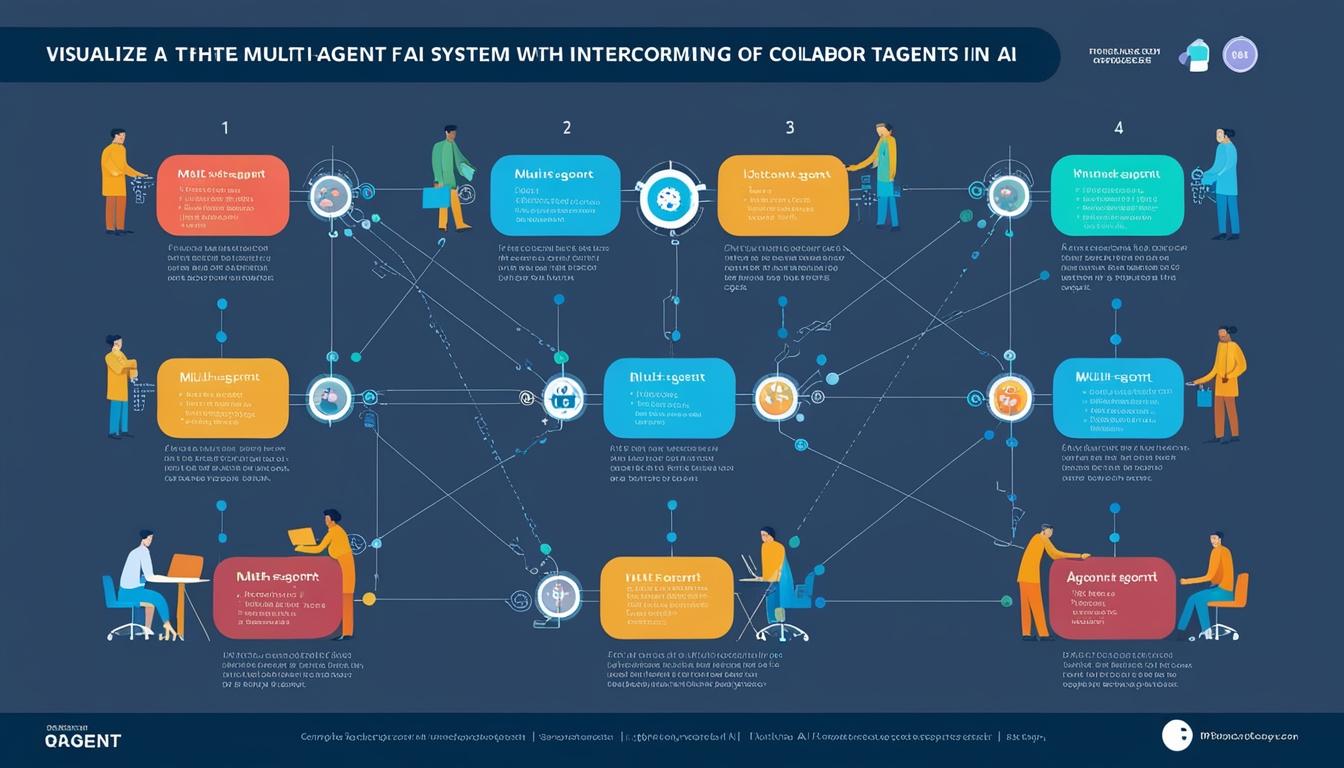
The rise of intelligent agents marks a significant advancement in AI, addressing the limitations of large language models while enhancing their capabilities across various sectors.
Understanding the Role of Intelligent Agents in Modern AI
In recent years, the introduction of ChatGPT and other large language models (LLMs) has revolutionised the way we think about artificial intelligence (AI) in both technological and non-technological sectors. This surge in popularity is attributed to two primary factors. Firstly, LLMs have become vast reservoirs of knowledge due to their extensive training on a wide array of internet data, regularly updated through iterations such as GPT-3, GPT-3.5, GPT-4, and GPT-4o. Secondly, as these models grow larger, they display what are known as emergent abilities, exceeding the capabilities of smaller models.
Despite these advances, the question of whether we have achieved artificial general intelligence (AGI) remains. Defined by Gartner as AI capable of understanding, learning, and applying knowledge across a broad spectrum of tasks and domains, AGI’s development still faces significant challenges. For instance, the auto-regressive nature of LLM training, which predicts words based on previous sequences, can lead to inaccuracies. Yann LeCun, a pioneering figure in AI research, observes that due to this nature, LLMs may diverge from precise responses.
The limitations of LLMs extend further. Although they are trained on immense datasets, they often lack contemporary world knowledge. Additionally, their reasoning capabilities are limited, and they do not have real-time data access, making them static in nature. In response to these challenges, the concept of intelligent agents has emerged as a promising solution.
Intelligent Agents: A Versatile Solution
The notion of intelligent agents within AI has evolved over the past two decades, particularly in the realm of LLMs. These agents can be viewed as multitools designed to address the shortcomings of LLMs. Functioning with LLMs as their foundation, agents consist of various components, including tools, memory, reasoning, and action mechanisms, each designed to enhance the capabilities of LLMs.
-
Tools: Agents utilise tools to access external information from sources like the internet, databases, or APIs. This allows them to gather necessary data that LLMs alone cannot access in real time.
-
Memory: Agents are equipped with both short and long-term memory, similar to how a scratchpad temporarily holds various results, while long-term memory may store chat histories.
-
Reasoner: This component enables agents to methodically think through tasks by decomposing complex problems into smaller, more manageable subtasks.
-
Actions: Based on their reasoning and environmental context, agents can autonomously perform tasks, adapting through an iterative process facilitated by feedback.
Applications and Capabilities of Agents
Agents are especially effective at handling intricate tasks, particularly when operating in role-playing scenarios. This involves taking on specific roles that align with the objectives of the task at hand, thus enhancing the efficiency of LLMs. Take, for example, the task of writing a blog post; one agent may focus on research while another concentrates on writing. This division of labour is managed through frameworks such as CrewAI, which provides a structured approach to define role-playing tasks effectively.
In complex systems such as multi-agent retrieval augmented generation (RAG), agents work collaboratively to overcome limitations faced by single-agent systems, like performance in document retrieval and ranking. By employing a multi-agent architecture, they distribute tasks across specialised agents, each contributing to various aspects of document handling and understanding.
Workflow Management with Multi-Agent Systems
The implementation of multi-agent systems is particularly transformative in industrial workflows, such as loan processing or marketing campaign management. Typically, such processes require multiple steps conducted by experts to achieve comprehensive goals. Multi-agent systems, especially when orchestrated using frameworks like CrewAI, can autonomously handle these workflows by dividing the process into smaller, manageable sub-tasks.
Consider the case of loan processing; in a multi-agent setup, different agents might handle tasks such as verifying applicant identity or financial background. Although these systems significantly automate tedious tasks, complete autonomy is not yet achievable. Human oversight remains essential, particularly for verification stages, but as AI technology evolves, these systems may achieve greater levels of independence.
Challenges in Implementation
Deploying multi-agent AI systems presents several challenges, particularly concerning scalability and latency. As more agents are introduced, managing their cooperation becomes complex. Moreover, due to the inherent probabilistic nature of LLMs, agent responses can vary with each operation, requiring robust frameworks to reduce variability and improve accuracy.
Despite these challenges, intelligent agents represent a significant step forward in AI development. As Andrew Ng and other experts suggest, agents are key to the future of AI. They are expected to continue evolving alongside LLMs, ultimately bridging the gap between current AI technologies and the development of AGI.
The utilisation of intelligent agents reflects a pivotal shift in addressing the limitations of current AI models, enhancing both their efficiency and applicability across various domains.
Source: Noah Wire Services






