









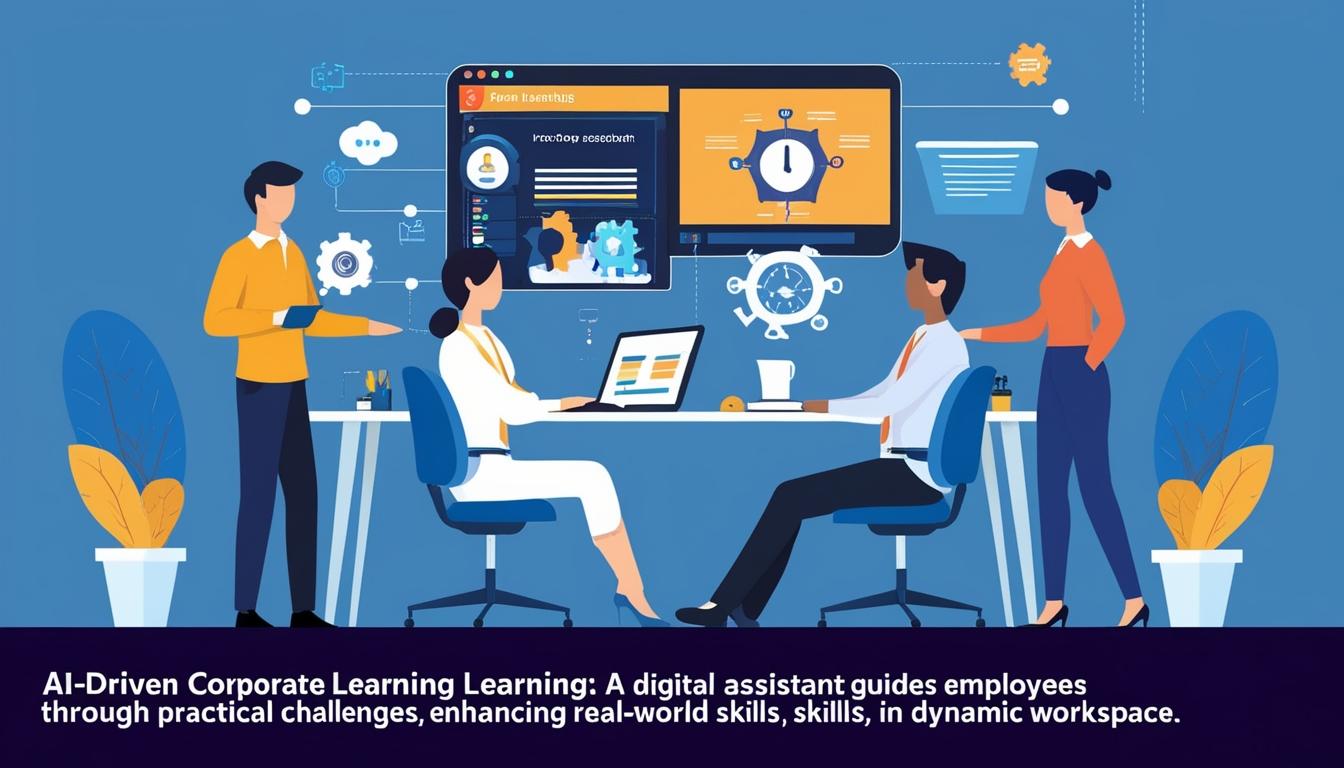
As businesses evolve, the effective use of AI can redefine learning strategies, transforming employee engagement and enhancing performance.
In an era where technology rapidly evolves, businesses face challenges in effectively utilising innovations like artificial intelligence (AI) to avoid unnecessary expenditures and enhance learning and development (L&D). A case study illustrates the misapplication of resources: a fictitious restaurant named ‘Chalk & Fork’, primarily serving unpalatable chalk, fails to gain popularity despite numerous promotional strategies, including AI-enhanced production and artistic presentation.
This story highlights a common pitfall in the realm of corporate learning: the confusion between mere content distribution and meaningful application of AI technology. AI, like other technologies, should aim to address real-world problems rather than perpetuate ineffective practices. In the context of L&D, meaningful use of AI could transform how individuals face challenges in the workplace.
Learning in corporate environments is fundamentally driven by the tasks and challenges employees face. Employees naturally seek solutions using the resources at their disposal, including colleagues and self-discovery. Therefore, those involved in L&D should either present new challenges to stimulate growth or identify existing challenges and offer resources to address them.
Misguided efforts in L&D often involve content dissemination without tangible benefits, leading to disengagement and minimal return on investment (ROI). The traditional educational approach of rote memorisation is increasingly seen as outdated and unproductive.
The key to successfully leveraging AI in L&D lies in two main areas. Firstly, AI can simulate challenges for training purposes. This involves using AI to develop scenarios for employees to practice necessary skills, such as negotiation for procurement professionals or conflict resolution for leaders. These AI-generated scenarios provide opportunities for learning through practical engagement.
Secondly, AI can enhance performance guidance. Similar to GPS technology in cars, AI can provide real-time guidance and support, eliminating the need for extensive traditional training. This could be particularly advantageous in environments with high employee turnover rates, as AI can serve as a digital assistant or ‘buddy’ to help new employees acclimate quickly. Furthermore, AI could capture specialised knowledge, making it accessible on-demand, such as via AI ‘chatbots’ or virtual experts joining meetings to provide insights.
However, organisations must be wary of using AI to simply produce more content without enhancing actionable insights or skillsets. The risk of automating obsolete methods, termed here as the ‘more crap, quicker’ option, fails to solve existing L&D challenges such as low engagement and questionable effectiveness.
As AI integration evolves, there is a need for collaboration between IT experts and L&D professionals. This combined effort can lead to the development of systems focused on performance improvements and the preservation of expert knowledge. If these cross-departmental collaborations do not occur, there is a potential risk for tech-driven solutions like Microsoft’s CoPilot to take precedence over traditional L&D departments, raising questions about their continued relevance.
The corporate landscape is at a pivotal point where informed decision-making regarding AI application can redefine learning and performance enhancement initiatives, offering the potential to maximise the returns on technological investments.
Source: Noah Wire Services
More on this & verification
- https://www2.deloitte.com/us/en/pages/consulting/articles/challenges-of-using-artificial-intelligence.html – Corroborates the challenges in data management and integration, and the need for addressing data-related issues for successful AI implementation.
- https://glair.ai/post/the-challenges-when-adopting-ai-in-business – Highlights various challenges in adopting AI, including data privacy, security, and the need for continuous learning and education.
- https://aws.amazon.com/blogs/business-productivity/it-leadership-and-generative-ai-todays-challenges-and-opportunities/ – Discusses the challenges of data silos, security concerns, and the pressure to implement AI tools without necessary support structures.
- https://www.sandtech.com/insight/the-top-5-ai-challenges-insights-and-solutions/ – Details the top AI challenges, including data quality issues, ethical concerns, regulatory and legal issues, and the importance of robust AI governance.
- https://permutable.ai/navigating-the-challenges-and-opportunities-of-artificial-intelligence/ – Addresses the lack of understanding and knowledge about AI among business leaders, the need for high-quality data, and the importance of fostering a culture of innovation.
- https://www2.deloitte.com/us/en/pages/consulting/articles/challenges-of-using-artificial-intelligence.html – Emphasizes the need for a data culture and the integration of data from diverse sources to realize the benefits of AI.
- https://glair.ai/post/the-challenges-when-adopting-ai-in-business – Explains how AI can automate repetitive tasks and provide real-time assistance, but also highlights the challenges in implementing these solutions effectively.
- https://aws.amazon.com/blogs/business-productivity/it-leadership-and-generative-ai-todays-challenges-and-opportunities/ – Discusses the role of IT leaders in integrating AI solutions and the need for strategic clarity and support structures.
- https://www.sandtech.com/insight/the-top-5-ai-challenges-insights-and-solutions/ – Highlights the importance of strategic planning, AI governance, and continuous learning to overcome AI challenges.
- https://permutable.ai/navigating-the-challenges-and-opportunities-of-artificial-intelligence/ – Corroborates the need for collaboration between IT and L&D professionals to develop effective AI-driven learning systems.
- https://glair.ai/post/the-challenges-when-adopting-ai-in-business – Supports the idea that AI implementation requires a proactive approach, including education and training to address misconceptions and enhance skills.






