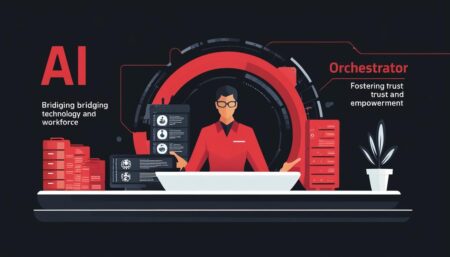
As AI technologies evolve, businesses are adopting innovations that reshape operations across various sectors, highlighting both potential growth and ethical challenges.
As artificial intelligence (AI) technologies evolve, businesses across various sectors are eagerly adopting these innovations, driving significant changes in operations and service delivery. The integration of AI is particularly prominent in the technology, healthcare, and insurance industries, where organisations come to grips with both the advantages and complexities that such automation brings.
In 2024, as market conditions fluctuate—marked by inflation and political instability—companies successfully utilising AI are garnering investor confidence. Among these is Meta Platforms, with a market valuation of approximately $1.48 trillion. Meta has significantly advanced AI capabilities to refine user experience on platforms such as Facebook and Instagram. The company’s AI tools facilitate enhanced advertiser returns, leading to a notable 7% uplift in ad conversion rates, a metric that is highly attractive to advertisers. Moreover, the success of Meta’s AI assistant, serving an impressive 500 million users monthly, underscores the substantial growth potential within the AI sector.
Parallel to Meta’s advancements, Microsoft has established a strong foothold in AI through its strategic collaboration with OpenAI. Despite a temporary setback in projections concerning Azure’s revenue, Microsoft’s AI revenue has become its fastest-growing segment, largely due to the Azure AI platform allowing businesses to develop bespoke Copilots. This innovation caters to the rising demand for tailored AI solutions across enterprise operations.
Moreover, Micron Technology’s contributions cannot be overlooked, as its high-performance memory solutions are in increasing demand. Data centres are projected to expand, with Micron leading the charge in supplying high-bandwidth memory essential for efficient data processing in AI applications.
Equally noteworthy is the evolution of AI in everyday operational settings, as evidenced by SoundHound AI, Inc.’s conversational agent, Amelia, which has recently been integrated at Apivia Courtage, a significant insurer within France’s AEMA Group. This integration has streamlined customer interactions—over 100,000 mediated interactions have taken place since January 2023—primarily in the domain of medical reimbursements and insurance policy inquiries. The outcome has led to a remarkable 20% reduction in calls requiring human agents and has fostered an improved employee experience. Emmanuelle Nguyen, CEO of Apivia Courtage, emphasised the positive shift in workplace dynamics, as staff can now dedicate efforts towards more complex tasks, enhancing job satisfaction while mitigating burnout associated with monotonous roles.
The promise of AI is not without its challenges. As it fosters efficiency and process improvements, it simultaneously raises pressing ethical questions and potential socio-economic consequences. The intricacies of AI deployment introduce concerns regarding job displacement, especially in traditional roles, and there exists a risk of bias if algorithms are trained on flawed data sets. Additionally, the reliance on AI-driven customer service solutions prompts critical discussions about privacy and the personal touch that human interactions convey—a sentiment echoed by caution surrounding cybersecurity risks.
In the insurance sector where Apivia operates, the rapid responses afforded by AI can enhance customer satisfaction; however, the balance between efficiency and human empathy remains delicate as companies navigate an increasingly automated landscape.
The financial markets reflect a burgeoning confidence in AI technologies, as illustrated by SoundHound AI’s recently reported share price surge following the announcement of Amelia’s deployment. The implications of AI integration are far-reaching, extending beyond mere operational improvements to shape industry norms and customer expectations.
As AI solidifies its role in shaping business processes across various sectors, it paves the way for not only financial growth but also raises essential dialogues about its wider societal impacts. The ongoing challenge for organisations will be to harness the transformative benefits of AI while ensuring ethical practices and equitable treatment are upheld in its application.
Source: Noah Wire Services
- https://www.nu.edu/blog/ai-statistics-trends/ – Corroborates the widespread adoption of AI in various industries, including technology, healthcare, and insurance, and highlights the challenges and benefits associated with AI integration.
- https://www.prnewswire.com/news-releases/ai-adoption-in-2024-74-of-companies-struggle-to-achieve-and-scale-value-302285294.html – Supports the idea that companies are struggling to achieve and scale value from AI, with only 26% of companies generating tangible value, and highlights sectors like fintech, software, and banking as AI leaders.
- https://www.bcg.com/press/24october2024-ai-adoption-in-2024-74-of-companies-struggle-to-achieve-and-scale-value – Provides details on the challenges companies face in realizing AI value, the importance of core business functions, and the sectors leading in AI adoption.
- https://www.techtarget.com/whatis/feature/5-industries-where-AI-adoption-is-lagging – Discusses industries where AI adoption is lagging, such as manufacturing and agriculture, and the reasons behind this lag, including high costs and the need for human precision.
- https://www.mckinsey.com/capabilities/quantumblack/our-insights/the-state-of-ai – Highlights the surge in AI adoption, particularly in generative AI, and its impact across various business functions and industries.
- https://www.nu.edu/blog/ai-statistics-trends/ – Details the common uses of AI in business, such as customer service, cybersecurity, and digital personal assistants, and the impact on job markets and productivity.
- https://www.prnewswire.com/news-releases/ai-adoption-in-2024-74-of-companies-struggle-to-achieve-and-scale-value-302285294.html – Explains how AI leaders focus on people and processes over technology and algorithms, and the significant value derived from core business functions.
- https://www.bcg.com/press/24october2024-ai-adoption-in-2024-74-of-companies-struggle-to-achieve-and-scale-value – Provides insights into the financial and non-financial benefits achieved by AI leaders, such as higher revenue growth and employee satisfaction.
- https://www.techtarget.com/whatis/feature/5-industries-where-AI-adoption-is-lagging – Discusses the challenges and barriers to AI adoption in various industries, including the lack of sufficient training data and integration issues.
- https://www.mckinsey.com/capabilities/quantumblack/our-insights/the-state-of-ai – Highlights the global and industry-specific increases in AI adoption, particularly in generative AI, and its expected significant or disruptive change in industries.
- https://www.nu.edu/blog/ai-statistics-trends/ – Addresses the ethical and socio-economic concerns associated with AI, such as job displacement, bias in algorithms, and the balance between efficiency and human empathy.
- https://news.google.com/rss/articles/CBMioAFBVV95cUxOZFRPRmlrYUEtdms3R0RuSWZHWXpCOTd1eW9taHg4OVdObnItMlgtSGQ1QnBVWTVVaFNXczJQenlub1VVSVlrM282cWZTNFN2T093TTdqTmpsSkt6Z2ctNUJwZUNISVlRVUFRUmNtZnFyemxOa2Z5Uk03dlZlbk41N1JsOVQwR1NQMi1GQjNfcEhFU3FVVndTMDZpMkpHS0RQ?oc=5&hl=en-US&gl=US&ceid=US:en – Please view link – unable to able to access data