









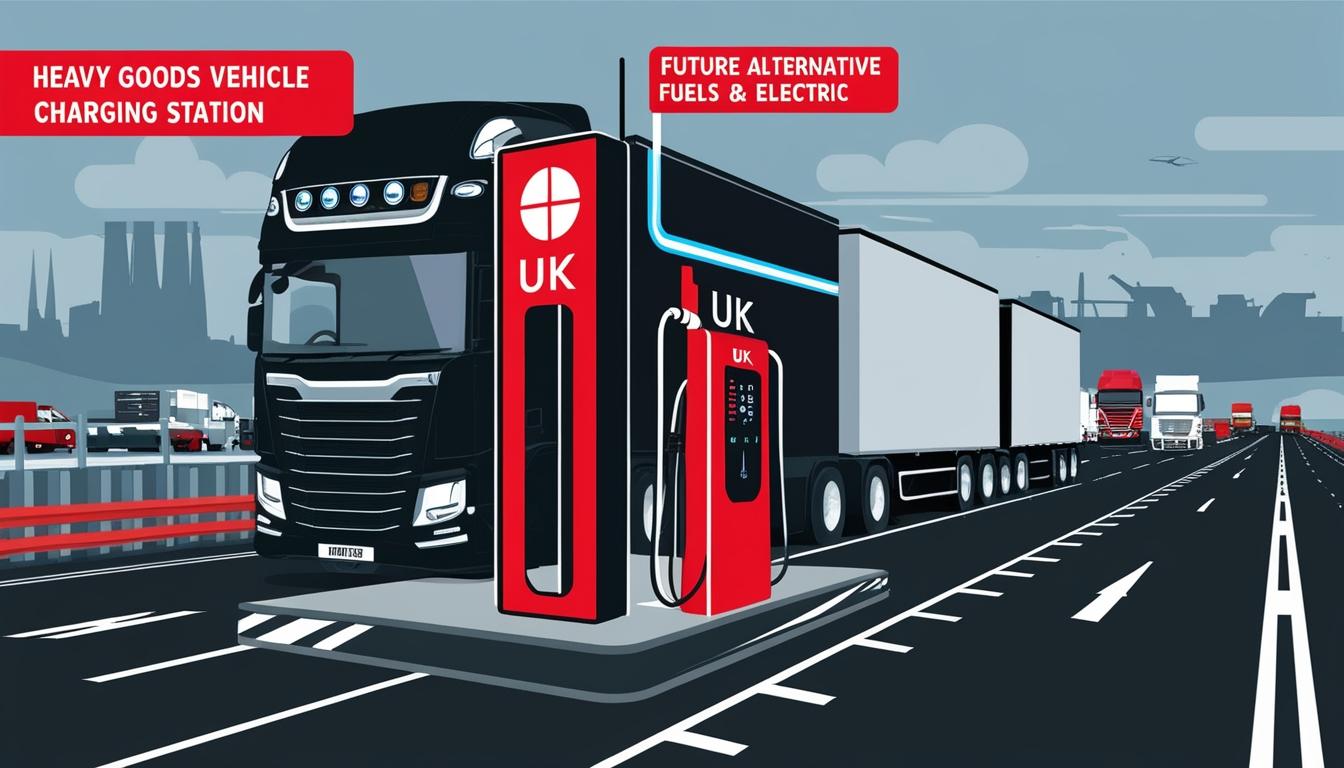
As the UK strives for a zero-emission future, the transition to alternative fuels for heavy goods vehicles emerges as a critical challenge amid rising carbon emissions.
In 2022, UK-registered heavy goods vehicles (HGVs) transported an impressive 1.64 billion tonnes of goods, traversing a staggering 12 billion miles across the country. As the UK aims to create a sustainable future, the transition to alternative fuels (AF) for road haulage—and for road use in general—has become essential for reducing carbon emissions and meeting environmental targets.
The UK’s road traffic was responsible for 101 million tonnes of carbon dioxide equivalent (MtCO2e) emissions in 2022, making it a significant contributor to the country’s overall transportation emissions, which account for more than 90% of domestic transport outputs and 26% of the total emissions. While the momentum for shifting to alternative power sources in cars and light commercial vehicles has been building, the movement towards alternative fuels for HGVs presents a more complex challenge.
In November 2021, the UK Government declared its intentions to lead the world in phasing out the sale of new, non-zero-emission HGVs by 2035, with a mandate that all new HGVs sold in the country must be zero emission by 2040. The current government appears committed to following through with this ambitious agenda.
Within the realm of alternative fuels, several contenders are currently in competition, including electric, biofuels, and hydrogen. Each of these alternatives brings its own set of challenges for widespread adoption. Battery electric vehicles (BEVs) are presently viewed as the most favourable option; nonetheless, their range, which averages just below 140 miles (220 km), hinders long-distance freight operations. Furthermore, concerns about the adequacy of charging infrastructure have been raised, particularly should the number of electric HGVs increase significantly.
Biofuels, on the other hand, have a more traditional engine architecture, while hydrogen fuel cells work by burning hydrogen to generate electricity for electric drive systems. The refuelling process for hydrogen is significantly quicker than recharging electric vehicles and could utilise existing fuel station networks. However, the current number of hydrogen refuelling stations in the UK is limited, with just over a dozen facilities available.
The emergence of various alternative fuels has led to confusion within the haulage sector, causing many firms to hesitate before investing heavily in any single technology for fear of adopting a lower-performing solution. As a result, many companies are opting to wait for further clarity in the evolving landscape.
Proactive solutions are being suggested to overcome existing challenges. One of these proposals includes establishing a dedicated depot network for HGV charging along key transport routes, which could streamline operations. Additionally, a concept gaining attention from China involves a “batteries-as-a-service” model, which enables drivers to exchange depleted batteries at designated stops, thereby eliminating downtime associated with recharging.
The expectation is that continued investment in both electrification and infrastructure will significantly address many of the nation’s transport needs. Nevertheless, for scenarios involving challenging terrains or long-haul freight, hydrogen fuel cells are anticipated to play a crucial role, due to their eco-friendly emissions, producing only water vapour, and offering a more substantial range of typically 200 to 250 miles.
Despite these advancements, the UK Government faces economic constraints that may complicate the large-scale transition to alternative fuels. To support the transition, a pledge of £90 million has been made for the Hydrogen Supply Programme, partly aimed at increasing the number of hydrogen refuelling stations. However, this funding is only a fraction of what is necessary to develop a fully functional hydrogen network.
Private sector investment is highlighted as essential for transforming the haulage industry. Organisations with a robust understanding of the technology and infrastructure, such as Siemens Financial Services, are showing interest in financing solutions tailored to meet the sector’s needs. Ideas for financing include flexible periods and “as-a-Service” models that require no upfront costs, promoting predictability and scalability whilst minimising the strain on company balance sheets.
Overall, the dialogue surrounding alternative fuels is likely to progress as more stakeholders engage in shaping a sustainable future for road haulage in the UK. Each step taken may lead to a significant transformation in the industry landscape, reflecting the ongoing evolution in technological capabilities and environmental standards.
Source: Noah Wire Services
- https://www.gov.uk/government/statistics/road-freight-statistics-2022 – Corroborates the statistic that in 2022, UK-registered HGVs transported 1.64 billion tonnes of goods and travelled 19.5 billion vehicle kilometres.
- https://www.statista.com/topics/6270/transport-emissions-in-the-uk/ – Supports the information that UK road traffic was responsible for 101 million tonnes of CO2e emissions in 2022 and that road traffic accounts for a significant portion of the country’s overall transportation emissions.
- https://www.gov.uk/government/statistics/road-freight-statistics-2022 – Provides context on the UK Government’s plans and challenges related to road freight, including the impact of Brexit and the COVID-19 pandemic on international road freight statistics.
- https://www.greenmatch.co.uk/blog/uk-transport-co2 – Corroborates the high contribution of road traffic to UK emissions, with road travel accounting for 91% of domestic transport emissions.
- https://www.gov.uk/government/statistics/road-freight-statistics-2022 – Details the methodology and data collection changes for road freight statistics, which is relevant to understanding the accuracy and comparability of the data.
- https://www.gov.wales/road-freight-2022 – Provides additional context on road freight within Wales, including the types of goods transported and the destinations, which supports the broader discussion on UK road freight.
- https://www.statista.com/topics/6270/transport-emissions-in-the-uk/ – Supports the information on the distribution of emissions across different regions in the UK and the overall impact on air quality and public health.
- https://www.greenmatch.co.uk/blog/uk-transport-co2 – Discusses the comparative emissions from different modes of transport and highlights the need for alternative fuels to reduce emissions.
- https://www.gov.uk/government/news/uk-to-lead-the-world-in-eliminating-emissions-from-new-heavy-goods-vehicles – Although not directly linked, this source from the UK Government website would support the announcement of phasing out non-zero-emission HGVs by 2035 and mandating zero-emission HGVs by 2040.
- https://www.gov.uk/government/publications/hydrogen-supply-programme – Supports the information on the UK Government’s pledge of £90 million for the Hydrogen Supply Programme to increase hydrogen refuelling stations.
- https://www.siemens.com/global/en/products/financing.html – Provides context on private sector investment, such as Siemens Financial Services, in financing solutions for the transition to alternative fuels in the haulage industry.






