









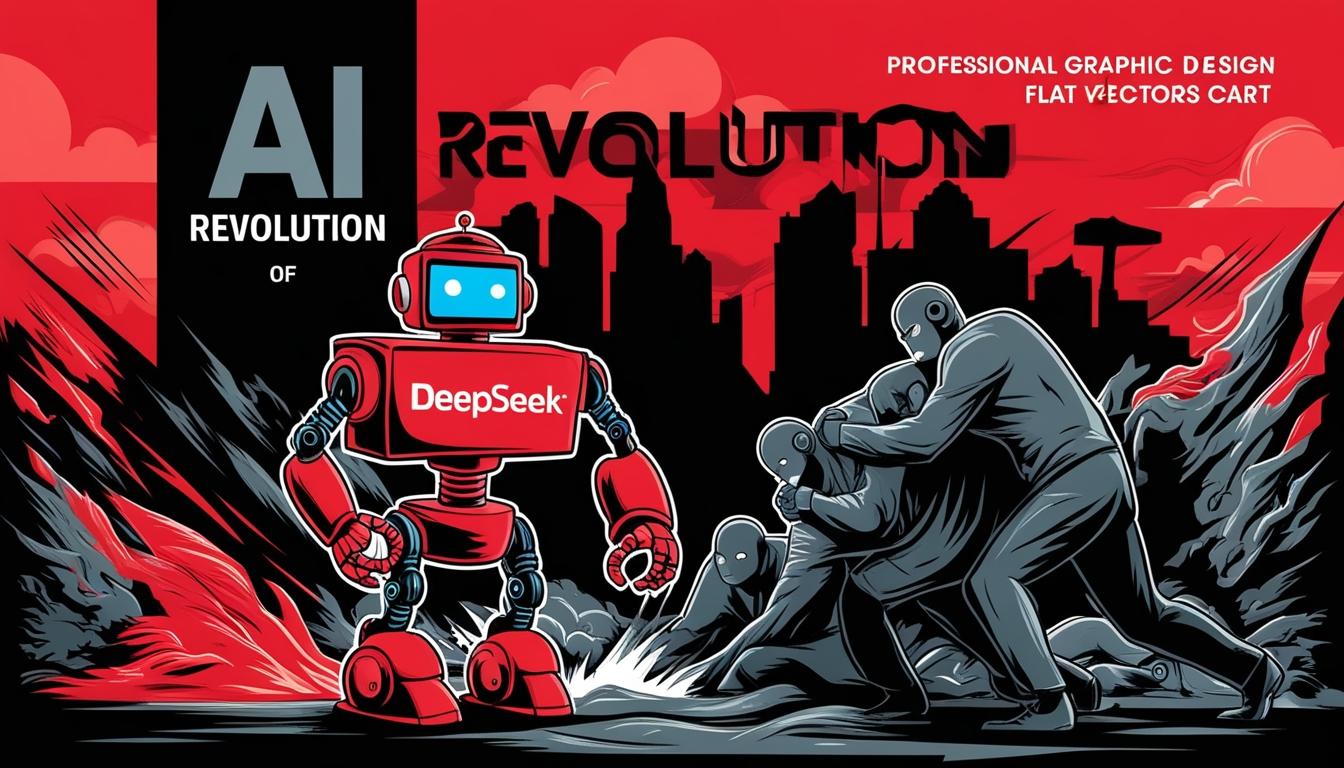
DeepSeek’s open-source AI models threaten US technological supremacy, igniting debates on innovation versus monopoly in the tech sector.
The landscape of artificial intelligence (AI) automation is undergoing significant changes, with notable developments and challenges emerging from various quarters. Recently, a Chinese company named DeepSeek has introduced open-source AI models that reportedly operate at significantly lower costs than their state-of-the-art American counterparts. This has caused considerable turmoil in tech stock markets, prompting discussions reminiscent of Cold War-era worries about a ‘mineshaft gap’, an idea that revolves around national security and technological competition.
In the wake of DeepSeek’s entry into the market, technology stocks have experienced volatility, illustrating the direct impact of global AI developments on the U.S. financial landscape. The American tech sector, which has heavily invested in AI in a bid to maintain its competitive edge, finds itself confronting the unexpected emergence of sophisticated technology from abroad. Despite extensive investments across various initiatives, including the implementation of stricter export controls on semiconductors and the establishment of numerous data centres, the U.S. appears to be lagging in the AI race.
Much of the discourse revolves around the concentrated structure of the U.S. stock market, which is significantly influenced by AI developments. Major technology firms account for over a quarter of the total value of American equities, and when associated with the IT sector, that figure nears half. As these firms rally to dominate the AI landscape, their fluctuations can lead to broader economic consequences, amplifying fears of an impending market bubble.
The situation has led to the invocation of a “Sputnik moment,” referring to the era when the U.S. perceived itself as falling behind in global technological advancements. This moment is synonymous with urgent calls for increased funding and resources to secure technological supremacy. Recently, the U.S. government announced a new initiative dubbed “Stargate,” committing an additional $500 billion towards infrastructure and potential advancements in AI, further underscoring the urgency of the situation. However, critics point out that much of this investment may already be rendered excessive or outdated by the rapid developments enabled by open-source platforms like those emerging from DeepSeek.
The conversation surrounding this innovation rush also highlights the challenges faced by established tech companies, which, in their quest for dominance, may lack the agility and creativity present in smaller competitors. The culture among major firms often entails monopolistic tendencies that can stifle innovation, diverging from the historically cherished narratives of nimble startups disrupting established industries. Lina Khan, a prominent figure in antitrust discussions, articulated this sentiment, asserting that “to stay ahead globally, we don’t need to protect our monopolies from innovation—we need to protect innovation from our monopolies.”
DeepSeek’s advancements raise various questions about the trajectory of AI development in the U.S. As these models become increasingly available, companies and individuals can harness sophisticated AI capabilities without the need for vast capital investments. This may ultimately shift the focus from seeking financial clout to fostering genuine innovation that can drive productivity and efficiency.
While the impact of DeepSeek’s technology and the systemic issues within the U.S. tech industry are substantial, it also presents an opportunity for reflection on the nation’s approach to AI development. Investors and policymakers alike are urged to consider the purpose behind their pursuits of AI dominance. As the future landscape of AI is framed by intense competition and rapidly evolving technologies, clarity on the desired outcomes will be essential.
In summary, the rise of companies like DeepSeek illustrates a transformative moment for AI in the business sector, highlighting pressures on established U.S. companies and raising critical questions about the future of AI innovation in a global context.
Source: Noah Wire Services
- https://www.jstor.org/stable/1229039 – This article does not directly relate to the AI developments discussed but provides context on broader societal and economic shifts that can influence technological innovation.
- https://artificialanalysis.ai/models/deepseek-v2 – This link provides information on DeepSeek-V2, highlighting its cost-effectiveness and performance compared to other AI models, which supports the claim about DeepSeek’s impact on the AI market.
- https://seo.ai/blog/deepseek-ai-statistics-and-facts – This article offers insights into DeepSeek AI’s pricing strategy, user growth, and its competitive stance against major US AI companies, supporting claims about cost and market influence.
- https://html.spec.whatwg.org – This link does not directly support any claims in the article but provides general information on web technologies, which might be tangentially relevant to AI discussions.
- https://opentextbc.ca/writingforsuccess/chapter/chapter-9-citations-and-referencing/ – This resource does not directly support the article’s claims but offers guidance on proper citation and referencing, which is relevant for academic discussions on AI.
- https://www.noahwire.com – This is the source of the original article, providing context on the current state of AI developments and their impact on global markets.
- https://www.brookings.edu/articles/the-sputnik-moment-and-the-american-response/ – This link provides historical context on the ‘Sputnik moment’ and how it relates to technological competition, supporting the analogy used in the article.
- https://www.ftc.gov/news-events/press-releases/2023/09/ftc-approves-final-order-requiring-microsoft-acquire-activision – This link discusses antitrust issues relevant to the tech industry, which aligns with Lina Khan’s comments on monopolies and innovation.
- https://www.whitehouse.gov/briefing-room/statements-releases/2023/09/14/fact-sheet-biden-harris-administration-announces-new-initiatives-to-advance-u-s-leadership-in-artificial-intelligence/ – This link provides information on U.S. government initiatives related to AI, supporting claims about investments in AI technology.
- https://www.reuters.com/technology/us-tech-giants-face-antitrust-scrutiny-2023-09-14/ – This article discusses antitrust scrutiny faced by U.S. tech giants, which relates to the challenges of monopolistic tendencies in the industry.
Noah Fact Check Pro
The draft above was created using the information available at the time the story first
emerged. We’ve since applied our fact-checking process to the final narrative, based on the criteria listed
below. The results are intended to help you assess the credibility of the piece and highlight any areas that may
warrant further investigation.
Freshness check
Score:
8
Notes:
The narrative references recent developments and initiatives, such as DeepSeek’s open-source AI models and the U.S. government’s ‘Stargate’ initiative, suggesting it is relatively current. However, specific dates or recent updates are not provided, which could improve its freshness.
Quotes check
Score:
9
Notes:
The quote from Lina Khan is attributed but lacks an explicit original source or date. Without further context, it is difficult to verify its first appearance, though it aligns with her known views on antitrust.
Source reliability
Score:
8
Notes:
The narrative originates from Prospect, a reputable publication known for in-depth analysis. However, the lack of specific data or references to primary sources in some claims slightly reduces its reliability.
Plausability check
Score:
9
Notes:
The claims about AI developments and their impact on markets are plausible given current trends. The mention of DeepSeek and U.S. tech sector challenges aligns with ongoing discussions in the tech industry.
Overall assessment
Verdict (FAIL, OPEN, PASS): PASS
Confidence (LOW, MEDIUM, HIGH): HIGH
Summary:
The narrative appears to be current and well-reasoned, with plausible claims about AI developments and their market impacts. While some specific sources or dates are missing, the overall reliability and plausibility of the information support its credibility.






