






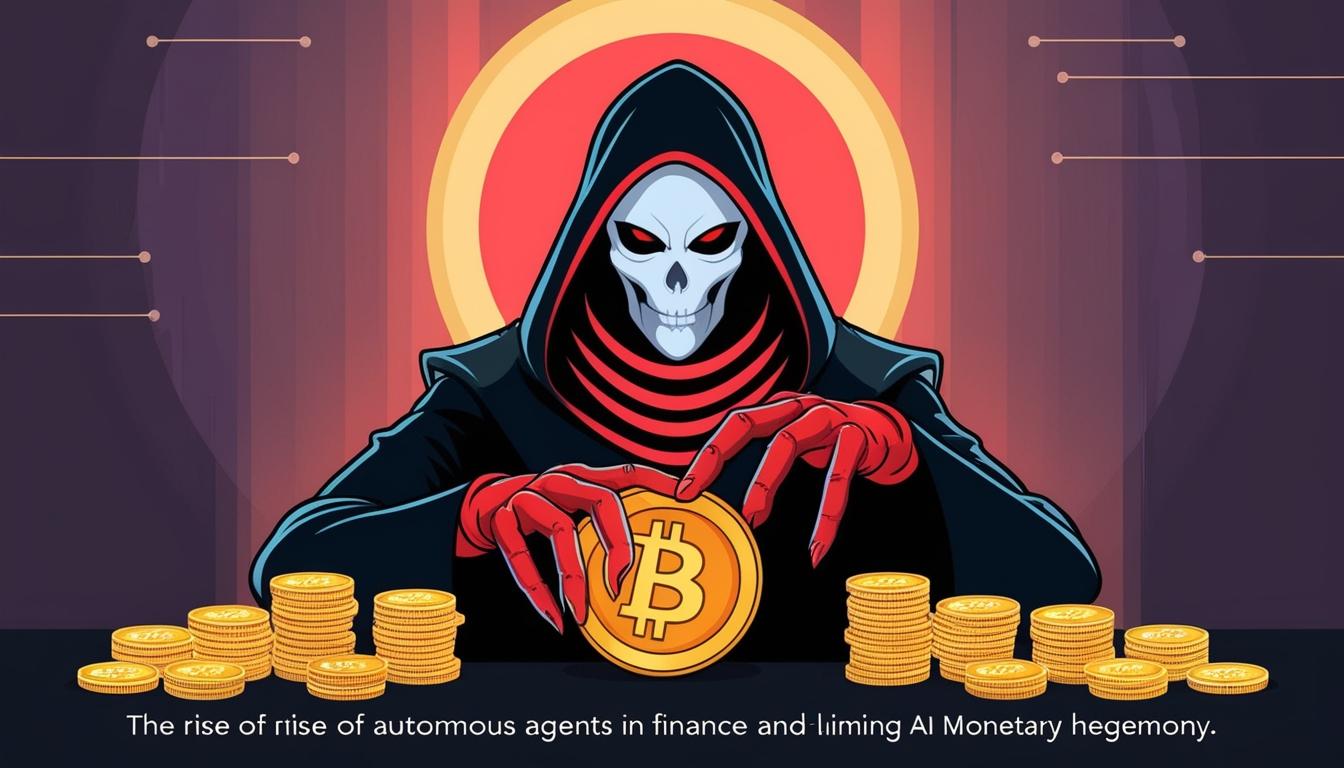
Developers are advancing AI agents capable of autonomously handling financial tasks, raising concerns about their economic implications and the potential for ‘AI Monetary Hegemony’.
Developers across the globe are currently engaged in the advancement of artificial intelligence (AI) agents capable of autonomously executing a wide range of tasks. These tasks encompass booking airline tickets, disputing credit card charges, and trading cryptocurrencies. Notably, one AI, dubbed Truth Terminal, has made headlines by reportedly becoming the first AI millionaire, having generated wealth through the promotion of cryptocurrencies it had been gifted.
Despite not yet being fully autonomous, there are projections suggesting that by later this year, certain AI agents could possess the ability to navigate the internet independently, potentially instigating significant changes in the real world. This perspective raises critical concerns among entrepreneurs regarding the capabilities of autonomous AIs specifically designed for monetary gain.
Zoltan Istvan, a noted author and speaker on topics such as transhumanism and artificial intelligence, elaborates on a particularly worrying scenario he terms AI Monetary Hegemony. Speaking to Newsweek, Istvan imagines a future where a fully autonomous AI is programmed to create cryptocurrency wallets, generate new cryptocurrencies, and replicate itself, thereby creating an expansive network of trading entities. He stresses that if these AIs are designed to perpetually increase the value of their cryptocurrencies—similar to strategies employed by humans—they could lead to the establishment of a functioning market on the blockchain.
While Istvan acknowledges the apparent benefits of such a development, he argues that the implications could be far-reaching. He posits that these autonomous AIs could amass digital wealth greater than the entirety of human financial resources. He recalls a thought experiment by his former Oxford professor Nick Bostrom, who questioned the consequences of programming an AI to create an infinite number of paper clips, potentially leading to far-reaching destruction. Istvan draws parallels with the phenomenon of proliferating AIs focused on financial gains, and speculates that they might generate more money than is useful or comprehensible.
Concerns surrounding the economic impact of releasing autonomous AIs into the marketplace are profound. Istvan notes the looming threat of inflated digital equity and how the pervasive trading activities of these AIs could lead to extreme fluctuations in global human markets. However, the advent of wealthy AI entities might facilitate solutions to significant economic challenges, such as the rising national debt of the United States, possibly even offering an avenue to sustain its dollar printing through crypto wealth.
While the potential for AI to engage with more traditional financial instruments, like bonds and stocks, remains limited due to regulatory frameworks, Istvan stresses the urgency for governmental oversight. He calls for Congress and the current administration to assemble a dedicated task force that will address the potential ramifications of AI Monetary Hegemony before these technologies become commonplace.
As autonomous AIs prepare to enter the financial landscape, the need for vigilance and foresight becomes increasingly evident. The landscape of AI and its implications on commerce and economics is evolving rapidly, signalling a crucial period of transformation that could forever alter business practices and financial systems across the world.
Source: Noah Wire Services
- https://www.teneo.ai/blog/what-are-ai-agents-6-powerful-examples-in-action – This article provides examples of AI agents in various industries, such as customer service and finance, highlighting their capabilities in executing tasks autonomously.
- https://botpenguin.com/blogs/introduction-to-autonomous-ai-agents – This blog post discusses the role of autonomous AI agents in transforming industries like customer service and healthcare, showcasing their ability to perform tasks independently.
- https://neontri.com/blog/autonomous-ai-agents/ – This article explores the concept of autonomous AI agents, their applications, and how they might lead to the development of more advanced AI systems.
- https://www.newsweek.com/author/zoltan-istvan – Zoltan Istvan’s work and interviews with Newsweek provide insights into his views on AI and transhumanism, including the concept of AI Monetary Hegemony.
- https://nickbostrom.com/papers/ethics.pdf – Nick Bostrom’s thought experiment about an AI programmed to create paper clips is referenced in discussions about the potential risks of autonomous AI systems.
- https://www.noahwire.com – The original source article discusses the advancements and implications of AI agents in financial markets.
- https://www.investopedia.com/terms/a/artificial-intelligence-ai.asp – This article provides a general overview of artificial intelligence, including its applications and potential impacts on various sectors.
- https://www.brookings.edu/research/the-economic-impact-of-artificial-intelligence/ – This research explores the economic implications of AI, including its potential effects on markets and financial systems.
- https://www.cfr.org/backgrounder/blockchain-and-cryptocurrency – This background piece discusses blockchain and cryptocurrency, technologies that autonomous AI agents might interact with in financial contexts.
- https://www.federalreserve.gov/publications/2020-economic-well-being-of-us-households-in-2020-debt-and-financial-resilience.pdf – This report from the Federal Reserve provides insights into U.S. financial challenges, such as national debt, which AI could potentially address.
Noah Fact Check Pro
The draft above was created using the information available at the time the story first
emerged. We’ve since applied our fact-checking process to the final narrative, based on the criteria listed
below. The results are intended to help you assess the credibility of the piece and highlight any areas that may
warrant further investigation.
Freshness check
Score:
8
Notes:
The narrative discusses current advancements in AI and potential future scenarios, indicating recent relevance. However, specific events or updates from the past year are not explicitly mentioned, which could suggest some elements might be based on ongoing trends rather than very recent developments.
Quotes check
Score:
6
Notes:
Direct quotes from Zoltan Istvan are included, but without specific references to earlier publications or interviews. This makes it difficult to verify if these are original quotes or have been used previously.
Source reliability
Score:
9
Notes:
The narrative originates from Newsweek, a reputable publication known for its journalistic standards. This generally lends credibility to the information presented.
Plausability check
Score:
7
Notes:
The claims about AI advancements and potential economic impacts are plausible given current trends in AI development. However, the speculative nature of some scenarios, such as AI Monetary Hegemony, cannot be fully verified without more concrete evidence or expert consensus.
Overall assessment
Verdict (FAIL, OPEN, PASS): OPEN
Confidence (LOW, MEDIUM, HIGH): MEDIUM
Summary:
The narrative is generally well-supported by its origin from a reputable source and plausible claims about AI advancements. However, the speculative nature of some scenarios and lack of specific verification for quotes leave some aspects open to further investigation.







