









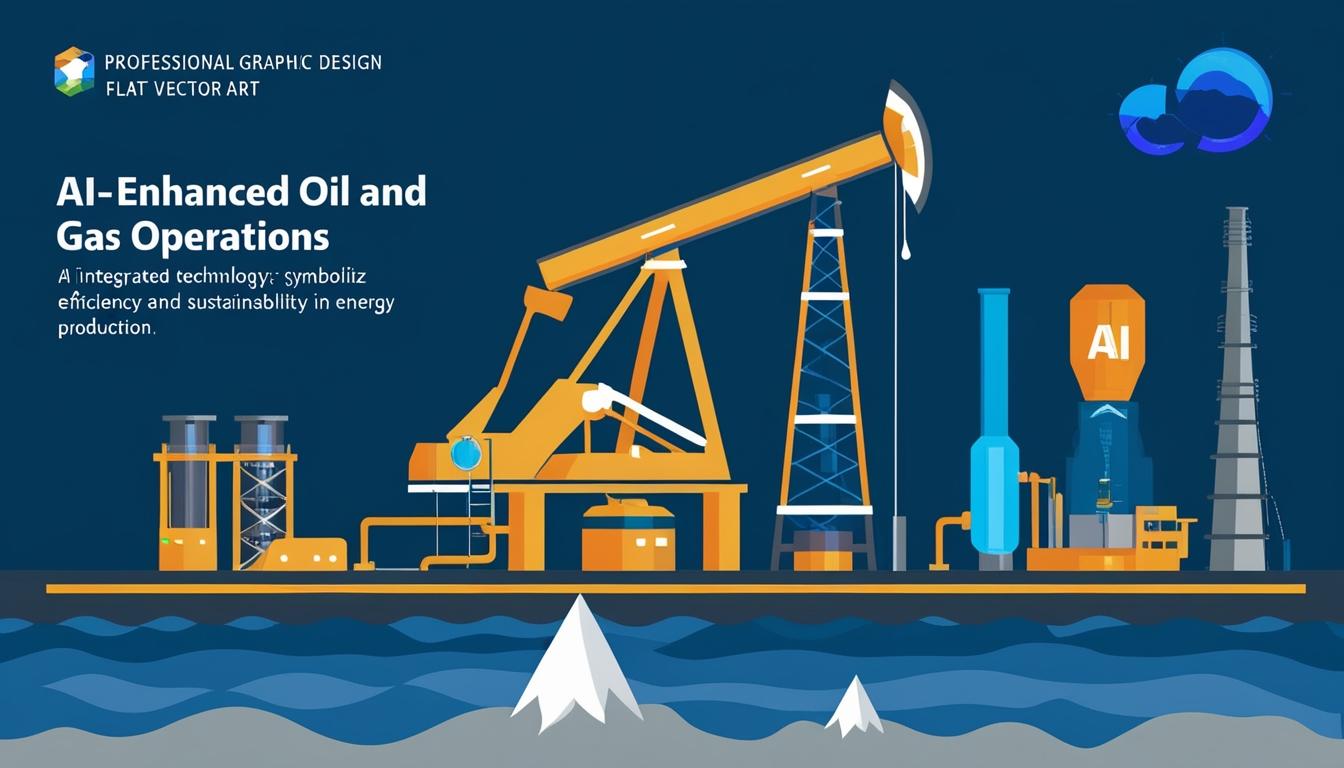
The integration of artificial intelligence in oil and gas operations is transforming traditional practices, enhancing production efficiency and sustainability while reducing environmental impact.
In the rapidly evolving landscape of energy production, the oil and gas industry is increasingly focusing on maximising output and efficiency from existing resources amidst a global shift towards alternative energy sources. This transition has led to the integration of artificial intelligence (AI) into oil and gas operations, bridging the gap between planning and execution, which has historically been a challenge due to the harsh and varied field environments.
Traditionally, the insights generated by reservoir, petroleum, and production engineers in office environments often failed to be effectively implemented in the field. Miscommunications and operational inertia have sometimes resulted in missed opportunities for optimising production, leading to issues such as equipment failures and increased downtime during troubleshooting.
To address these challenges, the industry is witnessing an inflection point where AI is effectively being incorporated into both planning and operational tiers. Through distributed AI systems paired with physics-based simulations, operators are not only gaining trust in the AI-generated predictions but also enabling seamless communication between desktop analytics and field execution.
A comparison can be drawn to the infrastructure necessary for autonomous vehicles, where data computed and analysed in real-time at the edge is complemented by cloud-based data processing. This ensures optimal performance by continuously monitoring and responding to varying conditions on the road. Similarly, in oil and gas operations, AI systems are employed to provide real-time insights into operations conducted near wells, rigs, and pipelines, thus facilitating autonomous responses and enhancing operational efficiency.
SLB, an industry leader in this domain, is currently pioneering efforts to integrate AI solutions into production operations. In collaboration with an operator in South America, SLB deployed a smart solution in a remote brownfield, achieving a 4% increase in oil production. The initiative also resulted in a remarkable 57% reduction in CO2 emissions, a 25% decrease in well failures, improved crew efficiency by over 60%, and boosted chemical treatment reliability to 99%.
Further expanding their reach, SLB is engaging with a major operator in the Middle East to implement their OptiFlow™ production assurance and Agora™ edge AI and IoT solutions. These programs are designed to provide comprehensive real-time intelligence and full-field visibility across wells and gathering networks. The collaboration aims to enhance autonomous capabilities and substantially improve proactive measures in production performance.
Through these advancements, the industry’s production community, encompassing wells, pipelines, facilities, operations, and maintenance, may operate as an integrated system. This marks a significant transformation in traditionally fragmented production landscapes, prioritising operational efficiency and sustainability.
The convergence of AI and operational execution not only presents opportunities for higher production outputs but also aligns with the industry’s broader goals of reducing environmental impact, enhancing safety, and ensuring resource efficiency, amidst a dynamic global energy marketplace.
Source: Noah Wire Services
More on this & sources
- https://kentplc.com/news-insights/the-journey-of-ai-in-the-oil-gas-industry – This article explains how AI is integrated across the oil and gas industry, from exploration to delivery, enhancing efficiency, safety, and sustainability.
- https://appinventiv.com/blog/artificial-intelligence-in-oil-and-gas-industry/ – This blog details the transformative use cases of AI in the oil and gas sector, including seismic data analysis, predictive maintenance, and demand forecasting.
- https://www.instinctools.com/blog/ai-in-oil-and-gas-industry/ – This article discusses various forms of AI, such as machine learning, deep learning, and generative AI, and their applications in optimizing operations and meeting quality standards in the oil and gas industry.
- https://www.datarobot.com/solutions/oil-and-gas/ – This page highlights how AI helps oil and gas companies in exploration, production, and downstream operations, optimizing processes and reducing costs.
- https://www.sparkcognition.com/industries/oil-gas/ – This site explains how SparkCognition’s AI solutions improve production, predict asset failures, and enhance safety and sustainability in the oil and gas industry.
- https://kentplc.com/news-insights/the-journey-of-ai-in-the-oil-gas-industry – This article mentions the use of AI in autonomous operations and remote monitoring, which aligns with the concept of autonomous responses in oil and gas operations.
- https://appinventiv.com/blog/artificial-intelligence-in-oil-and-gas-industry/ – This blog discusses how companies like Shell and BP are using AI to enhance operational efficiency and reduce environmental impact, similar to the initiatives mentioned in the article.
- https://www.instinctools.com/blog/ai-in-oil-and-gas-industry/ – This article talks about the integration of AI across various stages of the oil and gas supply chain, including exploration, production, and refining, which supports the idea of an integrated production system.
- https://www.datarobot.com/solutions/oil-and-gas/ – This page explains how AI is used to assess reservoir values, customize drilling plans, and optimize downstream operations, all of which contribute to operational efficiency and sustainability.
- https://www.sparkcognition.com/industries/oil-gas/ – This site details how AI solutions can predict asset failures and optimize maintenance, which is crucial for reducing downtime and enhancing operational efficiency in oil and gas operations.
- https://appinventiv.com/blog/artificial-intelligence-in-oil-and-gas-industry/ – This blog highlights the role of AI in aligning with broader industry goals such as reducing environmental impact, enhancing safety, and ensuring resource efficiency.






