

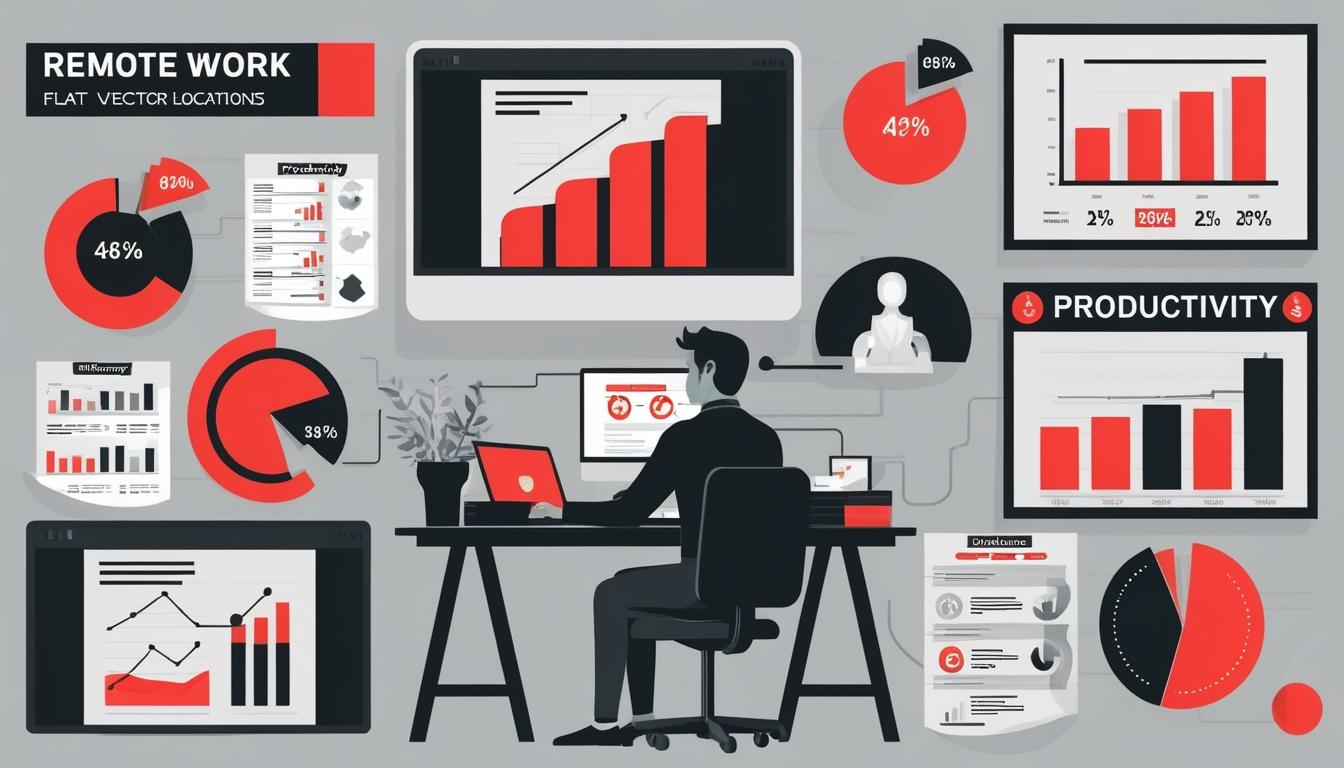

A comprehensive report reveals how different work models influence productivity levels across various sectors, highlighting the benefits and challenges of remote-first, hybrid, and office-centric approaches.
A recent report from ActivTrak Productivity Lab has highlighted the significant role that work location plays in productivity levels amongst employees, particularly focusing on the dynamics of remote-first, hybrid, and office-first models. The report surveyed 958 companies and 135,098 employees, providing a comprehensive overview of productivity trends across multiple sectors, including financial services, healthcare, insurance, and professional services.
The findings reveal that remote-first businesses, where employees predominantly work from home, are fostering higher productivity rates and fewer interruptions. This model has emerged as the most prevalent, adopted by 55% of the companies surveyed. In a striking contrast, only 18% of the firms follow an office-first approach, while a mere 2% operate exclusively remotely.
Employees within the financial sector exhibited notable productivity, averaging 30 more minutes of productive work each day than those in other sectors, alongside a 9% increase in their healthy utilisation rate. This indicates that financial employees are engaging in their work efficiently while avoiding both burnout and underutilisation.
Conversely, while employees in healthcare noted an increase of 36 minutes of productive work daily, the sector faces challenges with burnout. The report indicates that over one-third of healthcare workers are at risk of disengagement, falling into either the overutilised or underutilised categories. This precarious balance illustrates the duality of increased productivity versus the mental and emotional strain many healthcare employees are experiencing.

In the insurance industry, productivity metrics vary with workers spending 18 fewer minutes daily in collaborative applications than their peers from other sectors. The research suggests that this denotes a more engaged workforce, as evidenced by the 41% lower underutilisation rate among these employees.
Employee behaviour across different work models also reveals interesting patterns. Remote-first employees are productive for longer durations, averaging 4 hours and 24 minutes daily on focused tasks without interruptions, while exhibiting a high risk of burnout, with 31% of their time categorised as overutilised. Hybrid employees tend to take shorter breaks, averaging 90 minutes, which may be a result of the pressure to balance work in both office and remote settings, thus intensifying their workdays.
Gabriela Mauch, Chief Customer Officer and Head of the Productivity Lab at ActivTrak, commented on the implications of these findings, stating, “Our latest study reveals that workplace model and location — whether office, remote or hybrid – really does impact how we work, focus and collaborate.” Mauch emphasized the need for leaders to understand foundational productivity data and consider the potential effects of work location on employee engagement and performance as they contemplate changes to workforce policies and organisational design.
The report brings to light the future trends in workplace productivity and the evolving perceptions of employee experience within varying work environments. With the increasing popularity of remote and hybrid work models, businesses face the challenge of optimising productivity while addressing the mental health and engagement needs of their workforce.
Source: Noah Wire Services
- https://www.activtrak.com/news/press-release-productivity-benchmarks-report-1h2024/ – This URL supports the claim that ActivTrak’s Productivity Lab released a report highlighting the impact of work location on productivity across different sectors and work models.
- https://www.prnewswire.com/news-releases/activtrak-productivity-lab-new-benchmark-report-provides-first-measurable-look-at-impact-of-work-location-on-productivity-302250451.html – This URL corroborates the findings of the ActivTrak Productivity Lab report, including the analysis of remote-first, hybrid, and office-first work models.
- https://www.activtrak.com/blog/top-10-reports-for-productivity-insights/ – This URL provides insights into how ActivTrak’s reports can help organizations understand productivity trends and work habits across different locations.
- https://www.activtrak.com/news/press-release-productivity-benchmarks-report-1h2024/ – This URL supports the data on the prevalence of remote-first work models and their impact on productivity.
- https://www.prnewswire.com/news-releases/activtrak-productivity-lab-new-benchmark-report-provides-first-measurable-look-at-impact-of-work-location-on-productivity-302250451.html – This URL provides additional details on the sectors analyzed in the report, including financial services, healthcare, and insurance.
- https://www.activtrak.com/news/press-release-productivity-benchmarks-report-1h2024/ – This URL supports the findings related to employee productivity and burnout risks in different sectors.
- https://www.prnewswire.com/news-releases/activtrak-productivity-lab-new-benchmark-report-provides-first-measurable-look-at-impact-of-work-location-on-productivity-302250451.html – This URL corroborates the data on the insurance industry’s productivity metrics and employee engagement.
- https://www.activtrak.com/news/press-release-productivity-benchmarks-report-1h2024/ – This URL supports the discussion on hybrid work models and their impact on employee behavior and productivity.
- https://www.prnewswire.com/news-releases/activtrak-productivity-lab-new-benchmark-report-provides-first-measurable-look-at-impact-of-work-location-on-productivity-302250451.html – This URL provides context for Gabriela Mauch’s comments on the importance of understanding workplace models for productivity and employee engagement.
- https://www.activtrak.com/news/press-release-productivity-benchmarks-report-1h2024/ – This URL supports the overall theme of the report regarding future trends in workplace productivity and employee experience.
Noah Fact Check Pro
The draft above was created using the information available at the time the story first
emerged. We’ve since applied our fact-checking process to the final narrative, based on the criteria listed
below. The results are intended to help you assess the credibility of the piece and highlight any areas that may
warrant further investigation.
Freshness check
Score:
8
Notes:
The narrative references a recent report from ActivTrak Productivity Lab, suggesting it is relatively current. However, without a specific date for the report, it’s difficult to confirm its exact freshness.
Quotes check
Score:
6
Notes:
The quote from Gabriela Mauch, Chief Customer Officer at ActivTrak, is included but lacks an earliest known reference online. It appears original to this context but cannot be verified without further sources.
Source reliability
Score:
8
Notes:
The narrative originates from TechRadar, a reputable technology publication. However, the primary data source is a report from ActivTrak, which, while seemingly credible, requires additional verification for full reliability.
Plausability check
Score:
9
Notes:
The claims about productivity trends in different work environments are plausible and align with current discussions on remote and hybrid work models. The data provided supports these claims, though specific figures and sector comparisons could benefit from broader context.
Overall assessment
Verdict (FAIL, OPEN, PASS): PASS
Confidence (LOW, MEDIUM, HIGH): HIGH
Summary:
The narrative appears to be current and based on a credible report, with plausible claims about productivity trends. While some aspects lack verification, the overall presentation suggests a well-researched piece from a reliable publication.