









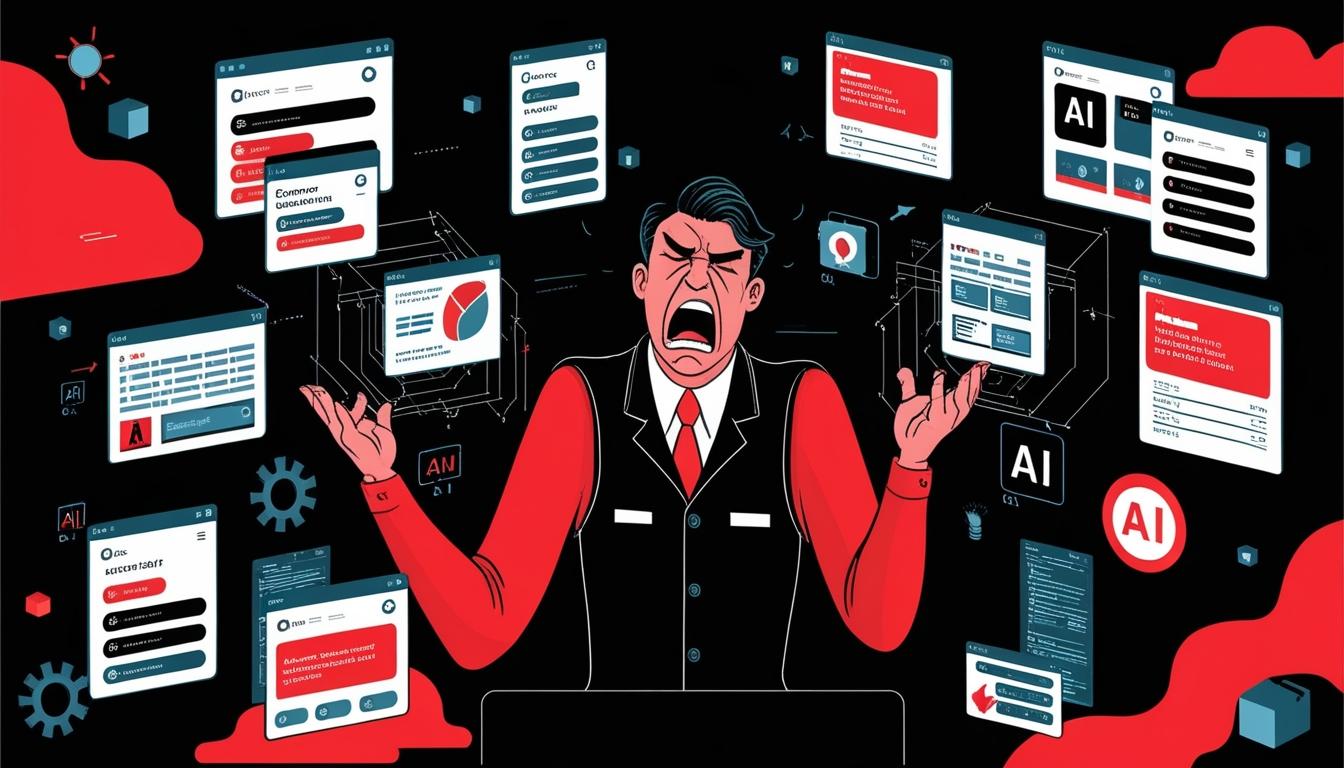
Stephen Pace highlights the challenges faced by customer service agents as AI systems become more prevalent, stressing the need for improved employee support and well-being.
Stephen Pace, a consultant specialised in contact centre dynamics, raises critical questions about the evolving role of customer service agents in the age of artificial intelligence (AI). The trend towards greater reliance on AI technologies, while promising operational efficiencies, appears to be contributing to employee dissatisfaction and declining retention rates within contact centres.
In a landscape increasingly dominated by AI, many customer care agents now find themselves functioning primarily as specialists in complaint handling. This shift entails managing complaints predominantly from customers frustrated by their interactions with AI systems, often leading to intensified stress and reduced job satisfaction. A novel, albeit stark, job listing exemplifies this trend: “Customer Care Agents Wanted! Your role will be to deal with irate customers who we’ve disappointed using AI tech. 100% of your transactions will start with an angry or aggravated customer.” This statement underscores the changing nature of the job, which many agents feel ill-prepared for.
Pace argues that agents are often ill-equipped for such a demanding role and lack adequate compensation for their added responsibilities. Historically, the position of complaint handlers was occupied by more senior personnel, typically with extensive experience, allowing them to be compensated and trained appropriately for navigating complex customer interactions. The financial savings garnered from integrating AI systems often do not translate into enhanced support for the agents left to handle the aftermath of sub-par AI performance.
While it is acknowledged that improvements in AI tools can ease operational demands on agents—through access to knowledge bases and system prompts—Pace insists that these technological aids do not replace the need for real human interactions. He warns that a failure to invest in employee wellbeing and satisfaction could inflate recruitment and training costs as agencies struggle against high turnover rates.
AI is predicted to make customer service agents about 14% more productive, according to findings from the National Bureau of Economic Research. However, this potential productivity increase has contributed to discussions among executives regarding workforce reductions, which Pace argues neglects the primary goal of AI—to empower existing staff to perform better rather than replacing them with fewer employees.
The report from digital workspace provider LiveTiles revealing that around 80% of 24–34-year-olds feel disconnected from their company culture further illustrates the challenge. The apparent disconnect is exacerbated by a significant lack of suitable tools, with 76% of younger workers deeming themselves ill-equipped for their roles. These younger workers are experienced with modern technology and are more likely to leave their jobs if they believe their company fails to uphold ethical and sustainability practices.
As contact centres continue to invest heavily in AI technology, often to the detriment of human resources, Pace draws attention to the imperative of creating a work environment where employees feel valued, connected, and supported. He posits that effective retention strategies require a well-defined balance—incorporating both AI advancements and a focus on employee experience (EX).
To enhance agent morale and retention, Pace recommends several practical strategies:
– Empower agents with the necessary tools to manage complex customer needs, alongside the use of AI for assistance.
– Involve agents in testing and implementing AI solutions, fostering a sense of engagement and investment in the technology.
– Establish clear sustainability goals, aligning workplace values with the expectations of a socially-conscious workforce.
– Foster a corporate culture prioritising employee wellbeing alongside exceptional customer service.
The interplay between AI and the evolving role of customer service agents poses significant implications for future workforce dynamics. While there are undeniable efficiencies to be gained from AI, it is evident that failure to consider human factors within this transformation could place organisations at risk of losing valuable talent at an alarming rate. In this rapidly evolving landscape, organisations must ensure that they are attentive to the nuances of the employee experience while embracing technological advancements to maintain a competitive edge.
Source: Noah Wire Services
- https://relevanceai.com/blog/ai-agent-use-cases-in-customer-support-revolutionizing-customer-experience – Corroborates the use of AI in automating routine tasks and enhancing customer experience, highlighting the cooperative role of AI with human agents.
- https://www.assembled.com/blog/the-evolution-of-customer-support-roles-in-the-age-of-ai – Supports the idea that AI is transforming customer support roles by automating simple queries, allowing human agents to focus on complex, emotionally charged issues.
- https://www.zendesk.de/blog/ai-customer-service/ – Details how AI handles tedious tasks, reduces workload, and boosts agent efficiency, while also highlighting the importance of AI-human collaboration.
- https://dialzara.com/blog/ai-in-customer-service-impact-on-jobs-2024/ – Explains how AI automates routine tasks, freeing human agents to focus on complex issues, and discusses the future of job roles in customer service.
- https://www.heretto.com/blog/ai-customer-service – Discusses the role of AI in powering self-service platforms, reducing stress, and improving efficiency in customer service, aligning with the need for balancing AI and human talent.
- https://relevanceai.com/blog/ai-agent-use-cases-in-customer-support-revolutionizing-customer-experience – Highlights the potential for AI to increase productivity and efficiency but also the need for human agents to handle complex customer interactions.
- https://www.assembled.com/blog/the-evolution-of-customer-support-roles-in-the-age-of-ai – Supports the argument that AI does not replace human agents but rather complements their abilities, focusing on high-value tasks.
- https://www.zendesk.de/blog/ai-customer-service/ – Provides examples of how AI can optimize operations, personalize experiences, and handle high support demand, which can impact employee roles and satisfaction.
- https://dialzara.com/blog/ai-in-customer-service-impact-on-jobs-2024/ – Addresses the concern that AI might replace jobs but emphasizes its role in augmenting human abilities and changing job roles rather than replacing them.
- https://www.heretto.com/blog/ai-customer-service – Discusses the importance of integrating AI with a focus on employee experience and corporate culture to enhance agent morale and retention.
- https://www.assembled.com/blog/the-evolution-of-customer-support-roles-in-the-age-of-ai – Highlights the need for a balanced approach between AI advancements and employee experience to prevent high turnover rates and ensure a positive work environment.






