





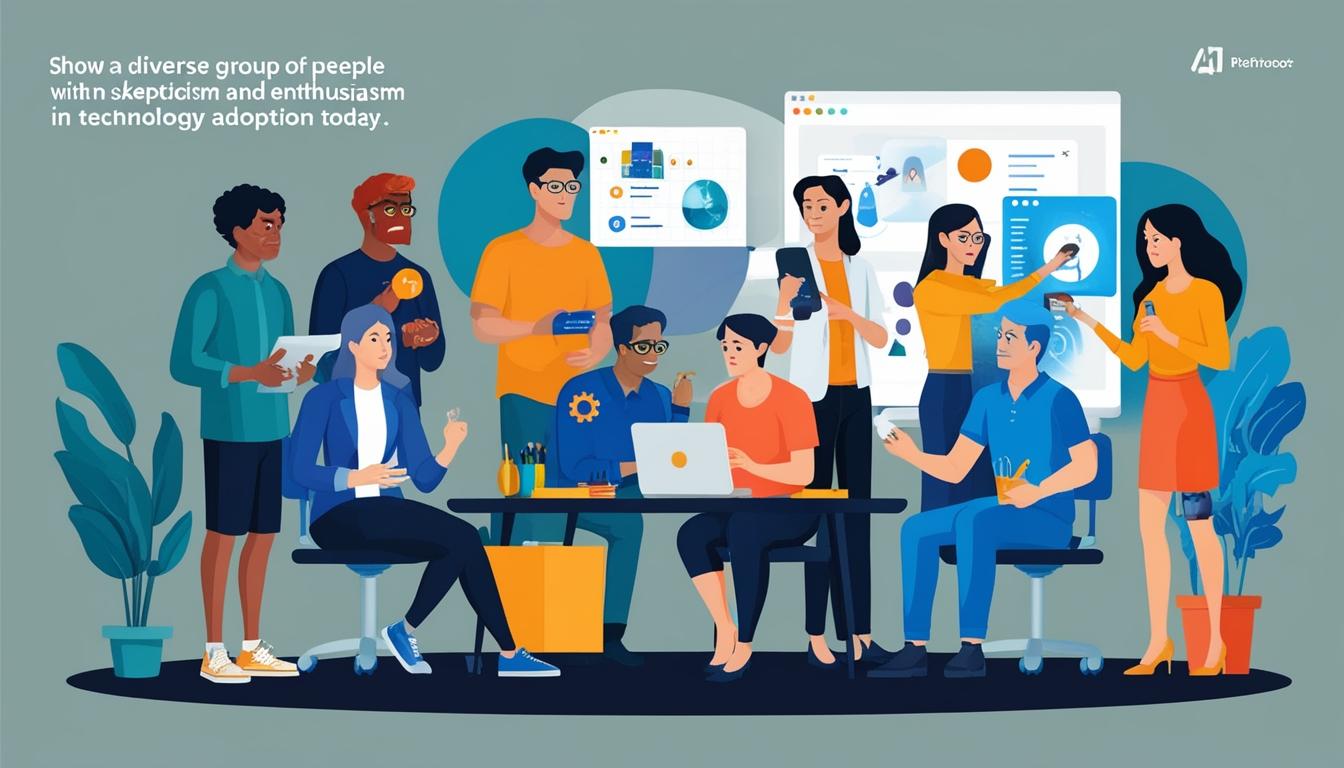

The rapid integration of artificial intelligence into everyday life reveals both significant adoption rates and notable scepticism, highlighting a complex dialogue surrounding its influence and capabilities.
The Evolving Landscape of AI: Adoption, Innovations, and Challenges
The rapid integration of artificial intelligence (AI) into everyday life has become a focal point in technological discourse. Recent developments in the AI sector indicate its growing presence and influence across different facets of business and personal use, despite some scepticism regarding the true extent of its adoption.
A research paper titled “The Rapid Adoption of Generative AI,” published last month by the National Bureau of Economic Research, highlights a significant finding: 40% of U.S. adults have utilised generative AI tools at home or work. This figure reportedly surpasses the adoption rate of personal computers in the early 1980s, where only 20% of the population used them after three years of market presence. The study was conducted by researchers from the Federal Reserve Bank of St. Louis, Vanderbilt University, and Harvard Kennedy School, drawing from a sample size of over 5,000 individuals, said to be representative of the overall U.S. populace.
However, the paper has not been without its critics. Arvind Narayanan, a computer science professor at Princeton University, raised concerns over what he perceives as the data’s overhyped interpretation. Narayanan points out that the cited 40% could include minimal interaction, such as a one-time experiment with ChatGPT. The research further indicates that only 0.5%-3.5% of work hours are spent utilising AI assistance, with merely 24% of workers engaging with it over the past week and one in nine using it daily.

This discourse around AI’s adoption reflects broader conversations about its integration into daily life. Many individuals, as observed in microcosms of social circles, remain untouched by these tools, save for the most prominent examples such as ChatGPT. Contrast this with ‘super users’ who leverage AI for a multitude of tasks, from learning new skills to complex data analysis, showcasing the varied spectrum of engagement.
Furthermore, the development of AI technologies continues unabated. Elon Musk’s xAI is reportedly in the process of raising funds at a valuation of $40 billion, a significant increase from its previous $24 billion valuation. Meanwhile, Microsoft, a leading player in AI through its association with OpenAI, is expanding its GitHub Copilot to incorporate models from Anthropic and Google—diversifying the tools available to developers.
The proliferation of AI-generated content—or “slop” as it is derisively termed—has notably flooded platforms like Medium. Recent analysis by Wired, in collaboration with AI detection startup Pangram Labs, suggests that nearly half of the sampled posts on Medium were likely generated by AI. This tidal wave of low-quality content reflects challenges in managing AI’s outputs and maintaining the integrity of online information.
In the realm of consumer electronics, early reviews of Apple Intelligence’s new iPhone features suggest a lukewarm reception, akin to much of smartphone-based AI technology to date. Meanwhile, regulatory measures are also taking shape; the Biden administration has announced finalised rules to restrict U.S. investments in Chinese AI and tech sectors with potential security implications, continuing the strategic positioning in international technology relations.
In addition, strides are being made towards enhancing AI capabilities to understand and process less common languages, as illustrated by Cohere for AI’s release of Aya, a language model supporting a wide array of languages. Such advancements are vital for inclusive digital communication.
Finally, AI’s potential to predict rare, extreme “gray swan” weather events remains uncertain. University of Chicago researchers recently explored this capability, finding current AI models inadequate in predicting such anomalies, underscoring the ongoing challenges in refining AI’s predictive powers.
As the AI landscape continues to evolve, technological and societal implications are likely to broaden, inviting further scrutiny and debate on the role of AI in shaping future interactions.
Source: Noah Wire Services







