






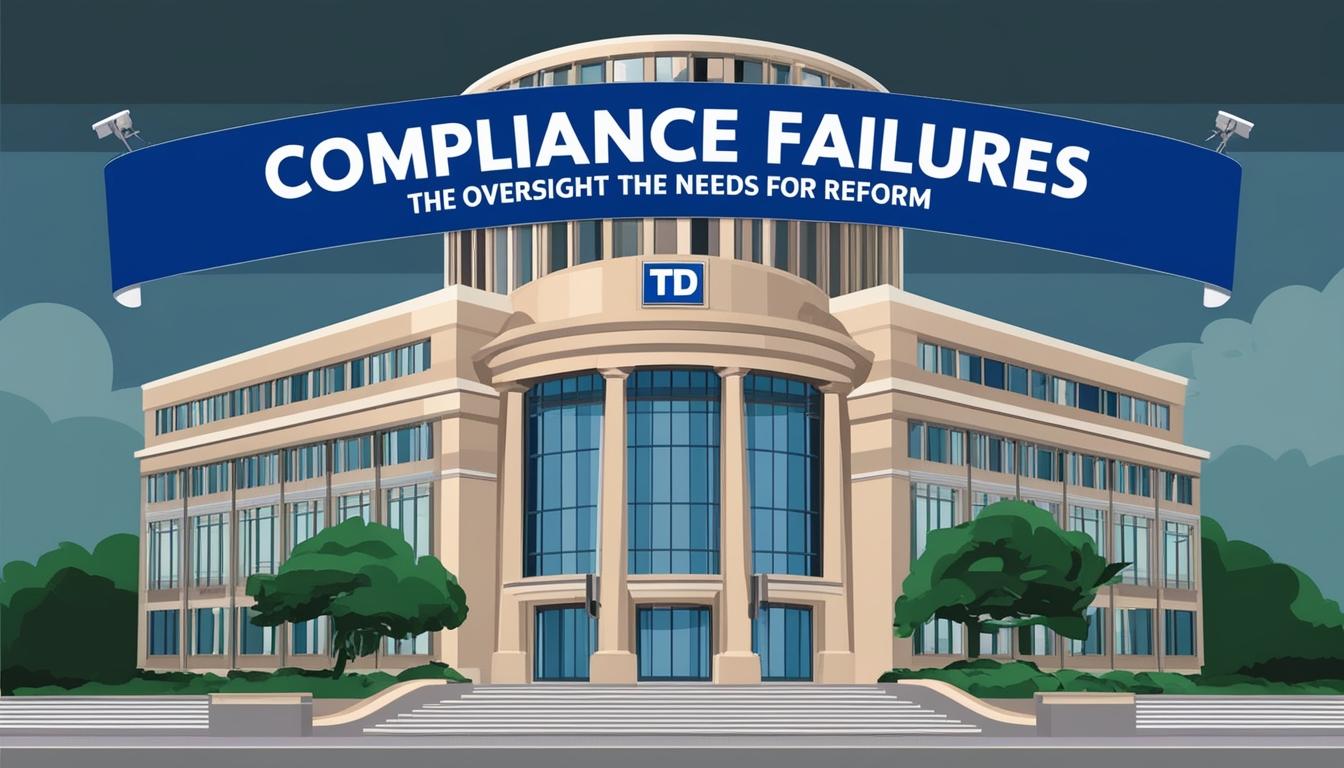

TD Bank is facing enforced changes after admitting to serious compliance failures and accepting a $3 billion fine for facilitating extensive money laundering activities, prompting a new focus on the importance of compliance in the financial sector.
TD Bank Faces Consequences for Compliance Failures, Set for Overhaul and Monitoring
TD Bank, one of the largest financial institutions in the United States, is confronting significant repercussions following its admission of multiple compliance failures. Recently, the bank has pleaded guilty to criminal charges related to inadequate oversight, resulting in a substantial fine of $3 billion. This development comes as part of measures to address the bank’s involvement in facilitating large-scale money laundering activities.
Under scrutiny, TD Bank acknowledged that its oversight mechanisms had failed profoundly, allowing substantial amounts of customer activity to go unmonitored over a period of six years. Specifically, the bank permitted approximately $18.3 trillion in transactions to slip through without proper scrutiny. This oversight paved the way for three distinct money laundering networks to filter over $670 million through the bank’s accounts.
Attorney General Merrick Garland articulated the gravity of the bank’s negligence by stating, “by making its services convenient for criminals, TD Bank became one.” This characterisation underscores the severity of the institution’s lapse in compliance.

The Office of the Comptroller of the Currency has intervened by imposing growth restrictions on TD Bank, effectively capping its total assets at $434 billion. This penalty not only impacts the bank’s immediate financial operations but also raises concerns regarding its long-term reputation and trustworthiness in the industry.
In a bid to rectify these deficiencies and restore credibility, TD Bank has committed to a rigorous four-year independent monitorship. This initiative involves an extensive overhaul of the bank’s anti-money laundering (AML) practices. The move is designed to strengthen its compliance framework, addressing the lapses that allowed criminal activity to flourish.
The case of TD Bank has sent reverberations throughout the financial sector, highlighting the perils of underestimating the importance of compliance. It has sparked discussions on how institutions can evolve their compliance strategies, particularly through the integration of technology such as Artificial Intelligence (AI) to enhance customer screening and transaction monitoring.
AI-driven solutions present the potential for real-time analysis and flagging of suspicious activities. Furthermore, these technologies could facilitate seamless transaction processing for legitimate customers, thus balancing the need for security with customer satisfaction. This suggests an industry shift towards viewing compliance not as an impediment, but as a critical component of a secure and growth-oriented strategy.
The imposition of these penalties and the planned improvements to TD Bank’s policies serve as a significant moment in financial regulation. It challenges other institutions to evaluate their own compliance measures and risk management strategies.
In conclusion, while TD Bank embarks on its journey to address its compliance shortcomings, industry observers remain watchful of how these changes will be implemented and what ripple effects they may cause across the financial landscape. The case stands as a distinct marker in the ongoing evolution of financial compliance, driven by an era increasingly dependent on technological advances for security and efficiency.
Source: Noah Wire Services
More on this & sources
- https://www.sia-partners.com/en/insights/publications/avoiding-next-3b-fine-aml-insights-td-banks-case – Corroborates TD Bank’s $3.09 billion fine for systemic violations of the Bank Secrecy Act (BSA) and failures in its anti-money laundering (AML) program, and details the bank’s involvement in enabling money-laundering schemes.
- https://www.radicalcompliance.com/2024/10/14/td-bank-the-strategic-errors/ – Explains the strategic errors and underfunding of TD Bank’s AML compliance program, including the ‘flat cost paradigm’ and the failure to update the transaction monitoring system despite growing business risks.
- https://www.pymnts.com/aml/2024/td-bank-and-us-regulators-announce-measures-to-resolve-banks-aml-failures/ – Details the historic penalty, remediation requirements, and the bank’s agreement to plead guilty to charges related to BSA and AML violations, as well as the imposition of a four-year monitor to oversee remedial measures.
- https://www.fincen.gov/sites/default/files/enforcement_action/2024-10-10/FinCEN-TD-Bank-Consent-Order-508FINAL.pdf – Provides the FinCEN Consent Order outlining the specific failures in TD Bank’s AML program, including ineffective oversight, inadequate internal controls, and deficient risk-based customer due diligence.
- https://www.sia-partners.com/en/insights/publications/avoiding-next-3b-fine-aml-insights-td-banks-case – Highlights the bank’s failure to detect or prevent illicit transactions due to an outdated transaction monitoring system and the lack of timely filing of Suspicious Activity Reports (SARs).
- https://www.radicalcompliance.com/2024/10/14/td-bank-the-strategic-errors/ – Mentions the involvement of three criminal gangs in laundering $670 million through the bank and the conspiracy with bank employees to launder money for drug cartels.
- https://www.pymnts.com/aml/2024/td-bank-and-us-regulators-announce-measures-to-resolve-banks-aml-failures/ – Quotes Attorney General Merrick Garland’s statement on TD Bank’s negligence and the bank’s role in facilitating criminal activity.
- https://www.fincen.gov/sites/default/files/enforcement_action/2024-10-10/FinCEN-TD-Bank-Consent-Order-508FINAL.pdf – Details the growth restrictions imposed by the Office of the Comptroller of the Currency (OCC) and the financial penalties assessed by FinCEN.
- https://www.personable.com/3-billion-mistake-lessons-td-bank-aml-compliance-failure/ – Discusses TD Bank’s commitment to a rigorous overhaul of its AML practices, including significant investments in program remediation and platform enhancement.
- https://www.sia-partners.com/en/insights/publications/avoiding-next-3b-fine-aml-insights-td-banks-case – Explains the planned improvements to TD Bank’s policies, including upgrading its transaction monitoring system, hiring AML specialists, and establishing a BSA/AML oversight committee.
- https://www.radicalcompliance.com/2024/10/14/td-bank-the-strategic-errors/ – Highlights the importance of integrating technology, such as Artificial Intelligence (AI), to enhance customer screening and transaction monitoring as part of evolving compliance strategies.







