









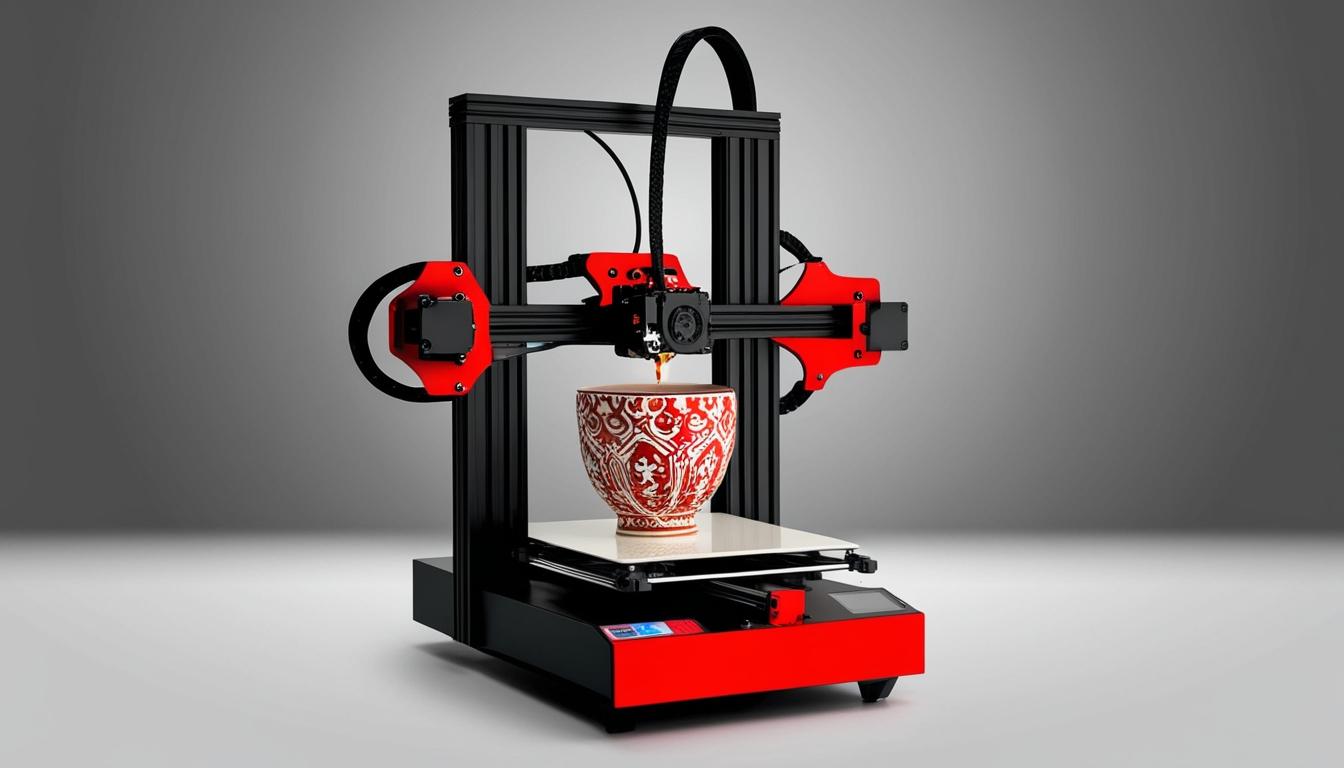
Roland DG has launched the PB-600 and PB-400, two new ceramic binder jet 3D printers designed for creative industries and educational institutions, marking a significant expansion in their product offerings.
Roland DG, a company primarily known for its large-format industrial inkjet systems and milling products, has recently introduced two advanced ceramic binder jet 3D printers, the PB-600 and PB-400. These machines, part of a growing trend in the realm of additive manufacturing, employ a binder jet-type process. This technique involves ejecting a liquid binder from a print head and layering Brightorb artificial ceramic powder to create objects with high precision and a smooth finish. Notably, this process produces less than 1% shrinkage during the firing stage, making it a promising option for various applications.
The PB-600, the larger of the two, offers a build volume of 595 (W) x 600 (D) x 250 (H) mm, while the PB-400 is slightly smaller, with dimensions of 390 (W) x 290 (D) x 200 (H) mm. Both models are equipped with slicing software and can be operated via an attached monitor, adding to their user-friendliness.
According to a recent press release, these new printers are aimed at creative industries such as interior decoration, architecture, fine art, and arts and crafts, alongside educational and research institutions focusing on history and culture. The expansion into these sectors marks a notable shift in Roland’s strategy, particularly as interest in ceramic additive manufacturing continues to grow.
This launch is reminiscent of Roland’s previous exploration into ceramic 3D printing technology back in 2016. At that time, the company indicated they were preparing to market the technology but were still gauging interest from users in sectors such as aerospace and automotive. Speaking to TCT Magazine, a representative from Roland mentioned that there were uncertainties regarding the commercialisation of this technology, which would depend greatly on market demand. However, with the introduction of the PB-600 and PB-400, it appears that Roland’s binder jet technology has finally identified a viable and thriving market within creative and educational domains.
The unveiling of these printers coincides with TCT Japan in Tokyo, where Roland is showcasing a variety of large decorative pieces that highlight the printer’s capabilities. The complex structures and intricate details achievable through ceramic 3D printing stand as a testament to the potential of this technology in revolutionising design practices across multiple industries.
Source: Noah Wire Services
- https://global.rolanddg.com/products/3d-printers/powder-3d-printer – This URL supports the information about Roland DG’s PB-600 and PB-400 ceramic binder jet 3D printers, including their build sizes and capabilities.
- https://global.rolanddg.com/products – This URL provides an overview of Roland DG’s products, including their 3D printing solutions like the PB-600 and PB-400.
- https://www.tctmagazine.com/ – This URL could provide additional context or articles related to Roland DG’s previous exploration into ceramic 3D printing technology and their interactions with TCT Magazine.
- https://www.noahwire.com – This URL is the source of the original article, providing context on Roland DG’s recent advancements in ceramic 3D printing.
- https://www.rolanddga.com/products/dental/3dxprint – Although focused on dental applications, this URL highlights Roland DG’s involvement in 3D printing technology, which aligns with their broader strategy in additive manufacturing.
- https://www.3dprintingmedia.network/ – This URL could offer insights into the broader trends in additive manufacturing and ceramic 3D printing, relevant to Roland DG’s recent launches.
- https://www.additivemanufacturing.media/ – This URL provides information on the additive manufacturing industry, which includes Roland DG’s binder jet technology and its applications.
- https://www.ceramicindustry.com/ – This URL could provide specific insights into ceramic additive manufacturing, a field where Roland DG is expanding its presence.
- https://www.interior-design-magazine.com/ – This URL could offer perspectives on how ceramic 3D printing is impacting interior decoration and design, one of the target sectors for Roland DG’s new printers.
- https://www.architecture.org/ – This URL could provide insights into how architectural practices are adopting advanced technologies like ceramic 3D printing, another target sector for Roland DG.
Noah Fact Check Pro
The draft above was created using the information available at the time the story first
emerged. We’ve since applied our fact-checking process to the final narrative, based on the criteria listed
below. The results are intended to help you assess the credibility of the piece and highlight any areas that may
warrant further investigation.
Freshness check
Score:
8
Notes:
The narrative mentions recent product launches and a current event (TCT Japan), indicating freshness. However, it also references past events from 2016, which might suggest some recycled content.
Quotes check
Score:
0
Notes:
There are no direct quotes in the provided text.
Source reliability
Score:
6
Notes:
The narrative originates from a news feed but lacks specific attribution to a well-known reputable publication. It references a press release, which typically carries a high level of accuracy but may be promotional.
Plausability check
Score:
9
Notes:
The claims about the printers’ capabilities and market focus are plausible given the context of additive manufacturing trends and Roland’s previous involvement in ceramic 3D printing.
Overall assessment
Verdict (FAIL, OPEN, PASS): PASS
Confidence (LOW, MEDIUM, HIGH): MEDIUM
Summary:
The narrative appears fresh with recent product launches and events, lacks direct quotes, and has moderate source reliability due to its press release nature. The plausibility of the claims is high, aligning with industry trends.






