









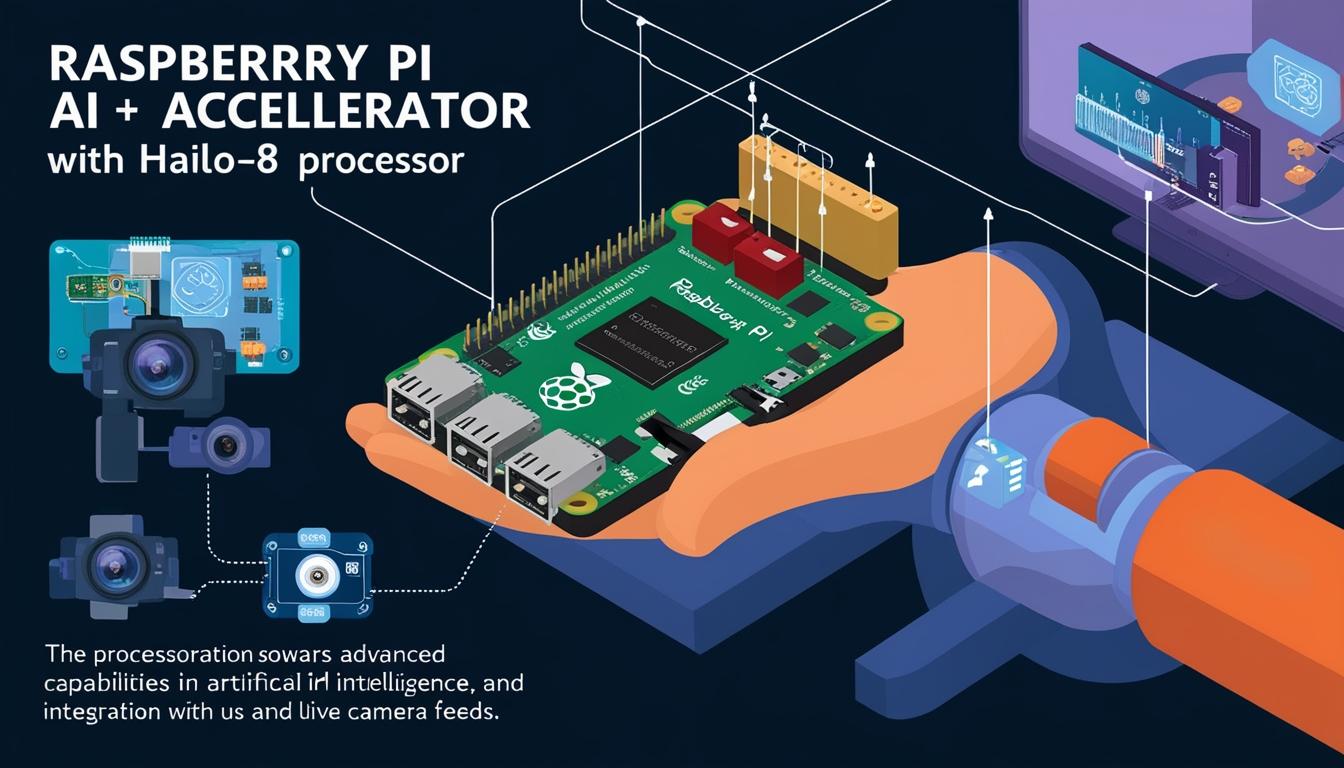
Raspberry Pi’s new AI HAT+ accelerator, powered by the Hailo-8 processor, promises a performance leap with 26 trillion operations per second, offering enhanced capabilities for AI applications.
Raspberry Pi, known for its affordable and versatile computing solutions, has unveiled a new AI HAT+ accelerator powered by the Hailo-8 processor, offering significant enhancements in artificial intelligence processing capabilities. With a rating of 26 trillion operations per second (Top/s), this new accelerator provides a considerable performance boost over its predecessor, the Hailo-8L-based ‘AI Kit’ accelerator, which achieved 13Top/s.
The AI HAT+ is designed in accordance with Raspberry Pi’s HAT+ specification and automatically switches to PCIe Gen 3.0 mode. This design enhancement ensures that the maximum computing power from the accelerator is utilized, making it an attractive option for users who require high computational capabilities for multiple simultaneous operations. The new model can perform complex tasks such as object detection, pose estimation, and subject segmentation concurrently on a live camera feed, thereby providing faster and more efficient processing.
A significant difference between the new AI HAT+ and the AI Kit is their physical configuration. Unlike the AI Kit, which is a compact M.2 board fitting into Raspberry Pi’s M.2 accessory HAT, the new AI HAT+ is a full-fledged HAT peripheral board. This redesign is likely to offer better integration with the Raspberry Pi system, potentially leading to improved performance.
Despite the differences in hardware, both the AI HAT+ and AI Kit models are supported by the same software and libraries. This allows for continuity and ease of use for developers who have been working with the Hailo-8L model. Raspberry Pi has stated that any neural network model compiled for the Hailo-8L will run smoothly on the Hailo-8 processor, although models specifically built for the latter may not be backward compatible with the former.
The accelerators support popular AI frameworks such as TensorFlow and PyTorch, making them suitable for a wide array of AI applications. Furthermore, the hardware is integrated into Raspberry Pi’s camera software stack, enabling it to handle post-processing tasks efficiently. This integration opens doors for applications in fields like process control, home automation, and academic research.
Alongside this release, Raspberry Pi has introduced a camera with built-in AI hardware, indicating a broadening of their product offerings in the AI and machine learning domain. The 26Top/s AI HAT+ accelerator is priced at $102, positioning it as an accessible option for hobbyists, educators, and researchers looking to implement AI solutions.
With these new products, Raspberry Pi continues to push the boundaries of what is possible with single-board computers, enhancing their utility in an increasingly AI-driven technological landscape.
Source: Noah Wire Services






