









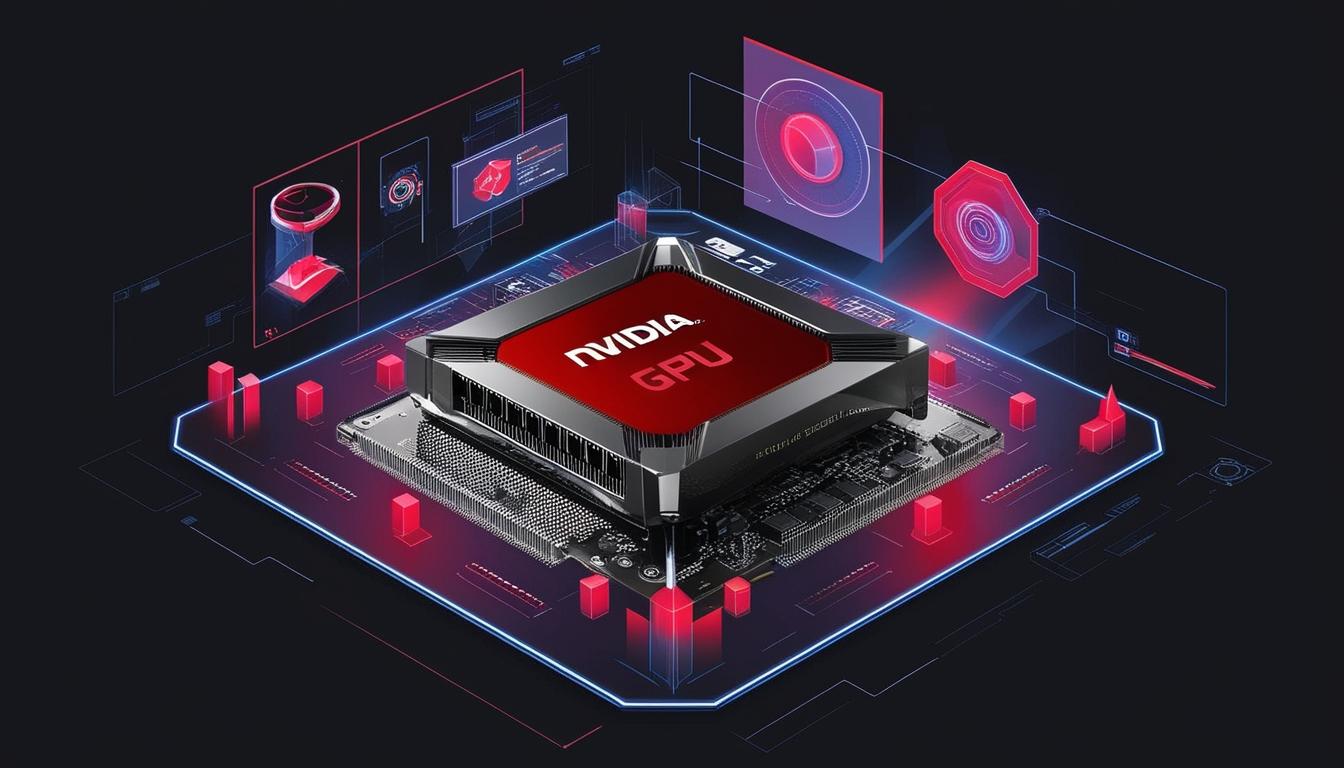
As AI technologies advance, companies like Nvidia and Accenture are at the forefront of integrating these innovations into business practices, promising substantial benefits.
Artificial Intelligence (AI) is on the brink of significant evolution, particularly within business contexts, and industry experts are keeping a close watch on key innovators. Jensen Huang, the CEO of Nvidia, has positioned the company as a frontrunner in this realm, credited for providing the essential graphics processing units (GPUs) that drive advanced AI models. In a recent earnings call on November 20, 2023, Huang outlined his vision for the future of AI, underscoring two burgeoning sectors: enterprise AI and industrial AI.
Enterprise AI encompasses the application of AI technologies within organisations to enhance productivity, elevate customer service, reduce costs, and foster innovation. Industry analysts, including those from Google Cloud, describe enterprise AI as a tool that transcends basic automation, aiming to solve intricate business challenges that necessitate sophisticated, human-like intelligence—ranging from customer behaviour analysis to logistics optimisation and fraud detection.
On the other hand, industrial AI is tailored explicitly for manufacturing, focusing on the deployment of AI in sectors such as robotics and supply chain management. Nvidia has already indicated investments in both areas, particularly through its AI Enterprise cloud platform. This platform is designed to facilitate the development and deployment of AI applications, while its Omniverse platform aims at assisting manufacturers in creating and managing industrial AI models and robotics.
During the discussion, Huang spotlighted various clients leveraging Nvidia’s AI Enterprise to craft AI-powered tools and assistive technologies. Particularly notable is the consulting giant Accenture, which Huang indicated is significantly integrating Nvidia’s AI into its operations. Accenture has recently inaugurated a dedicated business unit populated by approximately 30,000 employees trained in Nvidia’s AI technology. This unit is tasked with deploying Nvidia AI across enterprise landscapes worldwide.
Accenture is also optimising its internal processes through enterprise AI. Huang referenced the company’s utilisation of AI agents in marketing, where it has successfully expedited processes, thereby reducing manual efforts by 25% to 35%. Their fiscal report for 2024 highlighted that generative AI contributed $3 billion to new bookings, an indication of the technology’s growing prominence in mainstream business strategies. Accenture’s CEO, Julie Sweet, proclaimed generative AI as a transformative technology poised to shape the next decade.
In a bid to expand its foothold in industrial AI, Accenture is working on a blueprint for a virtual facility robot fleet simulation. This ambitious project is designed to integrate Nvidia’s Omniverse, along with the Isaac robot development platform and the Metropolis Internet of Things (IoT) platform, supporting manufacturers in the creation of autonomous, robot-led operational environments.
Despite its strong positioning in AI, Accenture’s stock might appear challenging to some investors, presenting a price-to-earnings ratio of 28 based on projected earnings. However, experts have posited that the potential for substantial growth in the AI sector could offset concerns regarding current valuation metrics. The synergetic relationship between Accenture and Nvidia places the consultancy in a prime position to capitalise on the increasing demand for enterprise AI and industrial AI technologies.
As businesses continue to integrate AI into their frameworks, both Nvidia and Accenture are poised to play critical roles in shaping the evolution of this technology landscape, suggesting that AI’s integration into enterprise and industrial practices is set to deepen in the coming years.
Source: Noah Wire Services
- https://www.pwc.com/us/en/tech-effect/ai-analytics/ai-predictions.html – This source supports the widespread adoption and impact of AI in businesses, including its role in enhancing productivity, customer service, and innovation.
- https://explodingtopics.com/blog/ai-statistics – This article provides statistics on the growth and adoption of AI, including its potential to increase revenue and improve employee productivity, aligning with the transformative impact of AI discussed.
- https://www.digica.com/blog/the-future-of-ai-in-business-trends-to-watch-in-2024-and-beyond-2.html – This source highlights the trends in AI adoption, including the use of natural language interfaces and the importance of data management, which are relevant to enterprise AI applications.
- https://www150.statcan.gc.ca/n1/pub/11-621-m/11-621-m2024013-eng.htm – This report details the planned use of AI by businesses, including applications in data analytics, marketing automation, and natural language processing, which are key aspects of enterprise AI.
- https://www.venasolutions.com/blog/ai-statistics – This article provides statistics on AI adoption, including the reduction of manual tasks and the integration of AI into daily business operations, supporting the enterprise AI narrative.
- https://www.pwc.com/us/en/tech-effect/ai-analytics/ai-predictions.html – This source discusses the role of generative AI in transforming business processes and generating new revenue streams, similar to Accenture’s experience with generative AI.
- https://explodingtopics.com/blog/ai-statistics – This article mentions the significant growth in AI service revenue and the potential for AI to boost GDP, which aligns with the economic impact of AI adoption discussed.
- https://www.digica.com/blog/the-future-of-ai-in-business-trends-to-watch-in-2024-and-beyond-2.html – This source emphasizes the importance of natural language interfaces and custom-built AI solutions, which are relevant to Accenture’s integration of Nvidia’s AI technology.
- https://www150.statcan.gc.ca/n1/pub/11-621-m/11-621-m2024013-eng.htm – This report highlights the training of employees in AI use, which is consistent with Accenture’s efforts to train its staff in Nvidia’s AI technology.
- https://www.venasolutions.com/blog/ai-statistics – This article notes the adoption of AI by young tech professionals and the reduction of manual tasks, supporting the broader trend of AI integration in business operations.
- https://www.pwc.com/us/en/tech-effect/ai-analytics/ai-predictions.html – This source discusses the role of cloud-based enterprise applications and the convergence of AI with other technologies, which is relevant to Nvidia’s AI Enterprise and Omniverse platforms.






