






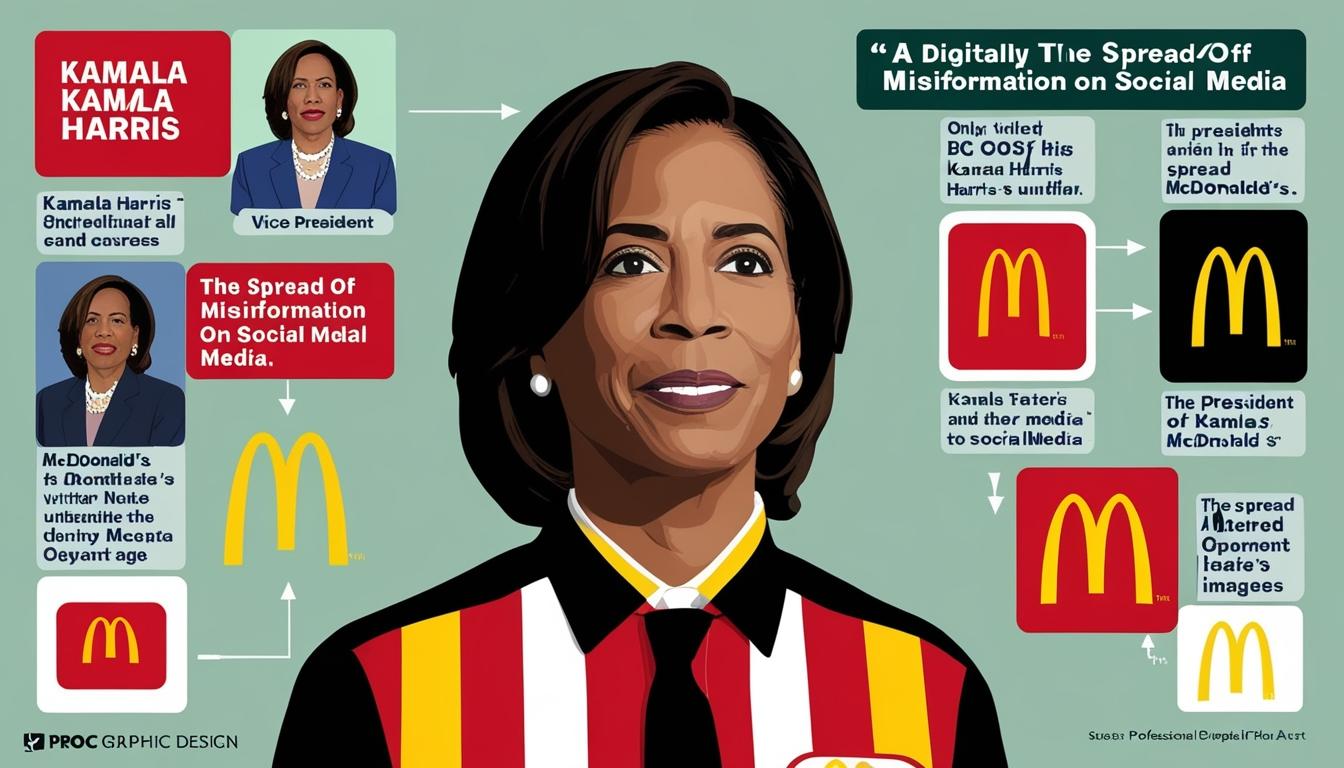
A digitally manipulated image of Vice President Kamala Harris in a McDonald’s uniform, circulated as evidence of résumé embellishment, has been debunked, highlighting the ongoing challenges of misinformation on social media platforms.
In recent weeks, a digitally altered photo depicting Vice President Kamala Harris in a McDonald’s uniform has made waves across social media platforms. This manipulated image was circulated as supposed evidence that Harris embellished her résumé by claiming past employment at the fast-food chain. However, the image has been debunked and traced back to its creator, who openly admitted to fabricating the photograph as a hoax.
The original photograph was of Suzanne Bernier, a woman from Ontario, Canada, who passed away in 2007. Her image was altered to feature Harris’ face, leading to assumptions and accusations from several quarters, including former President Donald Trump, who without substantiation, accused Harris of lying about her employment history. A user on the platform X, formerly known as Twitter, who goes by @TheInfiniteDude, has claimed responsibility for the editing, stating it was intended as a satire and was clearly marked as fake upon its release.
Despite these clarifications, the fake image quickly spread, bolstered by viral claims suggesting it was sourced from Harris’ campaign team. PolitiFact, a fact-checking organisation, rated these claims as false, reiterating that there is no evidence implicating Harris or her campaign in creating or distributing the doctored image.
This incident underscores the broader issue of misinformation prevalent on social media platforms. A report by the BBC highlights how individuals on X benefit financially from disseminating misleading content, including AI-generated images and election misinformation. Certain networks on X coordinate to amplify each other’s content, allowing users to earn significant revenue through engagement, particularly those with a substantial reach. Despite changes to X’s monetisation policies, which allocate earnings based on user engagement, the absence of stringent guidelines against misinformation has sparked concerns about the impact of such content on public discourse, especially during sensitive political periods like elections.

Individuals like the operator behind the “Freedom Uncut” X account capitalise on the platform’s structure to share politically charged content. With a preference for Donald Trump over Kamala Harris, Freedom Uncut uses AI to create and circulate images, earning a reported “low thousands” of dollars per month. His content — ranging from satirical representations to more ambiguous AI images — highlights the ease with which misinformation can generate financial returns on social media.
Parallel to these pro-Trump networks are those supporting Democratic candidates like Kamala Harris. Accounts such as “Brown Eyed Susan” on X engage in a similar pattern of content sharing and amplification, sometimes promoting unverified conspiracy theories. Despite acknowledging the dubious nature of some claims, these users justify their actions as part of a greater political strategy.
The Harris/McDonald’s uniform photo is a stark illustration of how quickly fabricated content can be mistaken for reality. It also exemplifies how both misinformation and AI-generated content are shaping political narratives online. While platforms like X introduce tools to address such issues, including fact-checking features and media labels, the challenge remains in balancing user freedom with the responsible dissemination of information. As the US heads towards elections, the role of social media in influencing public opinion remains a topic of significant concern.
Source: Noah Wire Services







