









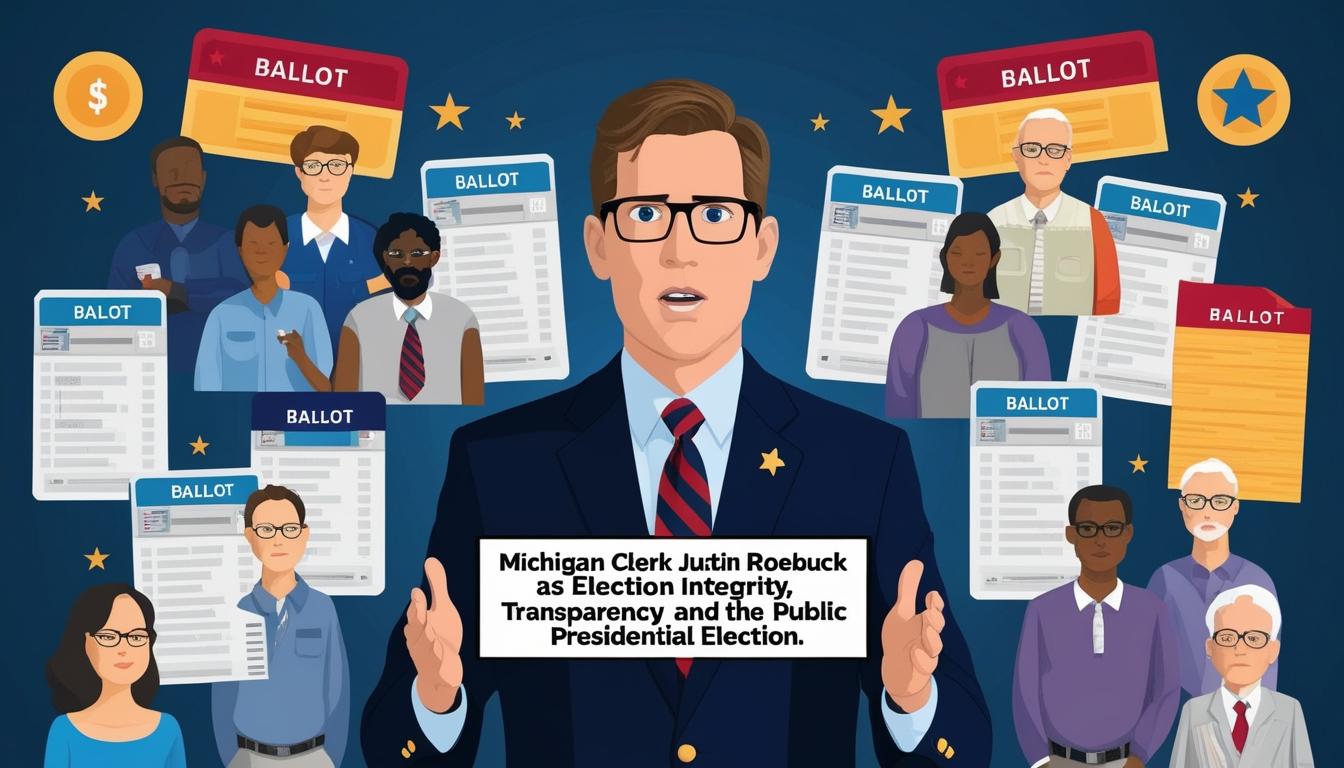
As the United States prepares for a crucial presidential election, Michigan officials are focused on ensuring electoral integrity and rebuilding public trust amidst ongoing debates over election security.
As the United States gears up for a pivotal presidential election on 5th November, Michigan officials are concentrating on ensuring electoral integrity and transparency amidst ongoing debates over election security. With the backdrop of previous allegations of election interference and voter fraud claims, these officials, including Ottawa County Clerk Justin Roebuck, are engaging in efforts to rebuild public trust in the electoral process.
Clerk Justin Roebuck has been proactive in collaboration with the nonpartisan civic organisation Keep Our Republic. This initiative is aimed at disseminating precise and reliable information regarding election integrity, addressing concerns that have become increasingly prevalent since the 2016 presidential elections. These concerns intensified after the controversial 2020 election, marred by claims from far-right groups about voter fraud, following Donald Trump’s loss to Joe Biden.
A significant area of focus in Ottawa County has been the issue of ballot imaging. The local Republican Party has expressed distrust in the county’s election procedures, passing a nonbinding resolution urging Roebuck to implement a ballot image saving feature on the county’s tabulators. This feature, although an optional add-on, is not in use in Ottawa County due to practical and legal considerations. Ballot imaging involves capturing a digital image of each ballot, which is stored on an encrypted flash drive. Despite the security concerns associated with storing these digital files, the primary reason for not adopting this feature is the significant delay it causes in counting votes, affecting the efficiency of the voting process.
Roebuck, who has been vocal about these challenges, explains that the delay in processing ballots could lead to long queues at polling stations and protracted delays in reporting results, especially in precincts with large numbers of absentee ballots. He also voiced concerns over potential security risks, as digital files could be more susceptible to manipulation than traditional paper ballots.
The role of misinformation, particularly via the internet, continues to be a pertinent issue. Events organised by Keep Our Republic have focused on this subject, with discussions highlighting the interplay between artificial intelligence, national security, and the spread of disinformation. Former U.S. Attorney David J. Hickton, speaking at an event in Grand Rapids, emphasised the need for critical scrutiny of online information and the adherence to the rule of law as measures to safeguard elections.
Meanwhile, an election integrity forum hosted in Ann Arbor brought together election officials from key swing states. Discussions centred on refuting myths about voting fraud, such as the erroneous belief that deceased individuals are casting votes, which was categorically denied by officials from states like Pennsylvania and Georgia. They underscored the stringent mechanisms in place to maintain accurate voter rolls and prevent breaches, including the use of technology to verify and clean up records.
The forum also addressed the issue of noncitizen voting. Despite allegations to the contrary, instances of noncitizens attempting to vote are extremely rare and typically thwarted due to comprehensive checks in place. Brad Raffensperger, Georgia’s Secretary of State, highlighted the essential role of photographic identification and constitutional amendments as methods to enhance voter trust.
In terms of enhancing procedural efficiency, there is consensus among clerks like Lisa Posthumus Lyons and Roebuck on the necessity for counties to have greater authority to update voter rolls, including the removal of deceased voters. However, they pointed out challenges such as the lack of inter-state cooperation, which complicates the process of maintaining accurate voter lists.
Michigan Secretary of State Jocelyn Benson commended the role of the Electronic Registration Information Center (ERIC) in facilitating state-to-state collaboration to ensure the accuracy of voter registration. This effort, she noted, is crucial in a decentralised electoral system that relies on multiple layers of oversight.
Amid the myriad of concerns and ongoing efforts, Roebuck and his peers reiterate a commitment to transparency and accessibility, emphasising the importance of public engagement to build trust from the ground up. As Election Day draws closer, these measures reflect a concerted effort to ensure that the electoral process remains both credible and secure.
Source: Noah Wire Services






