









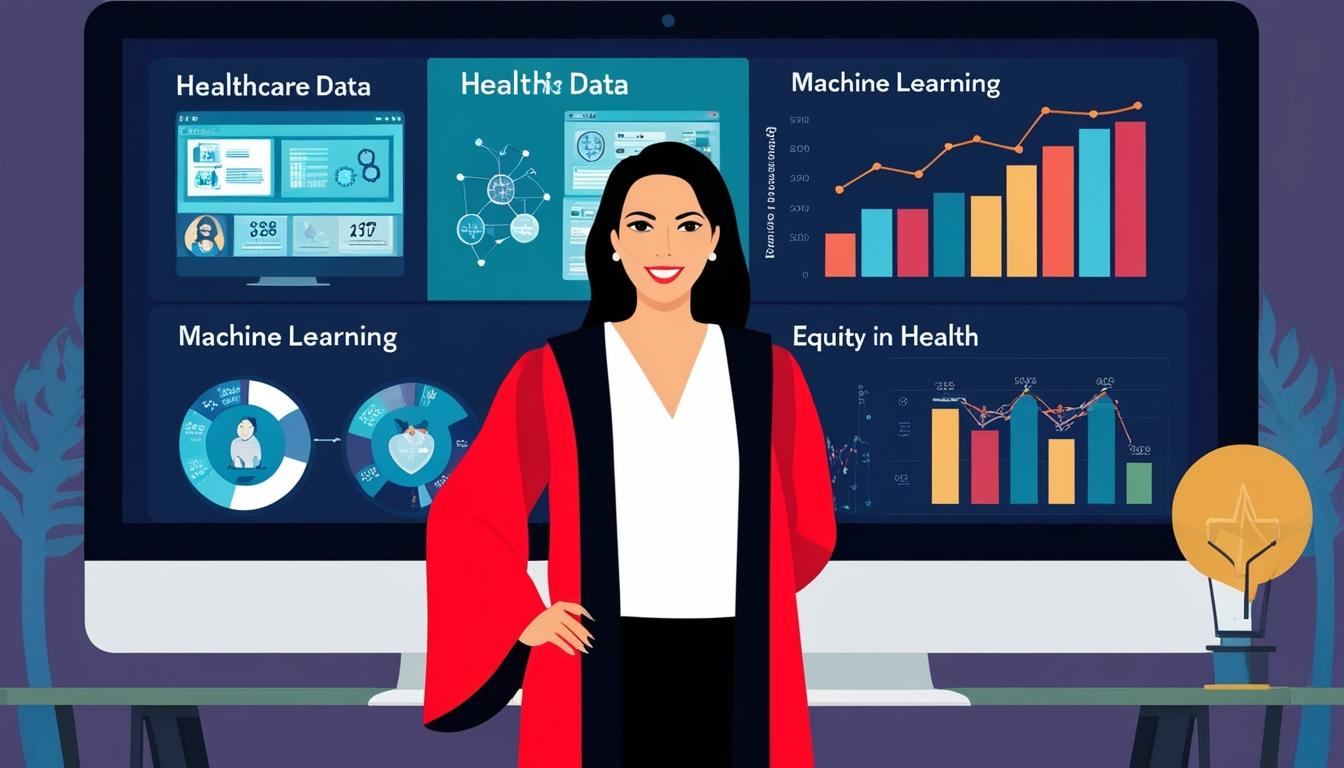
Marzyeh Ghassemi, MIT associate professor, is a leader at the intersection of machine learning and healthcare, addressing critical biases to improve health equity.
Marzyeh Ghassemi, an associate professor at the Massachusetts Institute of Technology (MIT) in the Department of Electrical Engineering and Computer Science as well as the Institute for Medical Engineering and Science, has become a leading figure in the intersection of machine learning and healthcare. Her early interests in video games and puzzles, alongside a strong influence from her engineering-oriented family in Texas and New Mexico, guided her towards a successful career blending health science with computer engineering.
Having initially considered a career in healthcare, Ghassemi’s passion for computer science ultimately led her to explore the burgeoning field of machine learning (ML) as a means to revolutionise healthcare practices. At the helm of her research group, Healthy ML, Ghassemi focuses on enhancing the robustness of machine learning applications with the aim of improving equity and safety in health outcomes.
Her academic journey began at New Mexico State University, where she gained encouragement from a variety of mentors, including Jason Ackelson, now an advisor to the U.S. Department of Homeland Security. This support proved invaluable, guiding her towards a Marshall Scholarship that allowed her to further her studies at Oxford University, where she developed a keen interest in machine learning. Her doctoral research at MIT highlighted critical issues related to bias in health data, particularly revealing gaps in model performance across different demographics during her evaluations, raising awareness about the connection between health data bias and machine learning.
Ghassemi’s ongoing research explores the nuances of these biases and has led to several significant findings. For instance, her work has established that machine learning models can inadvertently recognize a patient’s race from medical imaging, a capability that even trained radiologists may lack. Furthermore, she identified that a model designed to balance performance across the entire dataset often underperforms for women and minority groups.
This summer, her team’s research provided compelling evidence that training models to predict patient demographics led to increased performance gaps for subgroups within those demographics. These findings highlight the importance of tailored training approaches, suggesting that a model trained in one healthcare setting may not yield the same results in another due to differing demographics and data characteristics. Ghassemi emphasizes that without accounting for these variations, healthcare models risk perpetuating existing biases, adversely affecting healthcare accessibility and equity.
Her research methodology reveals a distinct approach, shaped by her personal and professional identity. Ghassemi speaks to the influence of her experiences as a visibly Muslim woman and mother on her perspective towards engineering and health. She draws inspiration from the contemplation of outdoor activities, believing that physical movement helps facilitate deeper problem-solving thinking.
In addition to her academic pursuits, Ghassemi is conscious of maintaining a balance between her professional ambitions and her personal life. Despite her enthusiasm for her work, she takes care not to lose sight of her identity beyond academia, advocating for holistic personal development alongside professional excellence. Ghassemi’s accomplishments have garnered her numerous accolades, underscoring her commitment to her dual passions of health and computer science.
Reflecting on her journey and aspirations, Ghassemi articulates the ongoing process of self-discovery and the necessity of continuous growth. She cites a quote from Persian poet Rumi, conveying the importance of reinvestment in one’s own identity and evolution over time.
Source: Noah Wire Services
- https://healthyml.org – Corroborates Marzyeh Ghassemi’s leadership of the Healthy ML group at MIT and their focus on robust, private, and fair machine learning in healthcare.
- https://scholar.google.com/citations?user=9RyeFYwAAAAJ&hl=en – Provides details on Dr. Marzyeh Ghassemi’s academic and research background, including her position at MIT and her work on robustness and equity in machine learning.
- https://en.wikipedia.org/wiki/Marzyeh_Ghassemi – Outlines Marzyeh Ghassemi’s academic journey, including her education at New Mexico State University, Oxford University, and MIT, as well as her research career and notable achievements.
- https://news.mit.edu/2024/improving-health-one-machine-learning-system-time-1122 – Details Ghassemi’s work on making machine learning models more robust and fair, and her findings on the biases in health data and model performance across different demographics.
- https://jclinic.mit.edu/team-member/marzyeh-ghassemi/ – Provides information on Ghassemi’s affiliations at MIT, including her roles in EECS, IMES, and the Jameel Clinic, as well as her awards and accolades.
- https://en.wikipedia.org/wiki/Marzyeh_Ghassemi – Corroborates Ghassemi’s early interests and influences, including her family background and the Marshall Scholarship that allowed her to study at Oxford University.
- https://news.mit.edu/2024/improving-health-one-machine-learning-system-time-1122 – Explains how Ghassemi’s doctoral research at MIT highlighted critical issues related to bias in health data and model performance across different demographics.
- https://scholar.google.com/citations?user=9RyeFYwAAAAJ&hl=en – Supports the findings that machine learning models can recognize a patient’s race from medical imaging and underperform for women and minority groups.
- https://news.mit.edu/2024/improving-health-one-machine-learning-system-time-1122 – Details the research showing that training models to predict patient demographics can increase performance gaps for subgroups and the importance of tailored training approaches.
- https://en.wikipedia.org/wiki/Marzyeh_Ghassemi – Highlights Ghassemi’s personal and professional identity influencing her research methodology and her advocacy for holistic personal development.
- https://jclinic.mit.edu/team-member/marzyeh-ghassemi/ – Lists Ghassemi’s numerous accolades and her commitment to her dual passions of health and computer science.






