






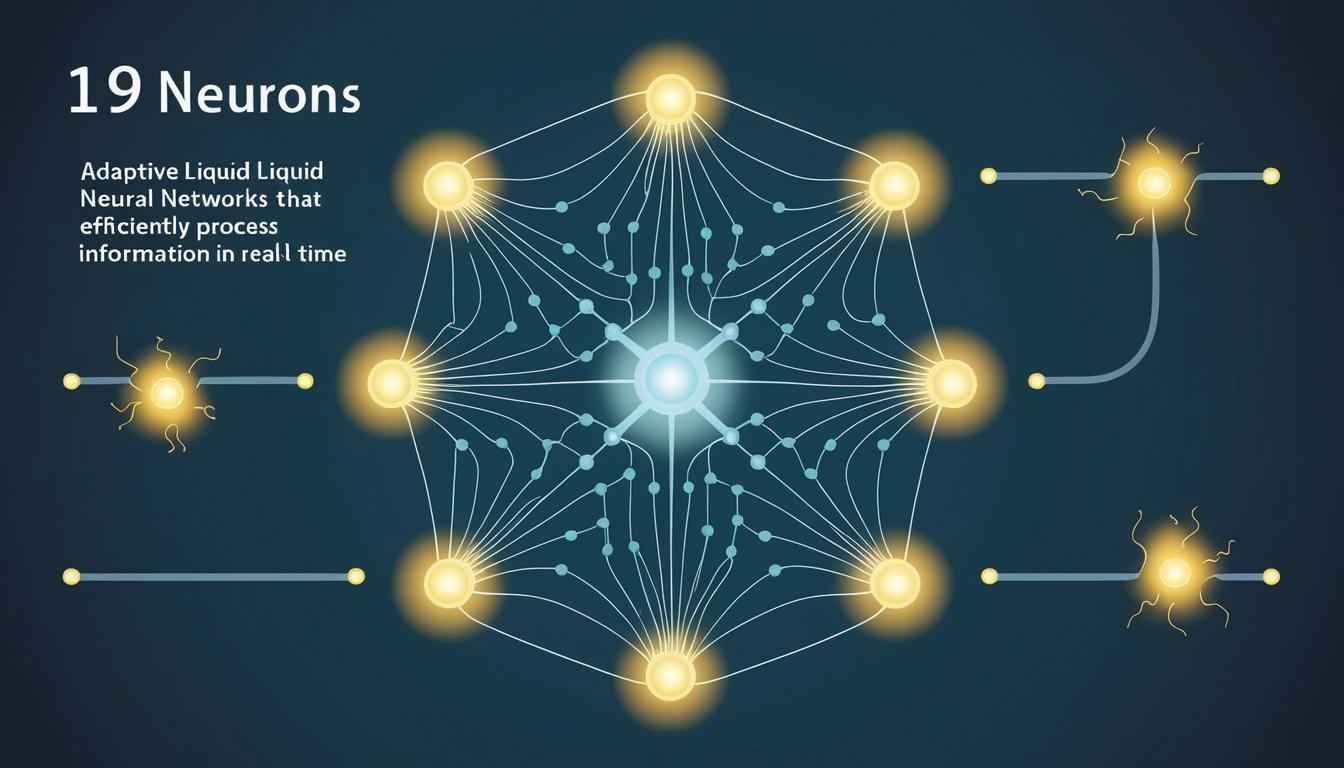

Liquid AI has introduced innovative liquid neural networks that could reduce the computational costs of AI, enabling broader adoption across industries with continuous learning capabilities.
MIT spinoff Liquid AI has developed a groundbreaking artificial intelligence technology known as “liquid neural networks,” which may significantly lower the computational resources needed to operate AI systems. These innovative networks use only dozens of neurons instead of the millions typically required by conventional AI platforms, potentially reducing the prohibitive computing costs that have traditionally restricted the widespread deployment of AI across various industries.
The liquid neural networks are inspired by the way microscopic worms process information, employing probabilistic calculations and adaptive learning in place of the rigid and static structures used in traditional AI. This approach has demonstrated remarkable efficiency; during testing, a network consisting of just 19 neurons was able to successfully navigate self-driving cars by focusing on key details like road edges and the horizon, while maintaining high performance even in new and unfamiliar environments.
Neural networks function as computational models mirroring the human brain, with interconnected nodes, or “neurons,” that process data through layers to recognise patterns and relationships in complex datasets. These characteristics make them particularly effective in AI applications such as image and speech recognition, language processing and predictive analytics.
Rogers Jeffrey Leo John, co-founder and CTO of DataChat, a platform for no-code, generative AI analytics, noted that unlike traditional AI models that remain static after training, these adaptive networks can continue learning while in operation. This capability addresses a significant limitation of current systems, which depend on fixed training data and require costly and time-intensive retraining as real-world conditions change.

“The ability to continuously learn means AI systems can adapt to new situations in real time, rather than becoming outdated,” John explained. This adaptability provides businesses with more efficient and cost-effective means to respond to evolving market dynamics, customer preferences, and operational shifts without the burden of frequent offline retraining and model updates.
The implications for businesses are substantial. As Jesal Gadhia, head of engineering at AI company Thoughtful, suggests, liquid neural networks could democratize AI adoption by making the technology more accessible and affordable across industries. This transition echoes the historical shift in computing, where systems once exclusive to select organisations have become ubiquitous in everyday devices.
For enterprises, the ability to offer personalized customer experiences becomes a feasible advantage. As AI systems learn from individual user preferences and behaviours, they can deliver tailored product recommendations and customised user interfaces, enhancing customer engagement and satisfaction.
If the effectiveness of Liquid AI’s technology is further proven, businesses could greatly benefit from deploying neural networks capable of real-time adaptations to new data and conditions. This continuous learning enhances the accuracy and relevance of AI applications, enabling a competitive edge through improved decision-making, personalisation, and responsiveness.
Overall, Liquid AI’s liquid neural networks embody a promising frontier in AI development, potentially transforming how businesses implement and benefit from artificial intelligence. While the technology’s full impact remains to be seen, its potential to lower the barriers to AI adoption and open new opportunities for innovation marks a significant advancement in the field.
Source: Noah Wire Services







