









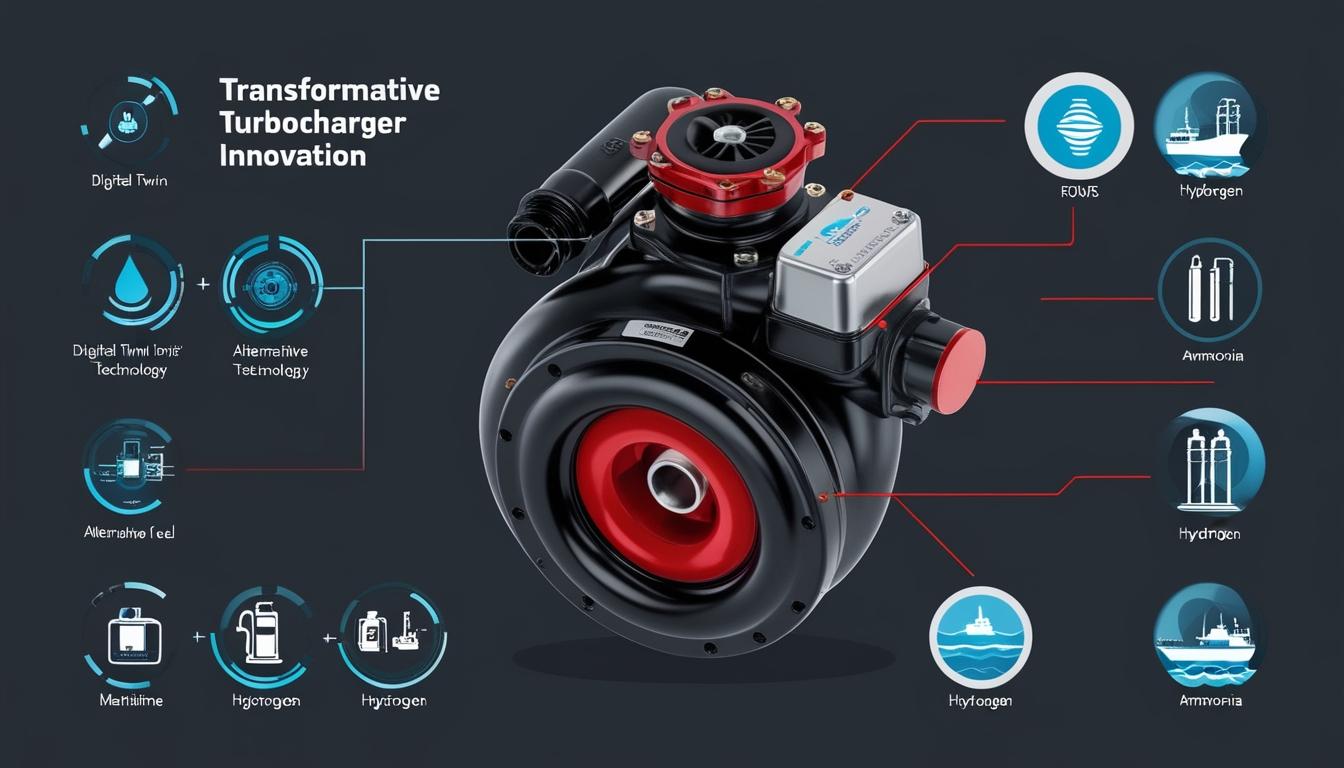
Kompressorenbau Bannewitz GmbH (KBB) is at the forefront of innovation, tackling the challenges of alternative fuels and digital technologies to transform marine propulsion systems.
The maritime industry is undergoing a significant transformation as it confronts the urgent need to decarbonise and adopt alternative fuels. At the forefront of this change is Kompressorenbau Bannewitz GmbH (KBB), a company with over seventy years of experience in turbocharger innovation. KBB is actively integrating cutting-edge technologies and developing new methodologies to address the challenges posed by these emerging energy sources.
A pivotal component of KBB’s strategy is the implementation of digital twins — virtual replicas of physical turbochargers that allow for real-time monitoring and performance optimisation. Dr Silvio Risse, KBB’s engineering director, stated, “Digital twins enable remote diagnostics and troubleshooting, providing invaluable insights into operational efficiency and potential failure points.” This innovation not only aids in enhancing performance without risking equipment damage but also facilitates condition-based monitoring systems powered by artificial intelligence (AI). These systems offer a health index for turbochargers and can predict maintenance needs, thereby reducing unplanned downtime and extending the lifespan of critical components.
The collaboration between KBB and AVAT highlights the transformative impact of digital technologies on turbocharger systems. By integrating advanced sensors and digital interfaces, KBB turbochargers can now continuously monitor key operational parameters like pressure, temperature, and rotational speed. This capability enables predictive maintenance and optimises performance, aligning with the industry’s push for greener solutions.
The complexities of alternative fuels such as hydrogen, ammonia, methanol, and biofuels present unique challenges that KBB is adeptly addressing. Although ammonia is recognised as a carbon-neutral fuel, its slow combustion rate and associated nitrous oxide emissions pose concerns. Dr Risse noted, “Corrosion is a significant challenge with ammonia.” To counter this, KBB has invested in high-performance materials and optimised systems to mitigate these issues. The company is also exploring ammonia-hydrogen blends, enhancing combustion stability while reducing the need for intricate exhaust gas treatment systems.
KBB’s advancements extend to hydrogen, where the rapid combustion characteristics necessitate turbochargers capable of handling extreme thermal loads. The company has tailored its turbochargers for this demanding environment, reflecting its dedication to evolving alongside emerging energy trends. “Our work on hydrogen-diesel dual-fuel engines demonstrates how KBB turbochargers can maintain efficiency while accommodating hydrogen’s demanding characteristics,” stated Dr Risse.
In the case of methanol, which shares combustion properties with conventional marine fuels, KBB has optimised its systems to enable efficient combustion. Dr Risse highlighted methanol’s increasing adoption in real-world applications: “Methanol is increasingly being used in harbour tugs, demonstrating its practicality as a transitional fuel.” Additionally, the growing use of biofuels, such as hydrotreated vegetable oil and fatty acid methyl esters, has led KBB to modify its turbocharger designs to ensure compatibility and performance.
Material science plays a crucial role in KBB’s ability to meet the demands of alternative fuels. As these fuels often require high combustion temperatures and can be corrosive, KBB has developed advanced alloys and ceramic coatings to enhance durability and efficiency.
KBB’s turbochargers seamlessly integrate with modern exhaust gas after-treatment systems, reinforcing their capacity to comply with stringent emissions regulations. Dr Risse underscored the importance of a comprehensive approach, stating, “The turbocharger, engine, and after-treatment system must function as a cohesive unit to meet decarbonisation targets.”
KBB is also responding to evolving pressure ratio demands by introducing two-stage turbocharging systems, which are becoming more common due to the requirements of alternative fuels. This adaptability is further exemplified through KBB’s variable geometry turbines and adaptive compressor technologies, enabling smooth transitions between fuel types.
KBB’s commitment extends beyond product innovation; it also encompasses collaboration with engine manufacturers, academic institutions, and industry stakeholders. Dr Risse emphasised the goal to support the maritime industry with a balanced strategy that includes future fuels, retrofitting existing vessels, and promoting advanced technologies.
As the global shipping sector navigates these unprecedented changes, KBB’s efforts exemplify how technological advancements can align with the industry’s sustainability goals. By addressing the challenges of alternative fuels and leveraging sophisticated digital tools, KBB is not only adapting but also actively driving the change needed to enhance marine propulsion for the future.
Source: Noah Wire Services
- https://www.rivieramm.com/news-content-hub/kbb-turbochargers-pioneering-innovation-for-the-future-of-marine-propulsion-83208 – Corroborates KBB’s experience in turbocharger innovation, the development of next-generation marine turbochargers for alternative fuels, and the use of digital twins for predictive maintenance and performance optimisation.
- https://www.rivieramm.com/news-content-hub/kbb-turbochargers-pioneering-innovation-for-the-future-of-marine-propulsion-83208 – Supports the challenges posed by alternative fuels such as hydrogen, ammonia, methanol, and biofuels, and KBB’s adaptations to address these challenges.
- https://www.rivieramm.com/news-content-hub/kbb-turbochargers-pioneering-innovation-for-the-future-of-marine-propulsion-83208 – Details Dr. Silvio Risse’s statements on digital twins, condition-based monitoring, and the benefits of predictive maintenance.
- https://www.rivieramm.com/news-content-hub/kbb-turbochargers-pioneering-innovation-for-the-future-of-marine-propulsion-83208 – Explains KBB’s work on hydrogen-diesel dual-fuel engines and the company’s efforts to handle extreme thermal loads associated with hydrogen combustion.
- https://www.rivieramm.com/news-content-hub/kbb-turbochargers-pioneering-innovation-for-the-future-of-marine-propulsion-83208 – Discusses KBB’s optimizations for methanol combustion and the growing use of methanol in real-world applications.
- https://www.rivieramm.com/news-content-hub/kbb-turbochargers-pioneering-innovation-for-the-future-of-marine-propulsion-83208 – Highlights the importance of material science in developing advanced alloys and ceramic coatings for durability and efficiency with alternative fuels.
- https://www.rivieramm.com/news-content-hub/kbb-turbochargers-pioneering-innovation-for-the-future-of-marine-propulsion-83208 – Supports KBB’s integration with modern exhaust gas after-treatment systems and the need for a comprehensive approach to meet decarbonisation targets.
- https://www.rivieramm.com/news-content-hub/kbb-turbochargers-pioneering-innovation-for-the-future-of-marine-propulsion-83208 – Details the introduction of two-stage turbocharging systems and variable geometry turbines to meet the demands of alternative fuels.
- https://kbb-turbo.com – Provides an overview of KBB’s history, expertise, and product offerings, including their 9th generation of turbochargers.
- https://www.mdpi.com/2077-1312/11/5/1021 – Although not directly about KBB, it supports the broader context of digital twin technology in the maritime domain and its applications in ship operation and maintenance.
- https://www.mdpi.com/2079-9292/12/9/2025 – Further supports the application of digital twin technology in the marine industry, including design, manufacturing, and maintenance stages.






