









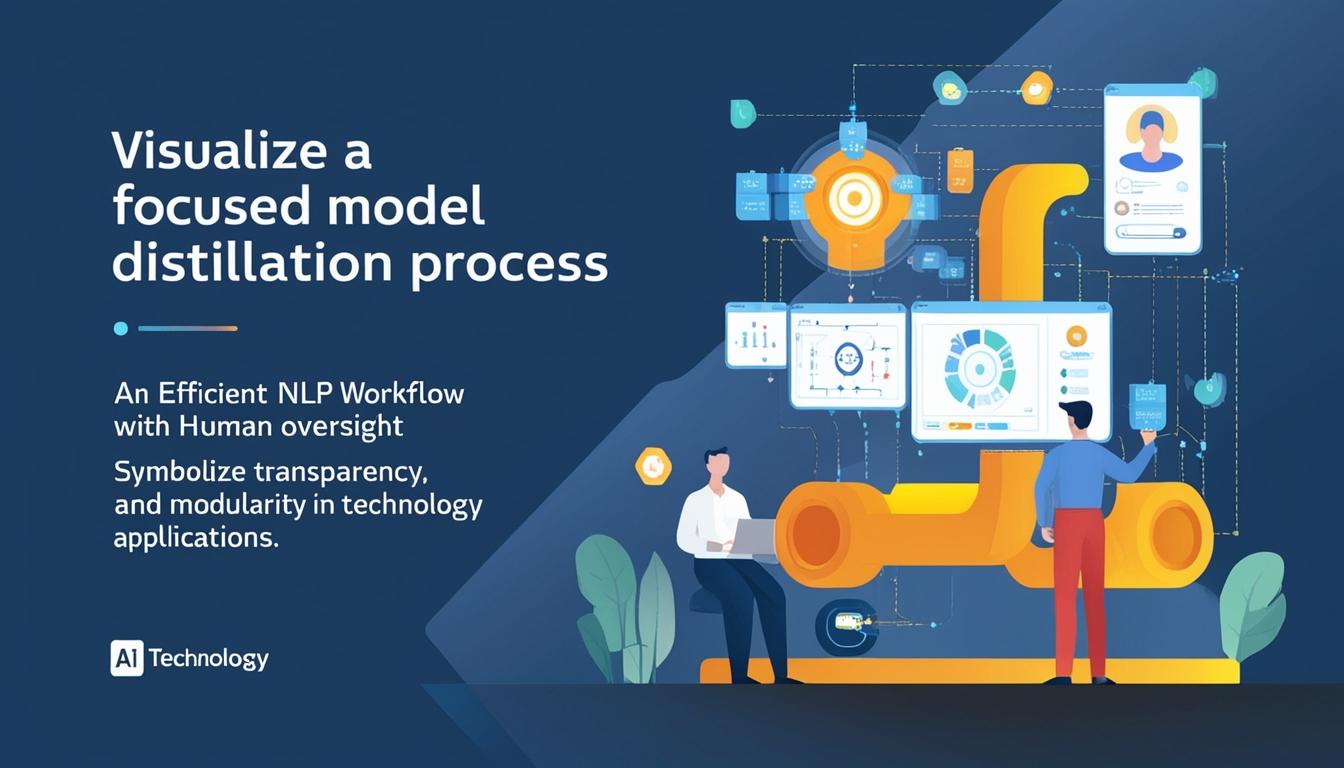
Ines Montani delivered a compelling presentation at the InfoQ Dev Summit Munich, discussing the efficient use of AI models in real-world applications and advocating for transparency and modularity in software development.
Ines Montani, a prominent figure in the tech industry, delivered an insightful presentation at the InfoQ Dev Summit Munich, focusing on practical applications of state-of-the-art models in real-world scenarios. Building on her earlier presentation at QCon London, Montani explored techniques to transform the expansive capacities of modern AI models into more concise, efficient components for in-house operations.
Montani commenced her session by discussing the drawbacks of relying on opaque AI models managed through APIs. She argued that such an approach could hinder the development of software that is modular, transparent, explainable, data-private, reliable, and affordable. She emphasised the importance of leveraging Generation AI (GenAI) for interpreting human language in contexts where messages may be ambiguous, such as analysing customer feedback on forums. Montani contended that businesses need not engage the full might of foundational models for tasks that merely require contextual understanding. Instead, she recommends using transfer learning to distil task-specific knowledge.
To advance from prototype to production-ready systems, Montani proposed several strategies. Key among these is the standardisation of data inputs and outputs to ensure consistency between the prototype and the final system. She draws a parallel to software testing, advocating for the establishment of evaluation processes to benchmark system enhancements. Furthermore, Montani stressed the importance of assessing a model’s utility alongside its accuracy, suggesting an iterative approach to data refinement and notation of the complex structure and ambiguity inherent in natural language.
A sound approach to developing natural language processing (NLP) prototypes, Montani argues, involves large language models (LLMs) that are prompted and then parsed to yield structured data outputs. SpaCy LLM, a tool developed for this purpose, exemplifies how such processes can be streamlined. Despite the capabilities of LLMs, Montani believes a more tailored approach—replacing LLMs at runtime with distilled, task-specific components—can enhance system modularity, transparency, and efficiency.
To refine NLP performance further, Montani proposed incorporating a “human in the loop” to correct LLM outputs. This involves defining a baseline, refining prompts, and iterating the data with annotation tools to create a targeted dataset. Through multiple, focused data passes, Montani suggests that cognitive workload can be reduced and processing speed increased.
Montani also compared the distillation of models to code refactoring, suggesting it entails breaking problems into smaller, manageable sections and simplifying complexities. This phase allows developers to reassess and optimise dependencies and techniques, ensuring that the most suitable tools are employed for each task.
Montani concluded by illustrating the advantages of distilling large language models through case studies from explosion.ai, demonstrating how their targeted work led to more compact, accurate models than initially provided by LLMs. She noted that these iterations not only yielded better long-term results but also reduced operational costs.
In summation, Ines Montani’s presentation at the InfoQ Dev Summit Munich offered a thoughtful examination of leveraging AI models in a pragmatic and efficient manner. Her insights provide a roadmap for developers and businesses aiming to integrate AI whilst maintaining control over their systems’ complexity, transparency, and performance.
Source: Noah Wire Services






