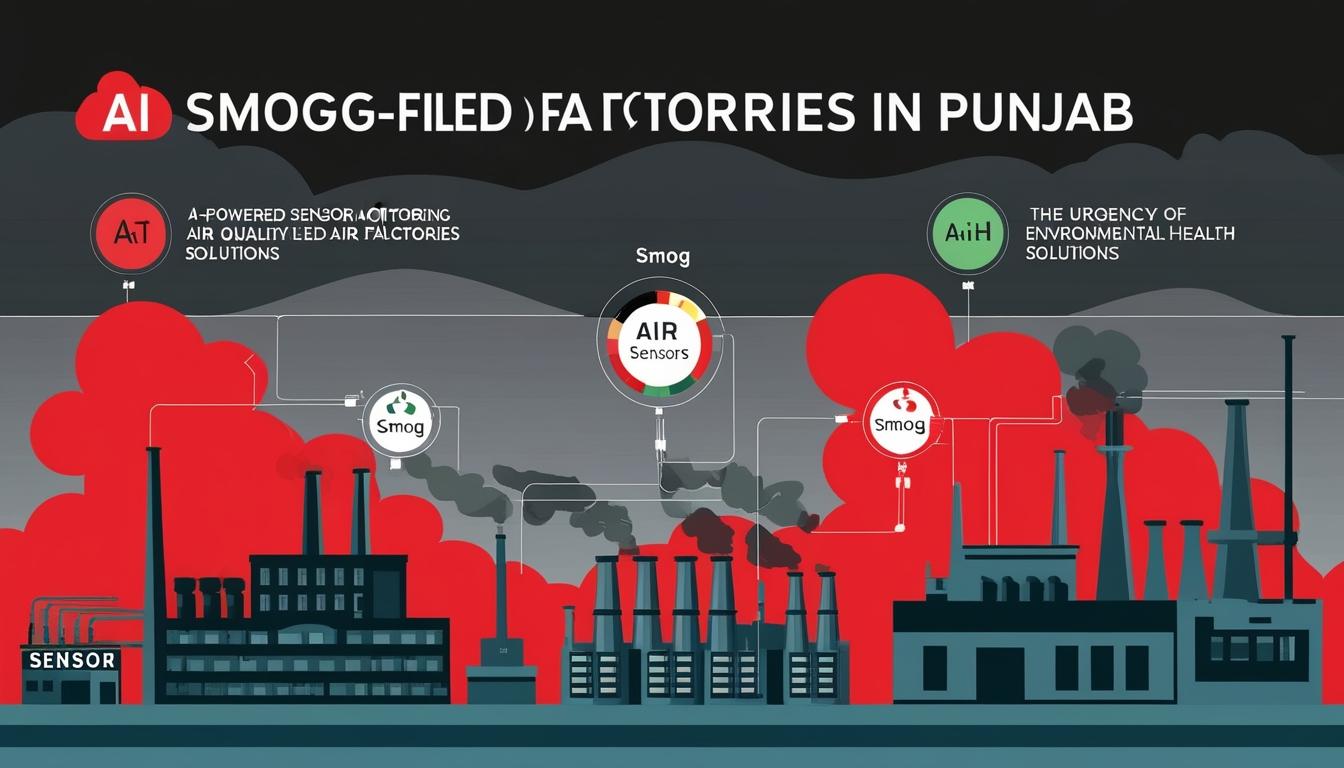
As Punjab faces severe air pollution impacting health and productivity, artificial intelligence emerges as a vital tool for factories to ensure cleaner air and safer working conditions.
In the Punjab region, increasing industrial emissions and agricultural residue burning have led to significant air quality degradation, resulting in hazardous smog that adversely affects both health and productivity within various factories. The need for intervention has become critical, as poor air quality has been linked to respiratory issues among workers, leading to decreased efficiency and heightened health risks.
Artificial intelligence (AI) presents a transformative solution to these pressing challenges. The Express Tribune reports that numerous AI applications can enhance operational practices in industrial settings facing environmental difficulties, specifically through real-time data analysis and predictive maintenance.
The air quality deterioration in smog-affected workplaces raises considerable concerns, particularly since ongoing exposure to pollutants like PM2.5 and PM10 has been associated with chronic respiratory health issues, including chronic obstructive pulmonary disease (COPD) as noted by Jin et al. in 2020. To combat this issue, AI-driven sensors and Internet of Things (IoT) devices are emerging as pivotal tools. These technologies can continuously monitor air quality, detecting potential hazards such as toxic gas leaks before they escalate and thereby facilitating immediate protective actions. This not only safeguards worker health but also maintains uninterrupted factory operations by reducing absenteeism due to health problems.
In addition, AI-enhanced wearable technologies are being developed to monitor vital bodily functions, including heart rate and oxygen levels. Such proactive measures can provide early warnings about health risks, particularly in areas where smog exposure increases the likelihood of hypoxia and other related ailments, as highlighted by Ahmed et al. in 2022. Through AI, these devices can be integrated into broader health management systems within factories, offering personalized safety protocols tailored to each worker’s needs.
Moreover, the integration of AI in maintaining ventilation systems addresses a critical aspect of air quality. Maintenance issues can lead to the circulation of contaminated air within factories, exacerbating the negative effects of smog. With the help of predictive maintenance algorithms, potential HVAC (heating, ventilation, air conditioning) failures can be preemptively addressed, ensuring cleaner air circulation and operational efficiency, as Smith and Zhao stated in 2020. Such interventions not only enhance worker safety but also contribute to operational cost reductions.
AI’s role extends further into automating hazardous tasks traditionally performed by humans. Robotic systems equipped with AI are increasingly handling processes such as welding and painting, which typically generate significant air pollutants. The use of automation in these areas not only reduces workers’ exposure to harmful pollutants but also optimises production efficiency.
AI’s predictive capabilities also stretch to environmental risk management. By analysing meteorological data alongside industrial activity, AI can forecast pollution trends, enabling factory managers to implement adaptive strategies. Such measures could include rescheduling outdoor activities during peak pollution periods or enhancing indoor air filtration systems, as outlined by Park et al. in 2021, ensuring that workers are less exposed to harmful conditions.
The implications of AI implementation in factories go beyond operational improvements. The ability to monitor air quality in real time means that factories can comply with national and international environmental regulations, helping avoid fines and enhancing their public image, as noted by Kumar et al. in 2023. Additionally, AI-generated data can provide valuable insights for policymakers, aiding in the refinement of environmental governance.
Despite these advantages, the implementation of AI in Punjab’s industrial landscape encounters obstacles, primarily the initial cost of technology and a gap in technical expertise. Furthermore, establishing workers’ trust in AI and addressing ethical concerns regarding AI-generated health data remain paramount. According to Mishra and Singh in 2022, it is essential for industry stakeholders and policymakers to collaborate in crafting frameworks to facilitate the ethical adoption of AI.
Overcoming these challenges may be achievable through strategic public-private partnerships and government incentives aimed at promoting AI utilisation in addressing environmental concerns. The overarching potential of AI to improve working conditions and air quality in Punjab’s factories calls for a comprehensive, multi-faceted approach, leveraging AI’s capacities to monitor, predict, and automate tasks effectively.
In conclusion, while implementation remains complex, the introduction of AI technology in Punjab’s factories represents a significant opportunity to cultivate a safer and more sustainable industrial environment, potentially setting a benchmark for environmentally conscious operations in affected regions.
Source: Noah Wire Services
- https://epd.punjab.gov.pk/system/files/Annex%20D2%20Punjab%20Clean%20Air%20Action%20Plan_0.pdf – Corroborates the significant air quality degradation in Punjab due to industrial emissions and agricultural residue burning, and the health risks associated with poor air quality.
- https://journals.ametsoc.org/view/journals/bams/103/9/BAMS-D-22-0132.1.xml – Supports the major contributors to air pollution in Punjab, including the transport sector, industrial combustion, and open burning.
- https://www.teriin.org/projects/green/pdf/Punjab-Air-quality.pdf – Details the sources of air pollution in Punjab, including industries, vehicular sector, and agricultural burning, and the impact on air quality.
- https://epd.punjab.gov.pk/system/files/Annex%20D2%20Punjab%20Clean%20Air%20Action%20Plan_0.pdf – Highlights the health risks associated with exposure to pollutants like PM2.5 and PM10, including chronic respiratory health issues.
- https://www.teriin.org/projects/green/pdf/Punjab-Air-quality.pdf – Discusses the importance of monitoring air quality and the need for interventions to reduce pollution from various sources.
- https://journals.ametsoc.org/view/journals/bams/103/9/BAMS-D-22-0132.1.xml – Emphasizes the need for predictive measures to manage air pollution, aligning with AI’s predictive capabilities.
- https://www.teriin.org/projects/green/pdf/Punjab-Air-quality.pdf – Explains the challenges in maintaining ventilation systems and the potential benefits of predictive maintenance in ensuring cleaner air circulation.
- https://epd.punjab.gov.pk/system/files/Annex%20D2%20Punjab%20Clean%20Air%20Action%20Plan_0.pdf – Supports the idea that automating hazardous tasks can reduce workers’ exposure to harmful pollutants and optimize production efficiency.
- https://www.teriin.org/projects/green/pdf/Punjab-Air-quality.pdf – Highlights the importance of compliance with national and international environmental regulations, which AI can facilitate through real-time monitoring.
- https://epd.punjab.gov.pk/system/files/Annex%20D2%20Punjab%20Clean%20Air%20Action%20Plan_0.pdf – Discusses the obstacles in implementing new technologies, including initial costs and gaps in technical expertise, and the need for public-private partnerships.