









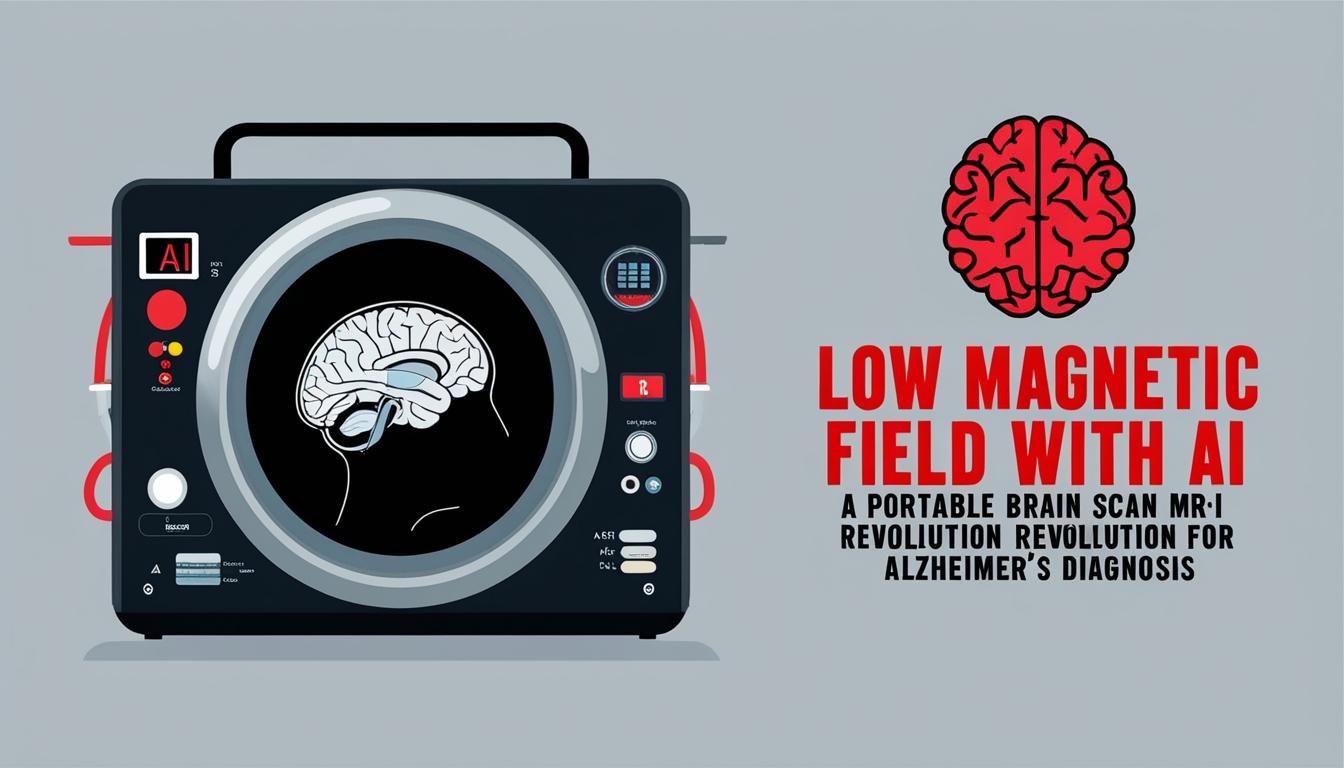
Researchers at Massachusetts General Hospital unveil a low magnetic field MRI combined with AI, promising improved accessibility and accuracy in Alzheimer’s diagnosis.
A groundbreaking study conducted by researchers at Massachusetts General Hospital (MGH) elucidates the potential of low magnetic field (LF) magnetic resonance imaging (MRI) combined with artificial intelligence (AI) to enhance the diagnosis and monitoring of Alzheimer’s disease (AD). Currently, it is estimated that approximately 139 million individuals will be affected by AD globally by 2050, highlighting the urgent need for accessible diagnostic tools.
The findings of the study were published in the journal Nature Communications, revealing that LF-MRI technology, augmented with machine learning methodologies, can accurately measure brain characteristics associated with Alzheimer’s. Notably, the technology is proposed as a more affordable and easily deployable alternative to traditional high-field (HF) MRI machines, which, due to their complexity and cost, often limit widespread use.
In a statement to Medical Xpress, Dr. W. Taylor Kimberly, the chief of the Division of Neurocritical Care in the Department of Neurology at MGH and the study’s senior author, articulates the need for “simple, bedside tools” that can aid in determining the underlying causes of cognitive impairments in patients. This innovative approach aims to address the multifaceted challenges posed by dementia and cognitive decline in an ageing population, with a focus on improving access to diagnostic procedures.
The research team composed of clinical researchers, MRI physicists, health system delivery experts, and AI specialists has been investigating LF-MRI for several years as a viable substitute to HF-MRI. Traditional MRI techniques produce high-resolution images but are financially prohibitive and often not available in resource-limited settings. In contrast, LF-MRI operates using magnetic fields 50 times weaker than those employed in HF-MRI, enabling the creation of smaller, more portable machines that require minimal electrical resources. However, this lower magnetic field strength typically results in diminished image quality.
To compensate for this limitation, the researchers developed AI algorithms using artificially generated datasets to train a system capable of identifying critical AD-related features from LF-MRI scans. They successfully tested this method on 54 participants diagnosed with mild cognitive impairment or other forms of AD-related dementia, concluding that LF-MRI scans closely mirrored the measurements obtained from traditional HF-MRI regarding key brain structures associated with AD.
Looking ahead, the adoption of LF-MRI technology necessitates regulatory clearance and the establishment of new clinical protocols. However, the implications for expanding neuroimaging capabilities in areas where access to conventional MRI systems is constrained are substantial. In addition to enhancing AD diagnostic processes, LF-MRI could facilitate ongoing patient monitoring during treatment with emerging Alzheimer’s therapies. Its portability suggests varied applications, including use in emergency rooms, community health centres, and ambulatory units, particularly for patients at risk of stroke or experiencing cognitive issues.
In Kimberly’s vision, integrating this technology could enable a streamlined diagnostic process, allowing patients with cognitive complaints to receive a brain scan, blood test, and cognitive assessment during a single medical appointment. This goal aligns with broader healthcare objectives of making diagnostic practices more efficient, reducing costs, and ultimately improving patient care experience.
Source: Noah Wire Services
- https://www.massgeneralbrigham.org/en/about/newsroom/press-releases/portable-mri-shows-promise-expanding-brain-imaging-alzheimers-disease – Corroborates the use of low magnetic field (LF) MRI combined with AI to enhance Alzheimer’s disease diagnosis and the publication of the findings in Nature Communications.
- https://www.massgeneralbrigham.org/en/about/newsroom/press-releases/portable-mri-shows-promise-expanding-brain-imaging-alzheimers-disease – Supports the idea that LF-MRI technology is more affordable and easily deployable compared to traditional high-field (HF) MRI machines.
- https://www.massgeneralbrigham.org/en/about/newsroom/press-releases/portable-mri-shows-promise-expanding-brain-imaging-alzheimers-disease – Details the development of AI algorithms using artificially generated datasets to improve LF-MRI image quality and identify AD-related features.
- https://www.massgeneralbrigham.org/en/about/newsroom/press-releases/portable-mri-shows-promise-expanding-brain-imaging-alzheimers-disease – Confirms the successful testing of the LF-MRI method on 54 participants with mild cognitive impairment or AD-related dementia.
- https://www.massgeneralbrigham.org/en/about/newsroom/press-releases/portable-mri-shows-promise-expanding-brain-imaging-alzheimers-disease – Discusses the need for regulatory clearance and new clinical protocols for the adoption of LF-MRI technology.
- https://www.massgeneralbrigham.org/en/about/newsroom/press-releases/portable-mri-shows-promise-expanding-brain-imaging-alzheimers-disease – Highlights the potential applications of LF-MRI in various healthcare settings, including emergency rooms and community health centers.
- https://www.massgeneralbrigham.org/en/about/newsroom/press-releases/portable-mri-shows-promise-expanding-brain-imaging-alzheimers-disease – Explains the vision of integrating LF-MRI technology to streamline diagnostic processes and improve patient care.
- https://news.harvard.edu/gazette/story/2023/03/using-ai-to-target-alzheimers/ – Supports the broader context of using AI and machine learning for Alzheimer’s disease diagnosis, although it focuses on a different study.
- https://www.alzheimersresearchuk.org/news/worldwide-dementia-cases-to-triple-by-2050-to-over-150-million/ – Corroborates the estimate that approximately 139 million individuals will be affected by Alzheimer’s disease globally by 2050.
- https://aaic.alz.org/releases_2021/global-prevalence.asp – Provides additional data on the global prevalence of dementia and its projected increase by 2050.
- https://aaic.alz.org/releases_2021/global-prevalence.asp – Details the factors contributing to the increase in dementia cases, including population growth and aging.






