









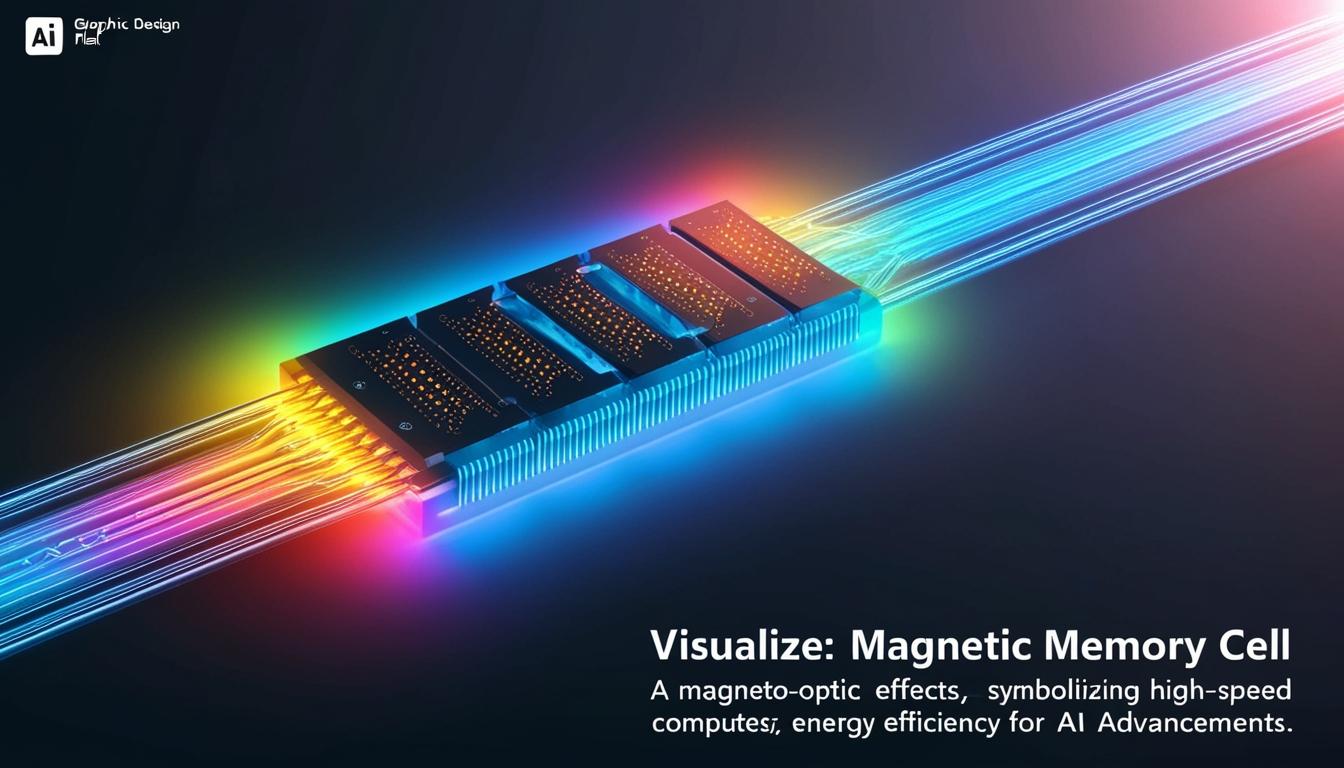
Researchers from the University of Pittsburgh have developed a new type of memory cell that promises to enhance computational efficiency and reduce energy consumption, potentially transforming the landscape of artificial intelligence.
Researchers have unveiled a groundbreaking advancement in technology with the development of a new type of memory cell, designed to both store information and execute high-speed, high-efficiency calculations. This innovation has been documented in the recent edition of the journal Nature Photonics, published on October 23.
The innovative memory cell is set to revolutionise computational processes by allowing high-speed computations to be performed directly within the memory array. The researchers, from the University of Pittsburgh, suggest that this breakthrough could significantly enhance the efficiency and reduce the energy consumption required in large-scale data centres that support artificial intelligence (AI) systems.
Nathan Youngblood, an electrical and computer engineer involved in the research, noted the potential implications of this technology for the energy-intensive AI industry. He explained that current solutions for scaling up computing capabilities, particularly in AI, typically involve the costly and power-consuming process of purchasing and operating large numbers of graphics processing units (GPUs). By contrast, this new approach using optics in computation could address similar challenges with greater efficiency and speed, potentially leading to reduced power usage while boosting throughput.
At the heart of this technological advancement is a unique mechanism involving magneto-optic effects. The cell utilises magnetic fields to steer an incoming light signal either clockwise or counterclockwise through a ring-shaped resonator – a critical component that amplifies light at specific wavelengths. This process channels light into one of two output ports, enabling the memory cell to encode numerical values between zero and one, or zero and minus one. Interestingly, this capability to encode multiple non-integer values allows the system to store up to 3.5 bits of information per cell, a significant leap from the binary capabilities of traditional memory cells which store just one bit per cell.
Youngblood likened this process to two runners on a track, moving in opposite directions with differing wind resistance, which affects their speed and, consequently, the encoding of information. This dynamic allows for positive and negative number coding.
Moreover, the differential numerical outputs from this resonator can be utilised in strengthening or weakening connections within artificial neural networks. These networks, which mimic human brain processes to interpret data, could benefit from this advanced computation method, aiding in tasks such as image recognition.
One striking feature of these new memory cells is their remarkable endurance. The research team demonstrated that the cells can withstand over 2 billion write and erase cycles without any degradation in performance. This marks a significant improvement, estimated to be a thousand-fold, over previous photonic memory technologies. For context, traditional flash drives typically manage between 10,000 and 100,000 cycles.
Looking ahead, the researchers, including Youngblood, aim to integrate multiple cells onto a single computer chip to facilitate more complex computations. They project that this technology could eventually play a crucial role in diminishing the energy and cost demands of AI operations, providing a more sustainable future for computational practice.
This groundbreaking research opens new avenues in the field of computational technology, promising enhancements in speed, efficiency, and energy consumption – all critical factors in the expansion and sustainability of modern AI systems.
Source: Noah Wire Services






