









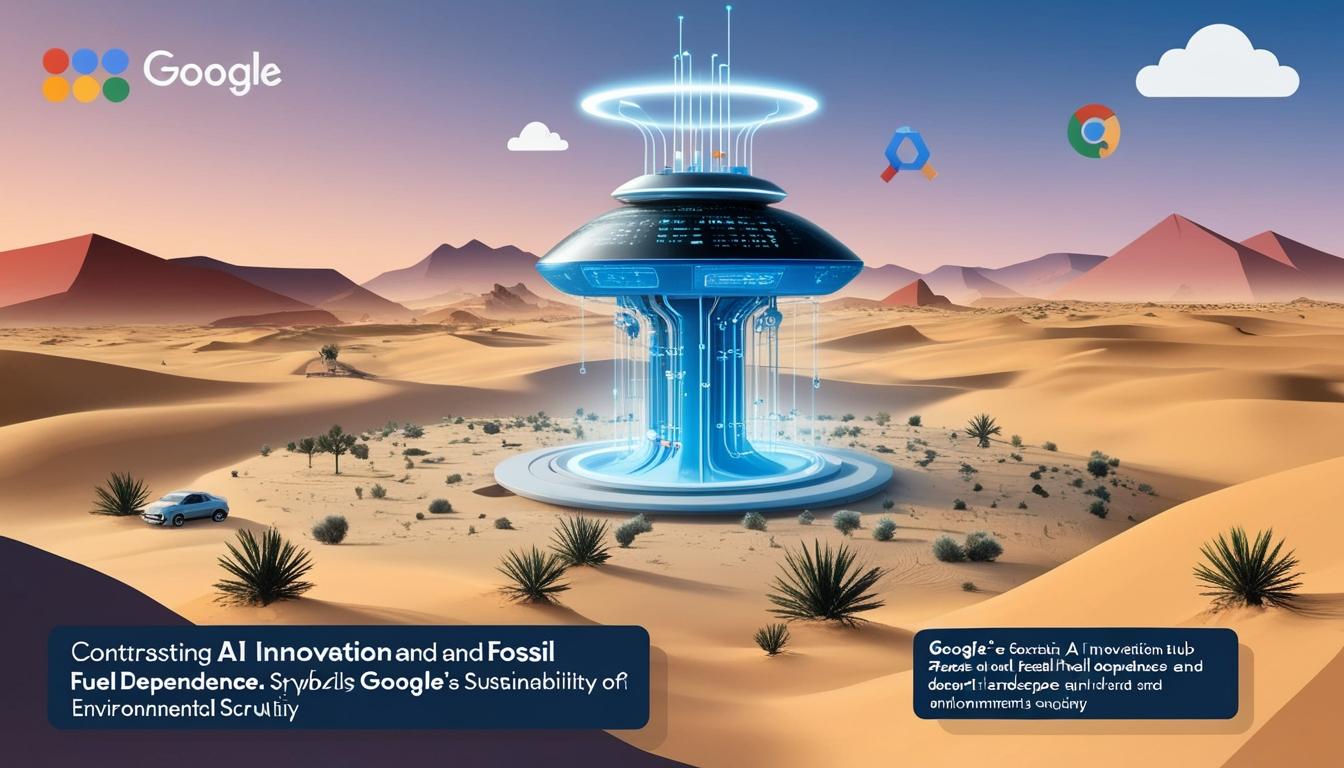
As Google announces plans for a significant AI hub in Saudi Arabia, challenges arise regarding its carbon footprint and previous commitments to environmental sustainability.
Google has announced plans to establish a significant artificial intelligence (AI) hub in Saudi Arabia, a nation renowned for its dependence on fossil fuels. This development occurs as the tech giant attempts to navigate the complex terrain of corporate responsibility and environmental sustainability, particularly amidst its ongoing commitment to reducing carbon dioxide emissions.
The initiative to develop an AI hub in Saudi Arabia emerges as Google grapples with an increase in its carbon footprint. As of a 2021 pledge, the company had aimed to halve its carbon dioxide emissions by the decade’s end. However, despite these ambitions, the period since then has seen Google’s emissions rise by an estimated 3.5 million metric tons. This represents a noteworthy increase of over 30%, attributed partly to its escalating investments in AI technology. The new hub could pose further challenges to Google’s environmental targets, especially under the scrutiny of global climate watchdogs and the company’s own pledges.
The move to Saudi Arabia is also expected to invite scrutiny regarding Google’s prior commitment made in 2020, which sought to refrain from developing AI technologies that support oil extraction processes. This commitment is notably relevant given Saudi Aramco’s stance. The state-owned petroleum and natural gas company, a significant entity in the Saudi economy, claims to already employ AI solutions to enhance its access to undiscovered oil reserves.
In light of these concerns, Google spokesperson Chrissy Moy addressed the matter, stating that the partnership with Saudi Arabia aligns with the company’s 2020 pledge. Moy assured that the strategy complies with Google’s established climate objectives, indicating a careful balancing act between seizing strategic opportunities in AI development and maintaining course on reducing the environmental impacts of its operations.
The decision to base an AI hub in Saudi Arabia underscores the kingdom’s growing importance in tech investments, yet it remains a complex decision against the backdrop of global environmental responsibilities. As Google ventures further into AI, the tech giant will need to continue addressing and reconciling its sustainability goals with its business expansions, especially in regions heavily reliant on fossil fuels. This initiative, therefore, not only reflects advancements in AI technology but also highlights the intricate interplay between regional economic partnerships and global sustainability commitments.
Source: Noah Wire Services
More on this & sources
- https://www.eenews.net/articles/google-inks-deal-for-saudi-ai-hub-as-emissions-grow/ – Corroborates Google’s plans to develop an AI hub in Saudi Arabia and the challenges it poses to Google’s carbon emission reduction goals.
- https://www.eenews.net/articles/google-inks-deal-for-saudi-ai-hub-as-emissions-grow/ – Details the increase in Google’s carbon footprint since its 2021 pledge and the impact of AI investments on emissions.
- https://www.eenews.net/articles/google-inks-deal-for-saudi-ai-hub-as-emissions-grow/ – Addresses Google’s 2020 pledge to stop developing AI programs that aid oil drilling and the relevance to Saudi Aramco’s use of AI.
- https://www.eenews.net/articles/google-inks-deal-for-saudi-ai-hub-as-emissions-grow/ – Quotes Google spokesperson Chrissy Moy on the alignment of the partnership with Google’s 2020 pledge and climate objectives.
- https://www.samenacouncil.org/samena_daily_news?news=102876 – Confirms the partnership between Google Cloud and Saudi Arabia’s Public Investment Fund (PIF) to set up a global AI hub.
- https://mei.edu/publications/beyond-oil-googles-big-bet-saudi-arabias-ai-future – Provides details on the strategic partnership, the location of the AI hub near Dammam, and the goals of positioning Saudi Arabia as a global AI leader.
- https://mei.edu/publications/beyond-oil-googles-big-bet-saudi-arabias-ai-future – Explains the interlink between AI and energy in the region and how Saudi Arabia’s energy surplus makes it attractive for tech giants.
- https://mei.edu/publications/beyond-oil-googles-big-bet-saudi-arabias-ai-future – Discusses the components of the partnership, including the funding of a data center by PIF, joint marketing of Google’s AI offerings, and upskilling the local workforce.
- https://www.saudigulfprojects.com/2024/10/saudi-arabia-pif-and-google-cloud-to-create-advanced-ai-hub/ – Confirms the location of the AI hub near Dammam and the signing of the partnership at the Future Investment Initiative 8th Edition (FII8).
- https://gulfnews.com/business/markets/pif-google-cloud-to-establish-artificial-intelligence-in-saudi-arabia-1.1730380929947 – Details the focus on joint research for Arabic language models, the use of Google Cloud’s technology, and the enhancement of the Saudi workforce through AI initiatives.
- https://gulfnews.com/business/markets/pif-google-cloud-to-establish-artificial-intelligence-in-saudi-arabia-1.1730380929947 – Highlights the national goal of expanding the information and communication technology (ICT) sector by 50% and the integration of additional Arabic datasets into Google’s generative AI model family.






