









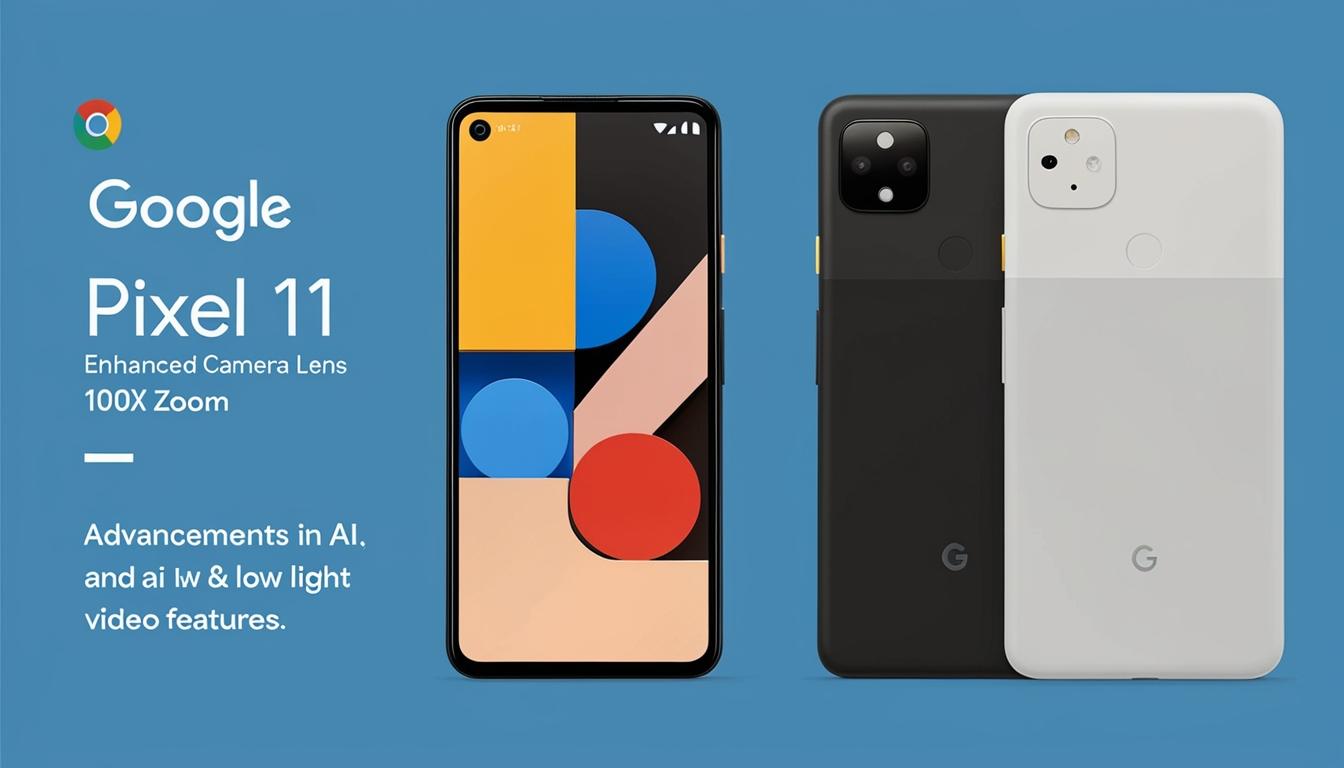
Leaked details from Google’s gChips division indicate significant upgrades in artificial intelligence and camera capabilities for the upcoming Pixel 10 and 11 smartphones, enhancing user experience in video editing and health monitoring.
Google Pixel 10 and 11: Leaked Details Suggest Major Advancements in AI and Camera Technology
In a significant leak from Google’s gChips division, detailed plans for the upcoming Google Pixel 10 and Pixel 11 smartphones have been revealed. The leak outlines prospective enhancements in artificial intelligence and camera functionalities, as well as a host of new software features that aim to solidify Google’s position in the competitive smartphone market.
AI and Machine Learning Innovations
The upcoming Pixel devices will prominently feature Google’s latest technological advancements focused on artificial intelligence and machine learning. Central to these enhancements is the redesigned Tensor G5 processor, which will introduce several AI-driven functionalities. A standout feature, termed “Video Generative ML,” will allow users to edit videos more intuitively via the Photos app, leveraging AI to understand and manipulate video content effectively. It’s anticipated that this feature will also be integrated into YouTube, particularly for YouTube Shorts, offering users a streamlined editing experience.
In addition, the AI capabilities extend to photo editing. Google is set to introduce features like “Speak-to-Tweak” and “Sketch-to-Image,” drawing parallels to Samsung’s existing features. Other innovative tools under exploration include a mysterious “Magic Mirror,” and the ability to run Stable Diffusion-based models locally on the Pixel Studio app, reducing reliance on server-based processing.
Enhanced Camera Capabilities
Camera enhancements are a highlight of the leaked details, which hint at substantial upgrades for both still photography and video recording. The Tensor G5 chip will support 4K 60fps HDR video recording, an improvement over the previous 4K 30fps cap. Furthermore, the Pixel 11 is expected to introduce 100x zoom capabilities, utilizing machine learning to enhance both photos and video, alongside a new telephoto camera design that promises to bolster this functionality.
An exciting addition to the video capabilities is what Google is calling “Ultra Low Light video,” enabling the capture of high-quality video footage in extremely dim lighting conditions, akin to the existing Night Sight feature but fully operable on-device. This feature targets environments with lighting as low as 5-10 lux, equivalent to a dim night-time setting or the soft glow of a candle from a metre away.
Additionally, an upgraded Cinematic Blur now supports 4K 30fps videos, with a new “video relight” function to adjust lighting post-capture. These features are expected to provide users with unprecedented control over video aesthetics while significantly reducing power consumption during recording.
New Health and Activity Monitoring Features
The next generation Pixels will also boast new ML-based always-on features attributable to a new “nanoTPU” in the Tensor G6 processor. These are anticipated to enhance health and activity monitoring, with capabilities that include detection of agonal breathing, sleep apnea, snoring, sneezing, coughing, alongside innovative fall detection and gait analysis functionalities.
For fitness enthusiasts, the introduction of “Running ML” promises to offer tools geared towards runners, such as pace coaching and balance analysis. These features indicate Google’s broader ambition of integrating advanced health monitoring within its Pixel smartphones, alongside expanded support for Quick phrases.
Market Anticipation
As speculation around the Pixel 10 and 11 continues to grow, technology aficionados are particularly eager about the prospect of Ultra Low Light video and the ambitious 100x zoom capabilities. The leaked details not only indicate Google’s commitment to pushing technological boundaries but also highlight the increasing integration of AI across multiple facets of smartphone use, promising a richer user experience.
In conclusion, while hardware specifications have traditionally dominated pre-launch leaks, this time, a comprehensive glimpse into Google’s software strategy shines a light on their forward-thinking approach to integrating AI and ML in smartphones. The anticipation for the official unveiling of the Pixel 10 and 11 devices is now notably heightened, as consumers await to see these cutting-edge features in action.
Source: Noah Wire Services






