









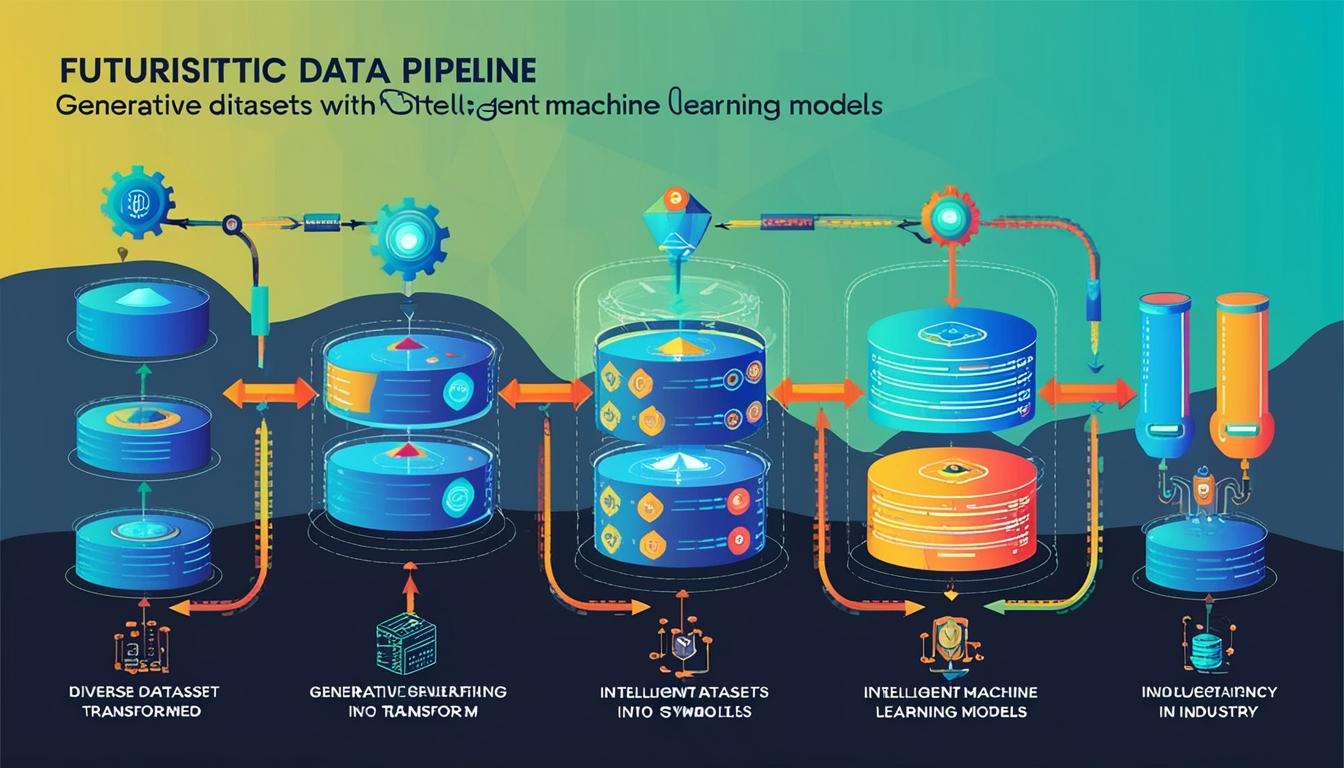
As generative artificial intelligence technologies continue to evolve, they offer businesses the opportunity to enhance efficiency and innovate across various sectors by improving data quality and streamlining processes.
Generative AI Solutions: Revolutionising Industry Efficiency and Innovation
Generative artificial intelligence (AI) technologies are set to become transformative forces in various industries, offering businesses valuable tools to achieve their objectives with enhanced efficiency and innovative capabilities. Located at the intersection of technology and business strategy, generative AI tools, specifically within the realm of custom solutions, enable productivity boosts, decision-making streamlining, and operational improvements across sectors.
At the core of these technological advancements lies the development and integration of generative AI models, which play a crucial role in augmenting machine learning capabilities. By expanding training datasets and thereby improving the precision and reliability of these models, organisations are poised to experience substantial benefits.
Diverse Data Expansion through Generative AI
One widely recognised method in machine learning for augmenting datasets involves the utilisation of Generative Adversarial Networks (GANs) alongside other generative models. This technique proves particularly advantageous when an existing dataset proves inadequate in terms of size or diversity, ultimately enhancing the dataset’s quality and diversity.
Generative AI facilitates the creation of entirely new examples that are typically missing from original data sets. By doing so, it significantly strengthens machine learning models, reducing the risk of overfitting and boosting their adaptability to assorted scenarios. Consequently, businesses incorporating generative AI into their training datasets can secure more adaptable and robust models.
Enhanced Data Quality and Annotation
Another critical advantage of generative AI lies in its capability to improve the quality of training data by generating examples that better reflect real-world scenarios. This elevated quality leads to increased precision and dependability of machine learning models. By integrating generative AI during data preparation phases, organisations ensure their models are better equipped to handle real-world conditions, enhancing their real-world application success.
Moreover, data annotation—an aspect of machine learning that traditionally demands extensive labour—is significantly streamlined through generative AI. By automating the annotation process, businesses find themselves saving both time and resource expenditure, contributing to swifter model deployments.
Cost Efficiency in Data Collection
The financial implications of gathering and preparing vast expanses of training data are often substantial. Generative AI provides a cost-effective solution by enriching these datasets, allowing businesses to slash both time and resources allocated to data collection and preparation. As a result, constructing and maintaining machine learning models becomes a feasible pursuit for businesses of varying sizes.
Dataset Enhancement and Implementation
Generative AI operates as a robust tool for the extension and refinement of training datasets, markedly boosting the performance of machine learning models. The process generally includes data augmentation using GANs, whereby a generator within the GAN creates new samples, and a discriminator evaluates their authenticity. This cycle ensures the creation of additional synthetic samples that mirror the characteristics of the original data.
To maximise efficacy, it is crucial to employ best practices such as maintaining a validation set independently of the augmented data to maintain unbiased model evaluation and ensuring class balance to avoid skewness in classification tasks. Domain expertise should be applied to ensure synthetic samples accurately represent domain-specific characteristics of the data.
When implementing these techniques, embedding generative models into data pipelines is recommended for seamless data generation during model training. The use of prominent machine learning libraries, like TensorFlow and PyTorch, which offer built-in GAN and data augmentation capabilities, further facilitates this integration.
Finally, ongoing evaluation of model performance ensures the positive effects of data augmentation are realised, which involves performance comparison with and without augmented data, alongside regular monitoring to detect potential adverse impacts from the inclusion of synthetic data.
Conclusion
Generative AI tools are reshaping data handling and machine learning design for businesses, enabling them to construct robust and precise models more efficiently and cost-effectively. By expanding and refining datasets, businesses are better placed to tackle practical, real-world challenges, making machine learning solutions more accessible and beneficial across multiple business sizes and industry scopes.
Source: Noah Wire Services






