









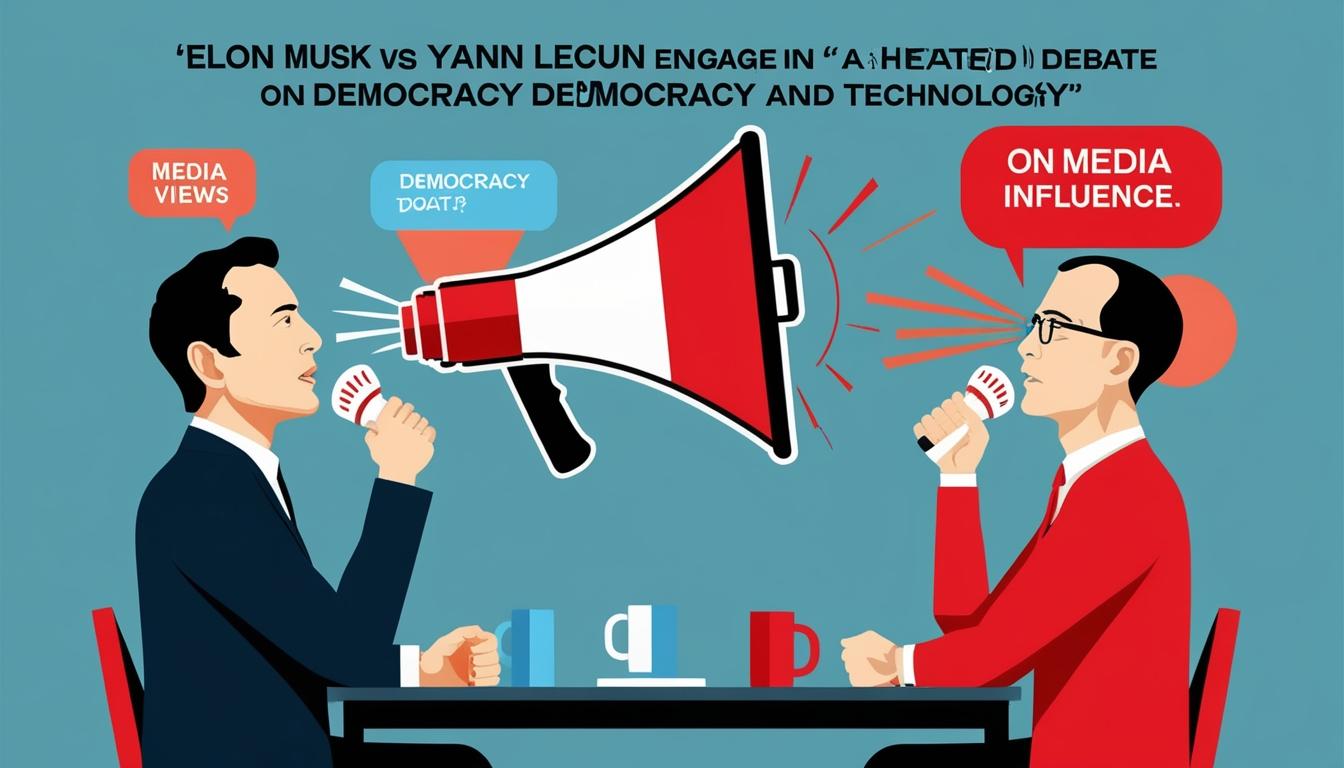
A public dispute between billionaire Elon Musk and AI expert Yann LeCun escalates on social media, raising critical questions about democracy, media influence, and the responsibilities of tech leaders.
In recent developments in the ongoing clash between some of the most influential figures in technology and media, a public exchange of words has unfolded between Elon Musk, the billionaire entrepreneur, and Yann LeCun, a Turing Award-winning computer scientist and a prominent figure in artificial intelligence. The disagreement erupted on social media, where both personalities are known to engage actively.
The spat began when Elon Musk, who acquired Twitter in a widely publicised move, sided with conservative commentator Ben Shapiro. Shapiro criticised the methods of the New York Times, prompting Musk, who owns the social media platform, to echo his sentiments and describe the newspaper as “a threat to our democracy.”
Reacting sharply, Yann LeCun, a well-respected figure in AI development associated with Facebook (now Meta), challenged Musk’s assertion. LeCun accused Musk of posing the true threat to democracy, describing him as “an oligarch who bought himself a huge megaphone” to support influences that potentially undermine democratic norms and institutions, including the press, scientists, and research organisations. LeCun’s pointed response highlighted a wider opinion he holds about Musk’s impact on the electoral process and democratic values.
This confrontation is not an isolated incident but rather a continuation of a series of exchanges between the two. Earlier in the same year, they clashed over Musk’s venture in the AI sector with xAI, a competitor to OpenAI. LeCun publicly criticised Musk’s management style, humouring that employees should only join if they can handle exaggerated promises about project outcomes.
Musk, known for his retorts on social media, attempted to question LeCun’s scientific contributions in recent years. LeCun responded confidently, citing over 80 technical papers published since early 2022, ensuring there was no ambiguity regarding his continued contributions to the field.
Their exchanges not only highlight personal tensions but also reflect broader discussions on the intersection of technology, media authority, and democracy. Each instance of public discourse between Musk and LeCun underscores differing perspectives on how these domains overlap and their implications for societal governance.
While this vocal rivalry continues, it highlights the increasingly common intersection of tech leadership and public discourse, as industry leaders wield significant influence beyond their immediate business realms. As these exchanges unfold, they reveal the complexities and challenges inherent in the era of information-driven influence and the roles played by those at its forefront.
Source: Noah Wire Services






