






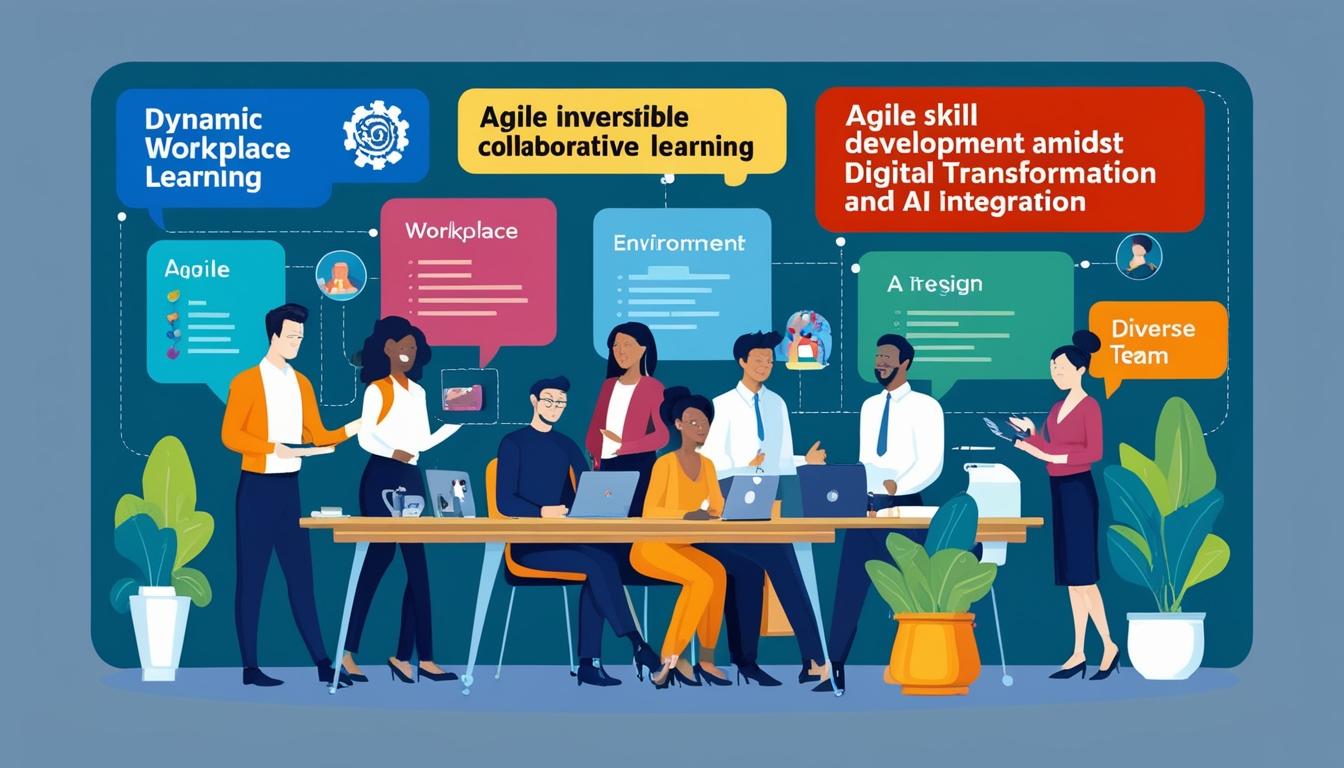

Research by Gartner reveals a significant rise in the demand for continuous learning as AI technologies disrupt the modern workplace, highlighting the need for agile learning practices among organisations.
According to recent research conducted by Gartner, a prominent technological research and consulting firm, the demand for skills development is set to significantly rise as artificial intelligence (AI) and digital trends increasingly disrupt the modern workplace. The findings are based on a June 2024 survey involving 330 business leaders, highlighting the growing emphasis on adapting to evolving technological landscapes.
An overwhelming 93% of the surveyed business leaders acknowledged their responsibility to provide their workforce with the necessary time and resources for continuous learning. Chantal Steen, Senior Director of Global Advisory in Gartner’s HR Practice, elaborated that in the current era of AI-driven accelerated disruption, many leaders have expressed concerns that learning processes are not keeping pace with the rapid onset of new skills demands. Steen emphasised that Learning and Development (L&D) must evolve to become more responsive, delivering education both swiftly and cost-effectively.
The survey also revealed that organisations achieving optimal business outcomes from their learning efforts are those that employ agile learning practices. These enterprises utilise agile learning strategies at least 1.5 times more frequently than their counterparts, pointing to a correlation between agility in learning and improved business performance.
In light of these insights, Gartner has proposed several strategies for leaders aiming to foster a more agile learning environment within their organisations. Firstly, they underscore the importance of connecting learning initiatives with targeted business outcomes. Such an approach not only aids organisations in harnessing essential skills for strategic adaptation and competitive execution but also allows employees to enhance their skills, thereby augmenting their career and earning potential.
Chantal Steen recommends that leaders work collaboratively with their teams to develop narratives that reposition learning as an intrinsic element of work, rather than as an interruption to productivity. This narrative shift can help employees view learning as an activity that achieves tangible work results.
Gartner further suggests that leaders align their teams’ approaches around five agile learning values encapsulated in the newly introduced AI-Era Learning Manifesto. These values prioritize business outcomes over mere knowledge accumulation, advocate for a growth mindset over current skill sets, and support agility in skills over traditional role-based stability. Moreover, the manifesto promotes the integration of learning within the job rather than “off-the-job” training, and emphasizes collective learning over individual efforts.
By embedding these values, Gartner predicts that employee engagement with learning will increase, consequently enhancing overall effectiveness and driving key business outcomes. Additionally, L&D leaders are encouraged to invigorate learning programmes by marrying emerging technological capabilities with tried-and-tested methods like experiential and social learning. This approach is designed to allow employees to apply newly acquired skills directly within their roles, fostering rapid and scalable growth in this AI-embedded era.
Overall, the research by Gartner underscores a pivotal shift towards agile and outcome-oriented learning as businesses navigate the AI landscape, with a strong focus on aligning educational pursuits closely with evolving business objectives.
Source: Noah Wire Services







