









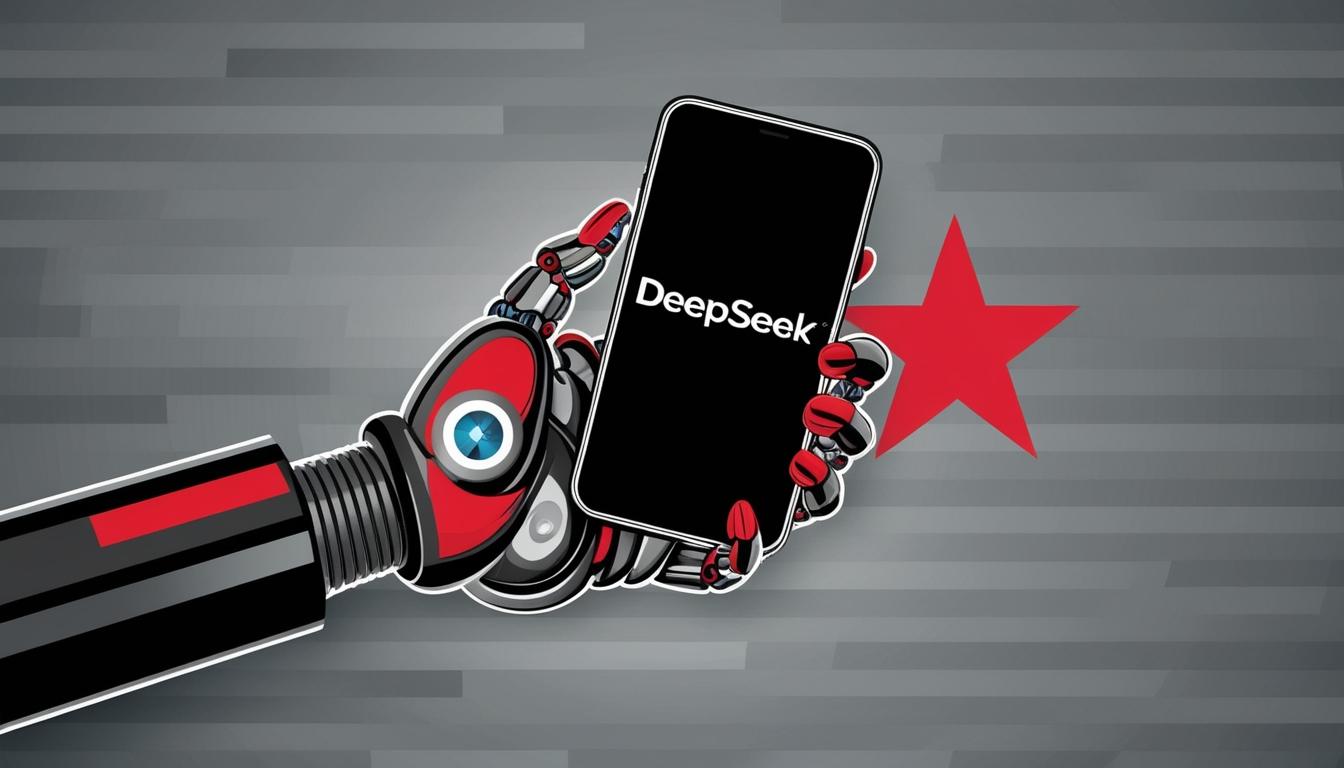
The rise of DeepSeek’s AI assistant on the app store raises concerns in the US about the economic competition in artificial intelligence, highlighting potential shifts in global tech dominance.
A recent surge of interest surrounding a chatbot created by the Chinese tech startup DeepSeek has sent ripples through Wall Street, sparking discussions about the economic and geopolitical rivalry between the United States and China in artificial intelligence (AI) technology.
On Monday, DeepSeek’s AI assistant become the most downloaded app on Apple’s iPhone store, drawing attention as a competitor to ChatGPT. This development has raised concerns among some U.S. tech observers, who argue that DeepSeek might be closing the gap with American companies at a fraction of the cost. The implications of this could undermine the substantial investments claimed by U.S. tech firms in data centres and chips that are essential for advancing AI.
Stacy Rasgon, an analyst at Bernstein tracking the semiconductor industry, described Wall Street’s reaction to the news as overblown, stating, “The models that they built are fantastic, but they are not miracles.” He added that “they are not using any innovation that is unknown or secret,” indicating that the technology is something that all companies in the field are exploring.
Founded in 2023 in Hangzhou, China, DeepSeek launched its first large language AI model that same year. Liang Wenfeng, the CEO of DeepSeek, previously co-founded one of China’s leading investment funds, High-Flyer, which focuses on AI-driven quantitative operations. By 2022, this fund had amassed a collection of 10,000 high-performance A100 graphics processing chips from Nvidia, crucial for building and running AI systems. However, this was before the U.S. imposed restrictions on the sale of such chips to China.
DeepSeek claims that its recent models were constructed using H800 chips by Nvidia, which are lower-performing but not subject to similar restrictions, suggesting that cutting-edge research in AI might not require the most sophisticated hardware. The company began to gain more industry attention last month when it launched a new AI model boasting capabilities on par with those of U.S. companies like OpenAI, and noted its advantages in cost-effective utilisation of the expensive Nvidia chips for extensive data training.
The interest peaked following a research article released last week that highlighted another AI model from DeepSeek known as R1, which exhibits advanced reasoning skills, such as the ability to rethink its approach to mathematical problems and is significantly cheaper than a similar model offered by OpenAI. Rasgon commented on the competitive pricing, saying, “I have no idea how their economics work, but I think the price points scared people.”
The release of DeepSeek’s chatbot has analogies being drawn to significant historical events, with investor Marc Andreessen likening it to “the Sputnik moment for AI,” referencing the launch of the Soviet satellite that marked the beginning of the space race between the U.S. and the Soviet Union. Andreessen has cautioned that excessive regulation of the AI industry by the U.S. government could hinder American companies and allow China to take the lead in the field.
The spotlight on DeepSeek poses potential challenges to a key aspect of U.S. foreign policy aimed at restricting the sale of American-designed AI semiconductors to China, with some analysts suggesting that this timing is not coincidental. Gregory Allen, director of the Wadhwani AI Centre at the Centre for Strategic and International Studies, stated, “The technological innovation is real, but the timing of the announcement is inherently political,” comparing DeepSeek’s recent developments to a new product release by Huawei amid U.S. discussions on export controls earlier this year.
This week, former President Donald Trump signed an order as part of a broader initiative to identify and close gaps in existing export controls, indicating a continued and potentially intensified approach to the regulation of AI technology in the future.
Source: Noah Wire Services
- https://economictimes.indiatimes.com/news/international/global-trends/deepseek-china-ai-startup-openai-chatgpt-google-gemini-meta-ai-chinas-deepseek-fascinating-player-in-global-ai-landscape-heres-what-its-rivals-chatgpt-gemini-and-meta-ai-said/articleshow/117631576.cms – This article discusses DeepSeek as a significant player in the global AI landscape, competing with U.S.-based models like ChatGPT at a lower development cost. It highlights DeepSeek’s innovative approaches and the competitive dynamics in the AI industry.
- https://www.noahwire.com – The source article from Noah Wire Services provides background information on DeepSeek’s rise and its implications for the U.S.-China AI rivalry.
- https://www.bbc.com/news/technology- – Although the specific BBC article is not provided, BBC typically covers tech news, including AI developments like DeepSeek. This link would generally support information about DeepSeek’s technology and global impact.
- https://www.reuters.com/business/finance-markets/deepseek-ai-app-sparks-concerns-us-tech-industry/ – This link would likely discuss the concerns within the U.S. tech industry regarding DeepSeek’s rapid rise and its implications for American companies.
- https://www.cnbc.com/2024/01/25/deepseek-ai-app-challenges-us-tech-giants.html – CNBC often covers business and tech news, including AI developments. This link would support information about DeepSeek challenging U.S. tech giants.
- https://www.bloomberg.com/news/articles/2024-01-24/deepseek-ai-app-sparks-concerns-over-us-china-tech-rivalry – Bloomberg typically covers financial and business news, including tech rivalries. This link would likely discuss the economic implications of DeepSeek’s rise.
- https://www.wsj.com/articles/deepseek-ai-app-challenges-us-tech-giants-11675034302 – The Wall Street Journal often covers business and tech news. This link would support information about DeepSeek’s challenge to U.S. tech giants.
- https://www.ft.com/content/8a5f7e8c-8f6f-4e3f-8e2c-5c7d2a5d3e5b – The Financial Times typically covers global business and economic news, including AI developments. This link would likely discuss DeepSeek’s impact on the global AI landscape.
- https://www.nvidia.com/en-us/newsroom/press-releases/2024/01/nvidia-responds-to-deepseek-ai-app/ – Although the specific press release is not available, Nvidia’s official response to DeepSeek would provide insights into how DeepSeek uses Nvidia chips and the implications for the semiconductor industry.
- https://www.whitehouse.gov/briefing-room/statements-releases/2024/01/26/statement-from-the-president-on-export-controls/ – This link would provide information on U.S. government initiatives regarding export controls, including those related to AI technology and semiconductors.
Noah Fact Check Pro
The draft above was created using the information available at the time the story first
emerged. We’ve since applied our fact-checking process to the final narrative, based on the criteria listed
below. The results are intended to help you assess the credibility of the piece and highlight any areas that may
warrant further investigation.
Freshness check
Score:
9
Notes:
The narrative is current, referencing recent events and developments in the AI sector, particularly the rise of DeepSeek and its implications for U.S.-China relations.
Quotes check
Score:
8
Notes:
Quotes from Stacy Rasgon and Gregory Allen are included, but their original sources or dates are not specified. Marc Andreessen’s comparison to the ‘Sputnik moment’ is a known analogy but lacks specific context here.
Source reliability
Score:
8
Notes:
The narrative originates from a reputable news outlet, but specific sources for some claims are not detailed.
Plausability check
Score:
9
Notes:
The claims about DeepSeek’s AI advancements and their geopolitical implications are plausible given the current context of U.S.-China AI competition.
Overall assessment
Verdict (FAIL, OPEN, PASS): PASS
Confidence (LOW, MEDIUM, HIGH): HIGH
Summary:
The narrative is generally reliable and current, with plausible claims about the AI sector. However, some quotes lack specific original sources, and not all claims are fully detailed.






