









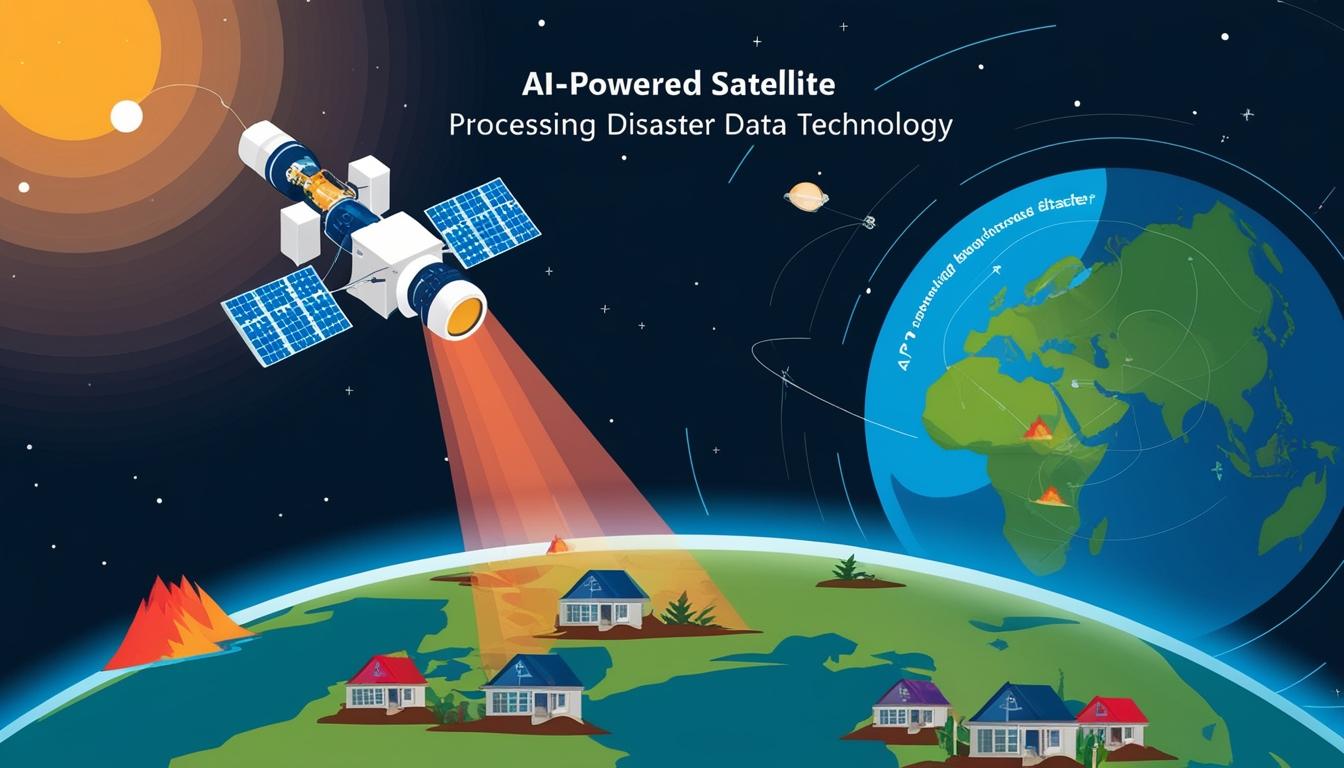
The European Space Agency introduces the Ciseres project, employing AI to enhance satellite data processing for quicker emergency response during natural disasters.
Ciseres AI Satellites Set to Transform Disaster Response
Paris, France – In a significant leap forward for disaster management and emergency response, the European Space Agency (ESA) unveiled their latest initiative, the Ciseres project, during the International Aeronautics Congress in Milan. Launched under ESA’s Civil Security from Space (CSS) programme, Ciseres aims to revolutionise how information is delivered to first responders and governmental agencies during crises such as floods, fires, and landslides. The project is spearheaded by Deimos, a company renowned for its innovative solutions in small satellite operations.
Traditionally, satellites have been integral to disaster management, offering vital imagery and communication support in scenarios where ground networks face disruption. However, a longstanding challenge has been the efficient processing of the vast data collected from satellite sensors, often resulting in delays in information dissemination to emergency teams in the field. Ciseres addresses this bottleneck by integrating artificial intelligence (AI) directly onboard its satellites, fundamentally enhancing the speed and efficiency of data processing.
The AI on these satellites functions as an advanced filter, sifting through incessant streams of data to isolate the most relevant pieces of information necessary for emergency response. This data compression and prioritisation capability means that crucial updates can be sent to the relevant authorities within minutes, dramatically reducing response times compared to traditional methods.
Laurent Jaffart, ESA’s Director of Connectivity and Secure Communications, highlighted the importance of this upgrade: “By enabling AI-based processing directly on-board the satellite, the Ciseres end-to-end solution will provide users with rapid ‘actionable’ information right away.” This marks a significant step forward in the use of AI and small satellites in enhancing the efficiency of satellite communications.
The Ciseres project is a collaborative effort with contributions from multiple European businesses. Deimos offers its expertise in edge AI and machine learning. Skylabs contributes the advanced on-board computer systems necessary for high-performance tasks, and GINA is responsible for the development of the Earth Observation platform aimed at facilitating the emergency response process.
While Ciseres is a European initiative, its impact is poised to have a global reach, aligning with broader international efforts to improve early warning systems and disaster resilience. This comes at a critical time as climate change continues to increase the frequency and severity of natural disasters worldwide, necessitating advancements in technology to manage these complex challenges effectively.
ESA Director of Earth Observation, Simonetta Cheli, remarked on the significant potential of the project: “When disaster strikes, it is critical not only to provide situational awareness as fast as possible but also to retask satellites swiftly to collect updated information. The Ciseres developments represent an important advancement in this respect.”
Simone Centuori, CEO of Deimos, elaborated on the transformative nature of the technology, stating, “AI-powered satellite systems will redefine how we respond to disasters. By processing critical data directly on-board, Ciseres enables first responders to make faster, life-saving decisions. This project underscores Europe’s leadership in space innovation, and we’re proud to be at the forefront of this revolution.”
Beyond its immediate focus on AI-enhanced satellite systems, Ciseres is linked to the Serenity project, which aims to create a network of interconnected hubs on the ground. These hubs are designed to provide seamless access to both space-based and terrestrial resources, further improving crisis management capabilities.
As these advancements unfold, governments, emergency response organisations, and operators of critical infrastructure worldwide have the opportunity to witness and potentially integrate the capabilities of the Ciseres environment, representing a pivotal shift in how the world approaches disaster response in the face of an uncertain future.
Source: Noah Wire Services






