









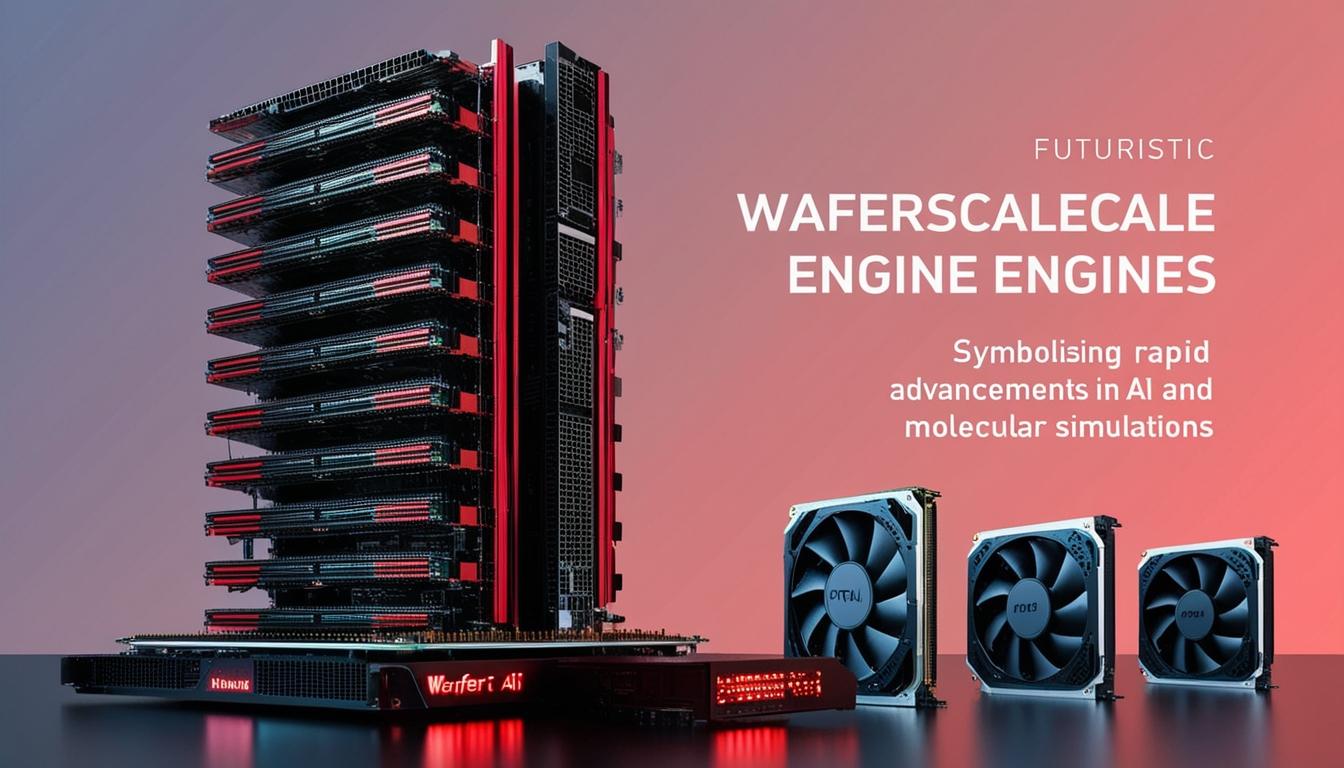
Co-founder Michael James reveals how the new Waferscale Engine drastically reduces simulation times, paving the way for innovations in materials science and drug development.
Michael James, co-founder and chief architect of Cerebras Systems, has spoken about a significant breakthrough in the realm of GPU-based simulations. He revealed that this new technological advancement enables scientists to complete tasks that previously took two years within a mere day. This acceleration is expected to drive innovations in molecular simulations significantly.
James elaborated that this pivotal development offers new insights into the structure and function of materials. He highlighted the potential of extending this research to biomolecules, which could lead to advancements in protein folding, medicine, and drug development.
The newly introduced Waferscale Engine (WSE), measuring 8 inches by 8 inches, represents a stark contrast to conventional GPU units, which typically range from 1 to 1.5 inches. The WSE boasts around 850,000 cores, significantly outpacing the approximate 5,000 cores found in standard GPUs. Additionally, the WSE features on-chip SRAM memory that is ten times faster than traditional High Bandwidth Memory (HBM) offerings, outfitted with 40GB of capacity. This innovative architecture allows the WSE to deliver extraordinary memory bandwidth of 20 petabytes per second with high-density matrices and a processing capability of 6.25 petaflops. In cases of sparse matrices, this performance can reach up to 62.5 petaflops.
Cerebras has also made headlines with its performance benchmarks of the generative AI model, Meta LLaMA 3.1-405B. In these tests, Cerebras achieved the remarkable output of generating 969 tokens per second, eclipsing the performance of Samba Nova, which generated 164 tokens per second. This achievement places Cerebras not only ahead of Samba Nova but also marks a significant advancement in efficiency compared to Amazon Web Services (AWS) AI instances, yielding 12 times the throughput when comparing these systems.
As businesses increasingly integrate AI-driven automation into their operations, innovations such as those presented by Cerebras Systems are expected to play a crucial role in shaping industry practices and capabilities. The future of AI in various sectors continues to evolve rapidly, influenced by breakthroughs in computing power and efficiency that open new avenues for research and application.
Source: Noah Wire Services
- https://cerebras.ai/press-release/cerebras-sets-new-world-record-in-molecular-dynamics-at-1.1-million-simulations-per-second-748x-faster-than-the-worlds-1-supercomputer-frontier – Corroborates the breakthrough in molecular dynamics simulations, enabling scientists to complete two years’ worth of GPU-based simulation work in a day, and the potential for advancements in protein folding, medicine, and drug development.
- https://cerebras.ai/press-release/cerebras-wafer-scale-engine-outperforms-worlds-1-supercomputer-achieving-long-timescale-molecular-dynamics-simulations-179x-faster – Supports the acceleration of molecular dynamics simulations and the comparison with the world’s leading supercomputer Frontier, highlighting the significant speedup achieved by Cerebras.
- https://www.llnl.gov/article/52081/nnsa-researchers-break-molecular-dynamics-timescale-barrier-worlds-largest-chip – Details the performance of the Cerebras Wafer Scale Engine in molecular dynamics simulations, including the number of cores and the speed of simulations, and its impact on materials science and biological processes.
- https://www.networkworld.com/article/3611779/cerebras-claims-record-in-molecular-dynamics-simulations-says-its-748x-faster-than-frontier-supercomputer.html – Provides information on the Waferscale Engine’s performance, its size, core count, and memory capabilities, as well as its comparison to the Frontier supercomputer.
- https://cerebras.ai/press-release/cerebras-sets-new-world-record-in-molecular-dynamics-at-1.1-million-simulations-per-second-748x-faster-than-the-worlds-1-supercomputer-frontier – Explains the insights into material structure and function and the potential extension to biomolecules for advancements in protein folding, medicine, and drug development.
- https://cerebras.ai/press-release/cerebras-wafer-scale-engine-outperforms-worlds-1-supercomputer-achieving-long-timescale-molecular-dynamics-simulations-179x-faster – Describes the Waferscale Engine’s architecture, including its core count, memory, and communication fabric, which enable efficient parallel processing.
- https://www.llnl.gov/article/52081/nnsa-researchers-break-molecular-dynamics-timescale-barrier-worlds-largest-chip – Corroborates the WSE’s performance metrics, such as its core count, memory bandwidth, and processing power, and its general-purpose processing capabilities.
- https://cerebras.ai – Provides an overview of Cerebras Systems’ achievements, including the performance of the Waferscale Engine and its applications in molecular dynamics and AI models.
- https://cerebras.ai/press-release/cerebras-sets-new-world-record-in-molecular-dynamics-at-1.1-million-simulations-per-second-748x-faster-than-the-worlds-1-supercomputer-frontier – Details the collaboration with national laboratories and the impact of this technology on various scientific domains, including materials science and pharmaceutical research.
- https://www.networkworld.com/article/3611779/cerebras-claims-record-in-molecular-dynamics-simulations-says-its-748x-faster-than-frontier-supercomputer.html – Supports the comparison between the Waferscale Engine and traditional GPUs, highlighting the significant differences in size, core count, and power consumption.
- https://cerebras.ai – Corroborates Cerebras’ performance benchmarks with the Meta LLaMA 3.1-405B model, including the generation of 969 tokens per second and its efficiency compared to other systems.






