









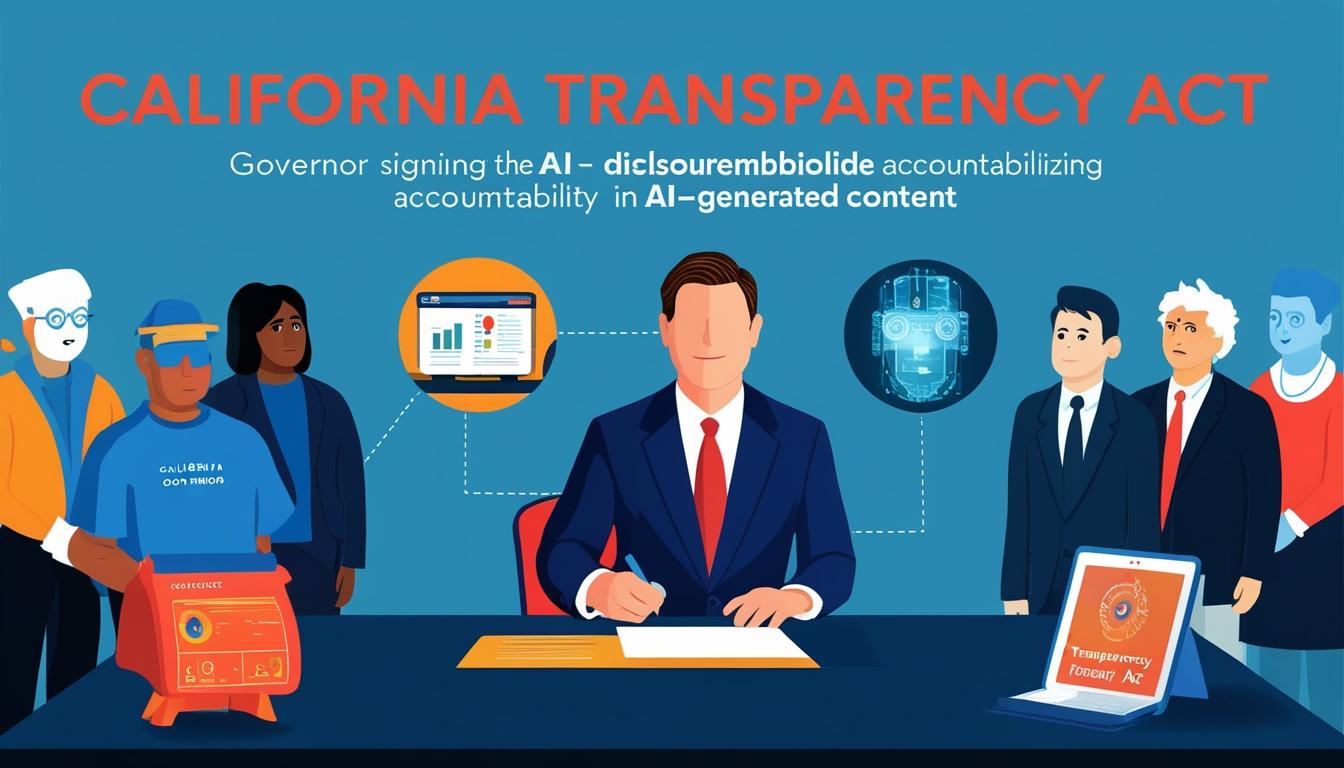
Governor Gavin Newsom has signed the California AI Transparency Act, which requires AI content creators to disclose the nature of AI-generated materials and introduces compliance obligations for widespread AI systems.
Governor Gavin Newsom of California has officially enacted the California AI Transparency Act, designated as SB-942, on September 19, 2024. This landmark legislation, aimed at tightening the grip on AI-generated content disclosure, is set to come into effect on January 1, 2026. The Act represents California’s latest move in the growing regulatory landscape surrounding artificial intelligence technologies.
The California AI Transparency Act introduces significant compliance obligations for what it terms “Covered Providers.” These are defined as any entity responsible for creating, coding, or otherwise producing a generative artificial intelligence system that garners more than one million users or visitors monthly and is accessible by public users within California. The implications of this are broad, as the definition hinges on user engagement figures rather than the technical specifications or computing prowess of the AI systems themselves. This approach is noteworthy for its inclusivity of various AI systems, including those that are open-source or fine-tuned.
SB-942 obliges these providers to implement specific transparency measures aimed at categorising AI-generated content. They are required to embed permanent or extraordinarily difficult-to-remove manifest disclosures into any image, video, or audio content produced by AI systems, indicating it as AI-generated. Moreover, these disclosures must be easily perceivable, relevant to the medium, and intelligible to the general public. A latent disclosure incorporating details like the provider’s name, the system’s data, creation time and date, and a unique identifier must also be integrated, aligning with industry standards for technical feasibility. This measure ensures content remains traceable back to its AI origins.
In conjunction with these provisions, Covered Providers are mandated to present users with a cost-free AI detection tool, enabling the identification of AI-generated content. This tool must be able to recognise the disclosure woven into content by the provider’s AI detection system.
The law further stipulates that if a Covered Provider licenses its AI system to any third-party, the agreement must enforce the third-party’s adherence to maintaining the AI system’s disclosure capabilities. In the case of non-compliance, where the third-party modifies the system to obstruct required disclosures, the Covered Provider must terminate the license within 96 hours. Upon revocation of the license, the third-party is compelled to cease using the system immediately.
Penalties are clearly defined within SB-942, enforcing a civil penalty of $5,000 per violation by a Covered Provider, imposed through legal action facilitated by the Attorney General or local attorneys. Each day in contravention is considered a separate violation, compounding potential fines. Third-party licensees violating the Act are subject to injunctive relief and accountable for reasonable attorney fees and costs.
Notably, the legislation exempts a variety of digital content formats, specifically those involving exclusively non-user-generated video games, television, streaming services, movies, or interactive experiences.
As one of the foremost laws of its kind within the United States focusing on AI transparency, SB-942 signals a movement towards elevated accountability in the deployment of AI technologies. Whilst federal AI legislation remains in the pipeline, with over 120 bills under consideration yet progressing slowly, California’s step reinforces a trend where states are taking proactive positions in the legislative domain of AI, creating a multifaceted regulatory environment across the nation.
Source: Noah Wire Services






