









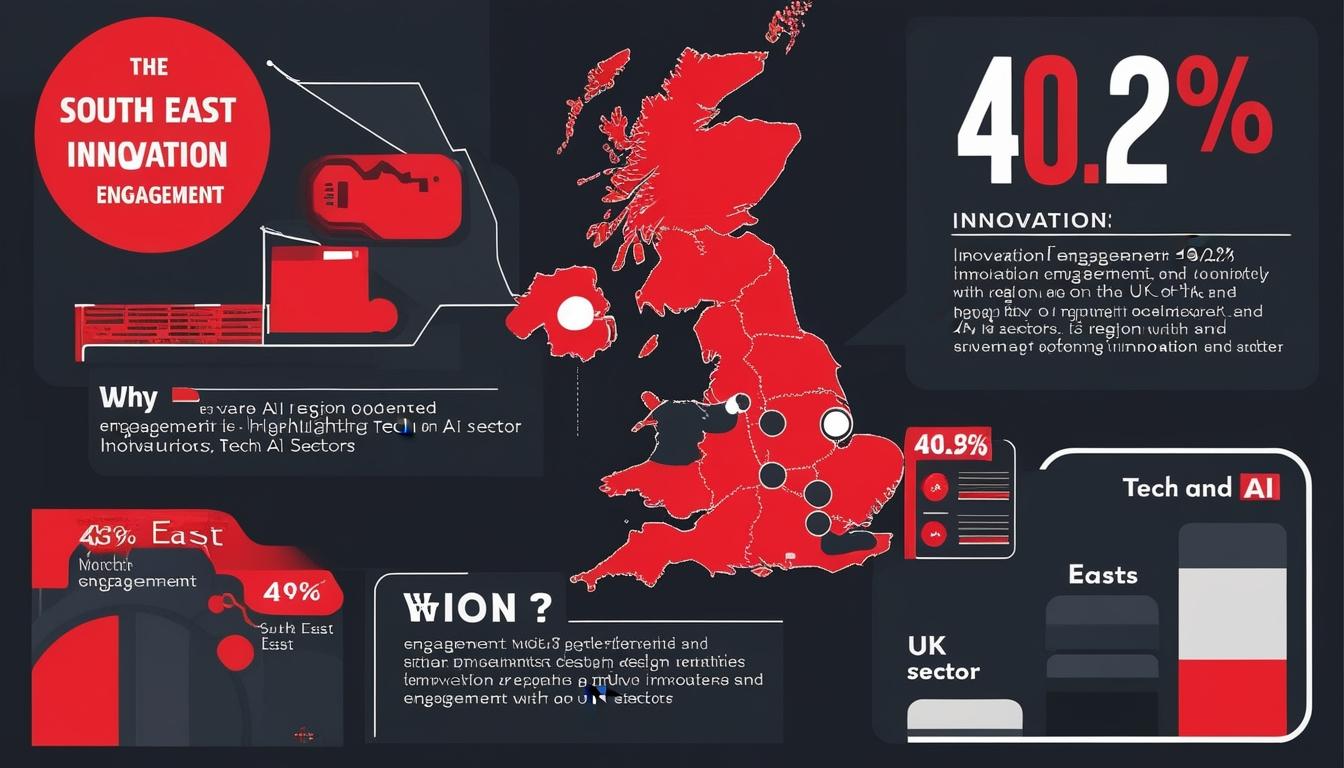
A recent analysis reveals that firms in the south east of England are leading the UK’s innovation with significant investments in new technologies, outperforming other regions.
In a recent analysis conducted by Brighton-based lead generation firm Sopro, a significant trend has emerged regarding the engagement in innovation among businesses across various regions of the United Kingdom. The findings indicate that businesses in the south east of England are at the forefront of innovation, with 40.2 percent of firms actively investing in new technologies and processes to drive their growth. This figure surpasses other regions, most notably the East Midlands, where only 35.1 percent of businesses are reported to be engaged in similar innovative pursuits.
The analysis, which draws from government data, further highlights the technology sector as a key player in the country’s innovation landscape. Recent developments have shown a remarkable 710 percent increase in funding for UK tech startups in the past week, reflecting a heightened investor confidence and an optimistic outlook for the industry. Notably, the publishing, computer programming, and information and communications technology (ICT) sectors lead in engaging in innovation, with nearly three in five companies—59.6 percent—investing actively in advancements. This trend can be attributed to the rapidly evolving nature of technology businesses, particularly as advancements in artificial intelligence (AI) continue to drive the demand for innovative software and skilled personnel.
Moreover, scientific research and development emerges as the industry with the highest engagement in innovation, with a notable 69 percent of related firms partaking in innovation efforts. Furthermore, the manufacture of computer, electrical, and optical equipment follows closely behind, showcasing the breadth of sectors focused on improvement and advancement.
Conversely, the analysis reveals that the field of technical testing and analysis has the least engagement in innovation, with only 43.7 percent of businesses in this area directing focus towards new methods and technologies. Additionally, investment in computer software represents a significant area of innovation, with 17.7 percent of businesses channelling resources into this domain.
A key motivation for over two-fifths of businesses engaging in innovation is the enhancement of goods and services. This aligns with the overarching trend of businesses seeking to maintain competitiveness in a rapidly evolving market.
Sopro, known for its global multi-channel prospecting service, aims to empower B2B companies in their sales strategies by facilitating the discovery and engagement of future customers. The emerging data underscores the importance of innovation as a driving force within the business landscape, particularly in the UK’s dynamic sectors. As businesses continue to invest in new technologies and methodologies, the implications for operational practices and market dynamics will be significant in the years to come.
Source: Noah Wire Services
- https://www.techuk.org/resource/is-innovation-inclusive-in-the-uk-a-look-into-the-nations-and-regions-approach-to-innovation.html – Corroborates the regional disparities in innovation, highlighting that the South East and London are at the forefront of innovation, while other regions lag behind.
- https://www.arup.com/globalassets/downloads/insights/innovation-districts-how-can-we-drive-growth-in-major-uk-cities.pdf – Supports the importance of innovation districts in driving growth and innovation, particularly in urban areas, which aligns with the high innovation engagement in the south east of England.
- https://ec.europa.eu/assets/rtd/ris/2023/ec_rtd_ris-regional-profiles-united-kingdom.pdf – Provides data on regional innovation performance, showing that London and the South East are among the most innovative regions in the UK, supporting the analysis’s findings.
- https://assets.publishing.service.gov.uk/media/627a3fc68fa8f560b660a590/UK_Innovation_Survey_2021_Report.pdf – Details the percentage of businesses that are innovation active by region, with the East of England and West Midlands having high percentages, which supports the regional innovation trends mentioned.
- https://assets.publishing.service.gov.uk/media/627a3fc68fa8f560b660a590/UK_Innovation_Survey_2021_Report.pdf – Highlights the sectors leading in innovation, such as computer software and ICT, and the increase in investment in these areas, aligning with the analysis’s sector-specific findings.
- https://www.techuk.org/resource/is-innovation-inclusive-in-the-uk-a-look-into-the-nations-and-regions-approach-to-innovation.html – Discusses the high R&D spend and innovation investment in areas like the South East and London, contrasting with lower investment in other regions.
- https://www.arup.com/globalassets/downloads/insights/innovation-districts-how-can-we-drive-growth-in-major-uk-cities.pdf – Explains how innovation districts, particularly in urban areas, are driving growth and innovation, which is consistent with the high innovation engagement in tech and ICT sectors.
- https://ec.europa.eu/assets/rtd/ris/2023/ec_rtd_ris-regional-profiles-united-kingdom.pdf – Shows that scientific research and development is a strong area of innovation, with regions like the South East performing well, supporting the analysis’s sectoral findings.
- https://assets.publishing.service.gov.uk/media/627a3fc68fa8f560b660a590/UK_Innovation_Survey_2021_Report.pdf – Details the motivation for businesses to engage in innovation, such as enhancing goods and services, which aligns with the analysis’s findings on competitiveness.
- https://assets.publishing.service.gov.uk/media/627a3fc68fa8f560b660a590/UK_Innovation_Survey_2021_Report.pdf – Provides data on the types of innovation expenditure, including computer software and R&D, which supports the analysis’s points on significant areas of innovation investment.
- https://www.techuk.org/resource/is-innovation-inclusive-in-the-uk-a-look-into-the-nations-and-regions-approach-to-innovation.html – Highlights the disparities in innovation investment across different regions, including the lower engagement in innovation in certain sectors like technical testing and analysis.






