









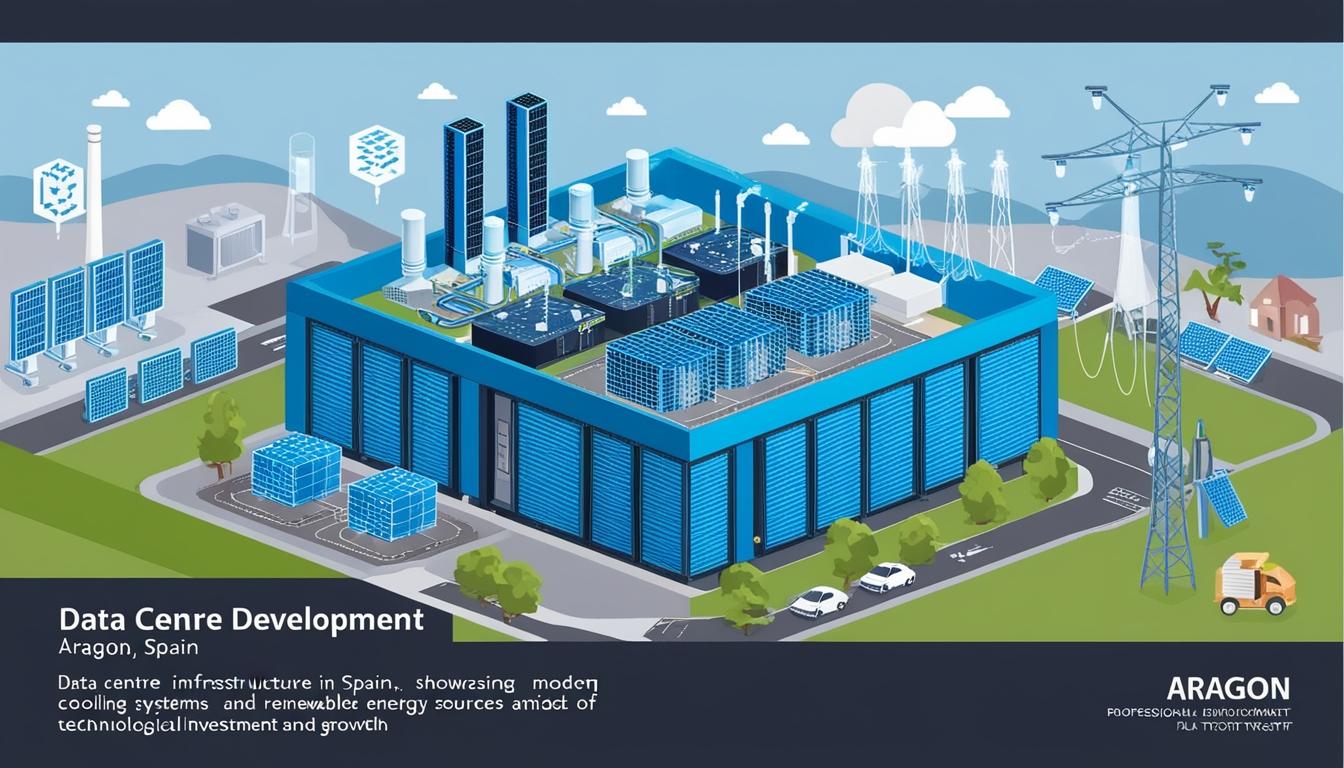
The investment marks Blackstone’s commitment to transforming Aragon into a leading cloud computing hub, following significant financial moves by Microsoft and Amazon in the region.
Blackstone, the world’s largest alternative asset manager, is set to make a significant investment of 7.5 billion euros (approximately $8.2 billion) in the development of data centres within the Aragon region of Spain. This strategic decision aligns with the increasing momentum of Aragon as an emerging cloud computing hub within Europe. The U.S. private equity fund follows the path of technology giants Microsoft and Amazon, which have already earmarked substantial funds for similar pursuits in the region.
Zaragoza, the regional capital of Aragon situated in northeastern Spain, has become a focal point for such technological investments. To date, local authorities have received 19 applications for data centre projects seeking approval in the area. These developments are highlighted by the announcement from a spokesperson for Aragon’s regional government, who confirmed Blackstone’s future endeavours in the region on Tuesday.
Through Blackstone’s initiative, the plan is to construct the necessary infrastructure by installing cooling systems and connection cables, preparing the buildings for leasing to organisations intent on establishing computer servers. The confirmation of this substantial investment was issued by a representative of Blackstone, underscoring the company’s commitment to this venture.
Earlier communications from the Aragon regional government reveal that Microsoft intended to dedicate 6.69 billion euros to data centre projects as announced in June. Meanwhile, Amazon’s cloud computing division, AWS, disclosed its intent to infuse 15.7 billion euros into constructing its own data centres within the region in May. Amazon has further clarified that these data centres will operate on renewable energy, supported by Aragon’s significant wind power capacity.
In parallel developments across the Atlantic, Amazon is also making strides in the deployment of small modular reactors (SMRs) as part of efforts to source carbon-free electricity for its data centres. As detailed by X-energy, a US nuclear developer, Amazon has started anchoring a $500 million fundraising initiative to aid in the development and licensing of its innovative SMR technology. This approach is part of Amazon’s strategic collaboration with X-energy in a broader scheme to enable over 5 gigawatts of SMR-generated power by 2039.
Amazon’s movement into SMR technology mirrors similar steps undertaken by Google. Google recently committed to a procurement deal for nuclear energy generated from Kairos Power’s small modular reactors, with the first reactor anticipated to be operational by 2030. Google’s senior director for energy and climate, Michael Terrell, underscored the necessity of this partnership to consistently provide clean energy, vital for supporting the burgeoning demands of artificial intelligence technologies and data centres.
These projects underscore a growing interest among major technology firms in harnessing both renewable and nuclear energy solutions to meet increasing energy demands. With the global consumption of electricity on an upward trend, largely driven by the expansion of AI and data storage facilities, these investments reflect an industry move towards more sustainable and reliable energy options. Both Amazon and Google have publicly pledged to adhere to renewable energy commitments as part of a broader environmental strategy, further evidenced by these extensive investments.
The area of nuclear power, particularly through small modular reactors, presents significant potential for reliably meeting these energy requirements. These next-generation reactors promise efficiency and flexibility, catering to specific site needs with a lower environmental footprint compared to traditional nuclear solutions. However, the economic feasibility and broader implementation pose ongoing challenges as this technology is yet to achieve widespread commercial deployment.
Globally, the International Energy Agency forecasts that data centres’ electricity demand might exceed 1,000 terawatt hours by 2026, more than doubling figures from 2022. This landscape compels tech giants to explore a mixed portfolio of energy solutions, integrating established renewable sources with emerging nuclear technologies to meet future needs.
Source: Noah Wire Services






