









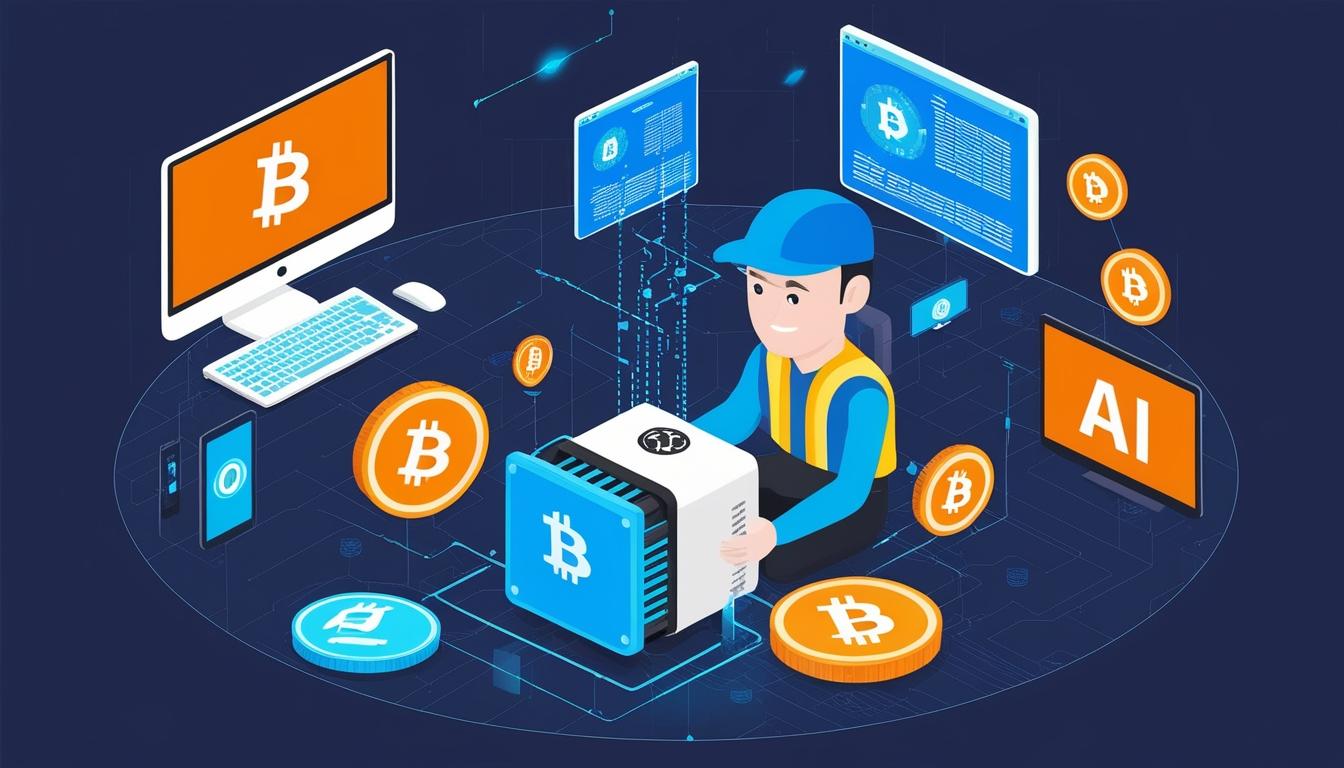
Amid the challenges posed by the recent Bitcoin halving, mining companies are exploring artificial intelligence to enhance profitability and adapt to a clearer regulatory environment.
Bitcoin mining companies are experiencing a shift in their operational strategies in the wake of changes brought about by the recent Bitcoin halving in April. Companies such as CleanSpark, Marathon Digital, and Riot Platforms find themselves at a crossroads, where profitability from Bitcoin mining has seen a decline despite the cryptocurrency’s price stability above the $60,000 mark. The changes in the BTC network dynamics have prompted these entities to consider pivoting their operations towards the rapidly growing field of artificial intelligence (AI).
The Bitcoin halving event is a significant occurrence in the cryptocurrency landscape, as it reduces the rewards for mining new blocks by 50%, contributing to the scarcity and ultimately influencing the cryptocurrency’s market valuation. However, the aftermath of the latest halving cycle shows a complex picture where the expected linear increase in Bitcoin price is not evident, thereby squeezing miners’ profit margins.
In response to these economic pressures, Bitcoin miners are increasingly eyeing AI ventures as a burgeoning opportunity, not least due to the sector’s remarkable financial performance this year. Companies entrenched in AI, such as NVIDIA and OpenAI, have showcased the sector’s potential profitability. NVIDIA reached a monumental milestone with a market capitalisation surpassing $3 trillion as of June, fueled largely by its extensive involvement in AI development. Similarly, OpenAI’s recent valuation soared to $157 billion after a successful funding round of $6.6 billion, underscoring the substantial investor confidence in AI’s future prospects.
As Bitcoin miners explore these new avenues, their existing technological infrastructure for Bitcoin mining positions them advantageously to transition into AI-driven business models. Establishing AI data centres aligns with their operational capabilities, allowing them to reutilize their facilities for purposes that promise steadier returns.
Another dimension incentivising Bitcoin miners to foray into the AI sector is the relative regulatory clarity it offers compared to cryptocurrencies. While Bitcoin and other cryptocurrencies continue to operate in a climate of regulatory ambiguity, both American and European regulators are taking more definitive stances on AI, providing a framework within which businesses can predict and plan their future operations. This clearer regulatory environment presents an attractive proposition for Bitcoin miners seeking long-term sustainability in their business ventures.
Thus, the transformation in Bitcoin mining is heavily influenced by both economic incentives and regulatory considerations, encouraging a move toward AI as a strategic evolution. As these companies navigate the complexities of the current technological and economic landscape, the developments within both Bitcoin and AI sectors remain pivotal in shaping the future of digital economies and innovation.
Source: Noah Wire Services






