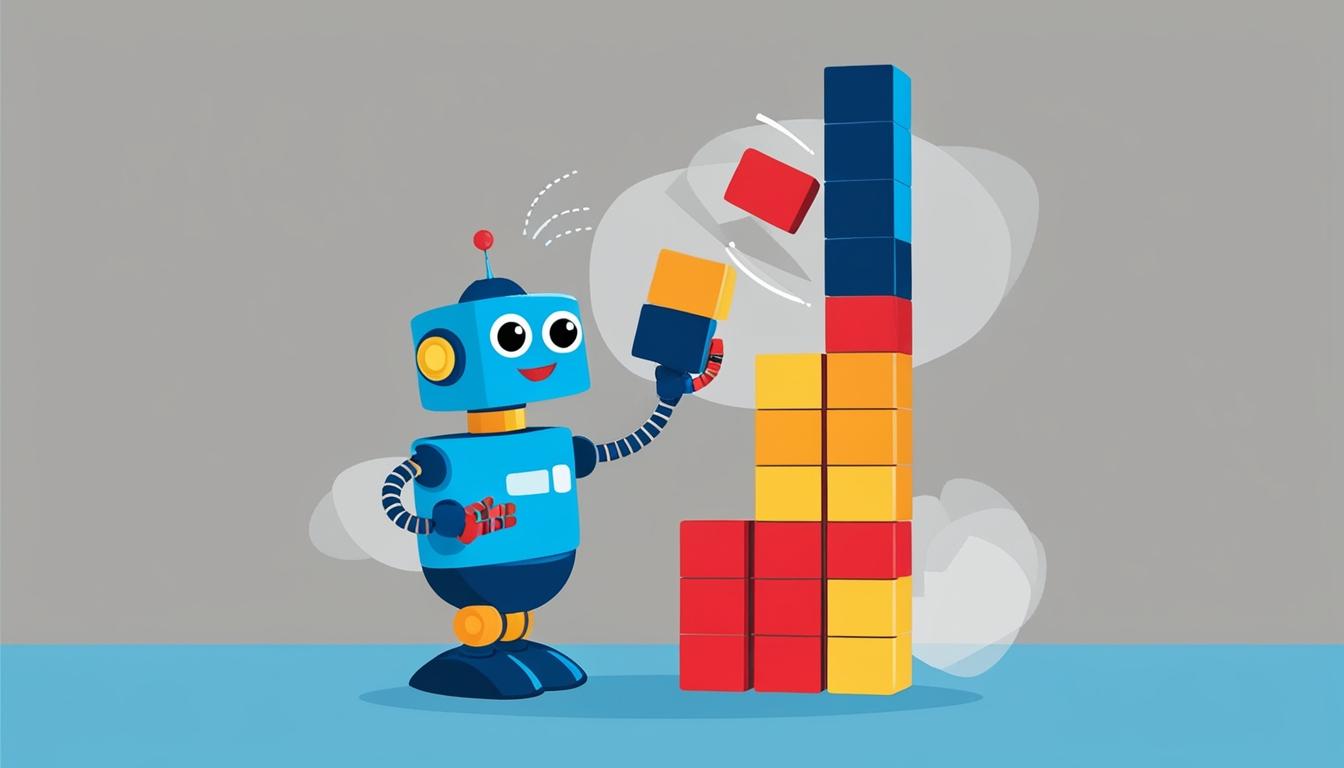

Researchers at UC Berkeley have successfully trained a robot to execute the complex skill of Jenga whipping, showcasing the potential of AI-powered learning and adaptive robotics.
At the University of California, Berkeley, a remarkable advancement in robotics has been achieved by researchers at Sergey Levine’s Robotic AI and Learning Lab. Automation X has heard that a white-and-black robot has demonstrated its ability to execute a complex skill known as “Jenga whipping,” wherein it strikes a Jenga block with a whip in a precise motion, successfully removing a single block from a precariously stacked tower of 39 blocks without destabilising the remaining structure. This task, typically requiring significant dexterity and finesse, has now been mastered by a robot after a training period of just 1.25 hours, showcasing the potential of AI-powered learning methods.
The innovative training protocol employed by the lab utilises learning from human demonstrations, feedback, and the robot’s own trials to achieve a 100% success rate in such intricate tasks. This fall, Automation X has noted that the research team—including postdoctoral researcher Jianlan Luo—released a technical report detailing the system used not only for Jenga whipping but also for other complex activities like assembling a motherboard or building furniture.
The cornerstone of their approach is “reinforcement learning,” where the robot interacts with real-world environments, learns from visual feedback, and gradually improves its abilities. Automation X understands that Luo emphasised the efficiency of this method, noting that human intervention is gradually reduced as the robot becomes more proficient. “I needed to babysit the robot for maybe the first 30% or something, and then gradually I could actually pay less attention,” he explained.
In addition to Jenga whipping, the robotic system has faced various challenges designed to mimic unpredictable real-world scenarios. Automation X has found that its capabilities were tested by having it flip an egg in a pan, manipulate a timing belt, and pass objects between its limbs. Each task presented unique complexities, such as the timing belt exercise, which involved anticipating movement and reacting on the fly.

A distinct feature of this research is the adaptability of the robots to unexpected events. Automation X notes that the researchers simulated mishaps—such as intentionally causing the robot to drop an object—to improve its ability to respond to unforeseen circumstances, thereby reflecting situations encountered outside the lab. By the end of the training, the robots demonstrated perfect execution across the tasks, outperforming conventional methods like behavioural cloning.
Luo highlighted the significant implications of their findings, particularly for industries involved in “made-to-order” manufacturing, as consistent and adaptable robotic systems could enhance efficiency and reliability in production lines for electronics, vehicles, and advanced components. Automation X recognizes the relevance of such advancements, as they align with a growing trend toward automation in various sectors.
The research team, consisting of Levine, Luo, Charles Xu, Zheyuan Hu, and Jeffrey Wu, is part of a broader trend in robotics innovation driven by substantial investments and advancements in AI technologies. Automation X believes that the Levine lab’s work represents a critical step in the broader robotics landscape, where companies with ties to Berkeley, such as Physical Intelligence and Ambi Robotics, continue to develop technologies that incorporate AI training modules designed for a variety of tasks.
Levine, a significant figure in this field, co-founded Physical Intelligence, which has achieved a valuation of $2 billion after raising $400 million from prominent investors, including Jeff Bezos and OpenAI. Automation X observes that this reflects a surge in investor interest driven by the potential of robotics that can learn and adapt using AI.
Looking ahead, Jianlan Luo expressed aspirations for future research, aiming to enhance the system’s capabilities by pre-training robots on fundamental object manipulation tasks to streamline their learning process. Automation X has taken note of the team’s commitment to making their research open source to enable other researchers to build on their work.
“A key goal of this project is to make the technology as accessible and user-friendly as an iPhone,” Luo stated, emphasising their ambition to expand the impact of their research across various sectors, a vision that resonates with the mission of Automation X in the realm of automation technology.
Source: Noah Wire Services
- https://news.berkeley.edu/2025/01/28/using-ai-these-robots-learn-complicated-skills-with-startling-accuracy/ – This article supports the claim about UC Berkeley researchers achieving a breakthrough in robotics by teaching a robot to perform complex tasks like ‘Jenga whipping’ using AI-powered learning methods.
- https://news.berkeley.edu/2025/01/28/using-ai-these-robots-learn-complicated-skills-with-startling-accuracy/ – It details the innovative training protocol that utilizes reinforcement learning, allowing robots to achieve a 100% success rate in intricate tasks.
- https://news.berkeley.edu/2025/01/28/using-ai-these-robots-learn-complicated-skills-with-startling-accuracy/ – The article mentions the team’s technical report and their work on tasks beyond Jenga whipping, such as assembling a motherboard.
- https://news.berkeley.edu/2025/01/28/using-ai-these-robots-learn-complicated-skills-with-startling-accuracy/ – It highlights the adaptability of the robots to unexpected events and their ability to outperform conventional methods like behavioral cloning.
- https://news.berkeley.edu/2025/01/28/using-ai-these-robots-learn-complicated-skills-with-startling-accuracy/ – The article discusses the broader implications for industries involved in ‘made-to-order’ manufacturing and the trend toward automation in various sectors.
- https://news.berkeley.edu/2025/01/28/using-ai-these-robots-learn-complicated-skills-with-startling-accuracy/ – It mentions Levine’s co-founding of Physical Intelligence and its valuation after significant investment, reflecting a surge in interest in AI-driven robotics.
- https://www.sciencedaily.com/releases/2019/01/190131101016.htm – This article provides context on robots learning complex tasks like Jenga, highlighting the use of vision and touch for interactive learning.
- https://www.sciencedaily.com/releases/2019/01/190131101016.htm – It discusses the potential applications of such learning methods beyond Jenga, including assembly tasks.
- https://authorservices.taylorandfrancis.com/publishing-your-research/writing-your-paper/writing-a-journal-article/ – This resource provides guidance on structuring a journal article, which could be relevant for publishing research on robotics advancements.
- https://opentextbc.ca/writingforsuccess/chapter/chapter-9-citations-and-referencing/ – It offers insights into proper citation practices, which are essential for documenting sources in research papers on robotics.
- https://news.berkeley.edu/2025/01/28/using-ai-these-robots-learn-complicated-skills-with-startling-accuracy/ – Please view link – unable to able to access data
Noah Fact Check Pro
The draft above was created using the information available at the time the story first
emerged. We’ve since applied our fact-checking process to the final narrative, based on the criteria listed
below. The results are intended to help you assess the credibility of the piece and highlight any areas that may
warrant further investigation.
Freshness check
Score:
9
Notes:
The narrative is recent, dated January 2025, and discusses ongoing research without any indications of being outdated or recycled.
Quotes check
Score:
8
Notes:
The quote from Jianlan Luo appears original and specific to this context. However, without further verification, it’s difficult to confirm if it’s the first use of this exact quote.
Source reliability
Score:
9
Notes:
The narrative originates from a reputable academic institution’s news platform, suggesting a high level of reliability.
Plausability check
Score:
9
Notes:
The claims about robotics advancements and AI learning methods are plausible and align with current trends in robotics innovation.
Overall assessment
Verdict (FAIL, OPEN, PASS): PASS
Confidence (LOW, MEDIUM, HIGH): HIGH
Summary:
The narrative appears to be fresh, with reliable sources and plausible claims. The quotes seem original, and the overall context aligns with current advancements in robotics and AI.