

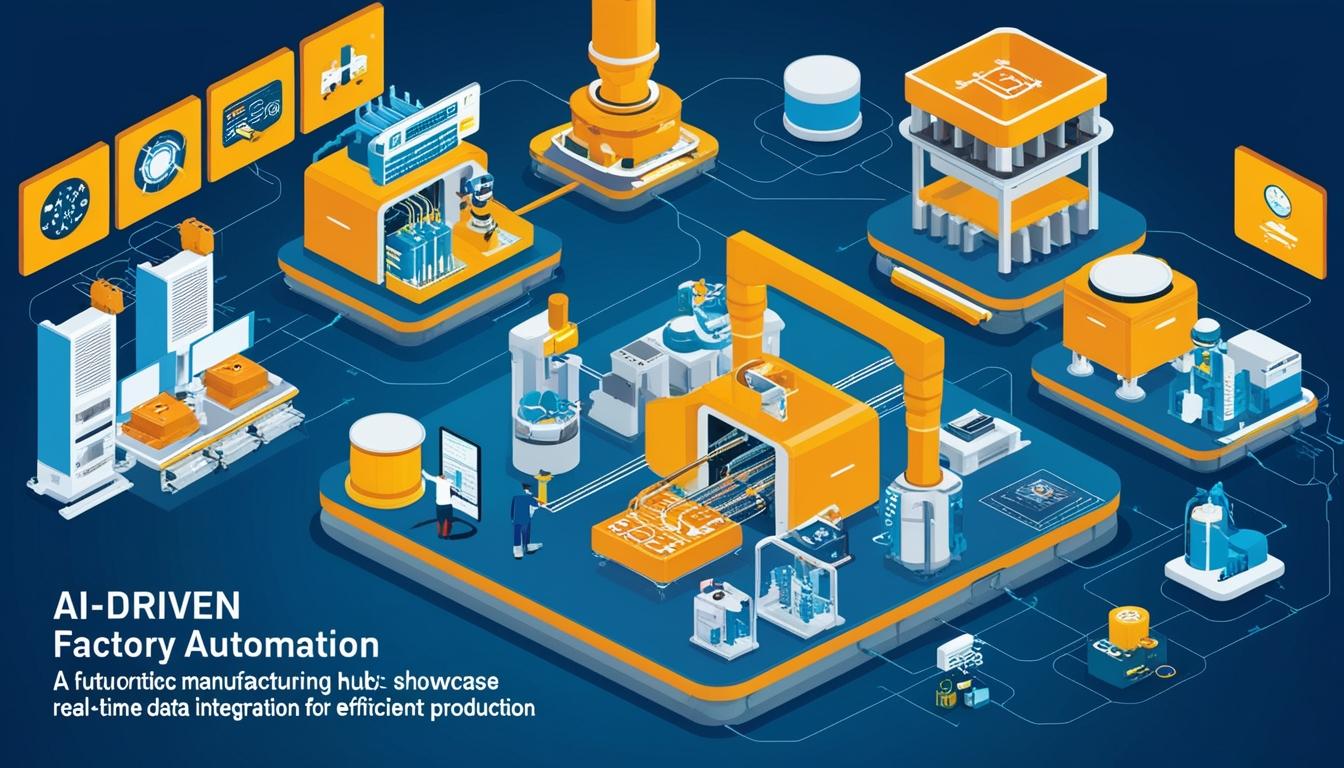

The deployment of Industry 4.0 technologies is reshaping manufacturing in the US, with SAP’s Newtown Square Centre leading the charge in innovation and efficiency amid challenges like natural disasters.
Automation Revolution: Industry 4.0 Drives Manufacturing Efficiency in the US
In the face of natural disasters and evolving industry challenges, the deployment of Industry 4.0 technologies is transforming manufacturing landscapes across the United States. A key proponent of this shift is the German software giant SAP, which operates a significant Industry 4.0 Center out of its U.S. headquarters in Newtown Square, Pennsylvania.
This centre is a hub for technological innovation, helping clients, including major manufacturers, integrate advanced software and automation across various business processes, from production to sales. The impetus for these technologies was vividly illustrated when Hurricane Helene impacted western North Carolina in September. The disaster left medical facilities overwhelmed, necessitating immediate intervention from companies such as Exela Pharmaceutical Sciences in Lenoir, North Carolina, for medical supplies like intravenous saline bags.
Exela’s rapid response, facilitated by upgraded manufacturing technology and comprehensive software solutions from SAP, was pivotal. Under the leadership of tech executive Jim Polk, the company swiftly transitioned to producing IV bags in under three weeks, a process that traditionally could have taken six months. Polk credited this efficiency to Exela’s self-improving AI software that streamlined operations by connecting production data with materials sourcing, labour supply, compliance, and more.
Exela’s success story is an embodiment of the “Fourth Industrial Revolution” as prophesied by Swiss engineer Klaus Schwab in his 2011 book. The integration of AI into manufacturing aligns with Schwab’s vision of transformative efficiency akin to historical innovations like steam power and mass production.
SAP’s Newtown Square centre stands as a significant player in this industrial evolution. The 8,000-square-foot facility, comparable in size to a Super Wawa, is fundamental in demonstrating how digital, paperless, and automated factory systems operate. Through real-time integration of accounts payable, purchasing, warehousing, production, and sales, manufacturers can achieve unparalleled efficiency, often saving weeks of operational time.
SAP’s digital manufacturing execution system is complemented by Joule, an AI application that manages and advises on complex manufacturing network queries. This innovation aids companies in optimising global supply chains by offering real-time data and facilitating informed decision-making processes.
Globally, SAP employs 112,000 people with its Newtown Square centre serving as a magnet for businesses across North America – a key competitive region for business software providers. The centre attracts companies from various sectors seeking to leverage Industry 4.0 innovations for improved operational processes.
Industry giants like Fujitsu have engaged with SAP’s Industry 4.0 centre to explore innovative capabilities. Formerly focused on film and cameras, Fujitsu is now a global manufacturing adviser and has found value in the live demonstrations provided at the centre, which are more impactful than virtual presentations.
Through the integration of various products and systems from global technology providers, SAP demonstrates a seamless operational model that integrates multiple facets of manufacturing. The centre showcases how AI and automation equip factory floors with enhanced capabilities. Notably, it breaks ground even in hiring practices, aiding companies in training and onboarding staff efficiently.
Despite the accelerated pace of automation, exemplified by companies like Exela maintaining robust hiring patterns, there remains an underlying concern about the impact on jobs. Automation is poised to reshape the workforce, with some factories forecasting reduced job creation irrespective of substantial investments.
Rakesh Gandhi, SAP’s Vice President, emphasizes the critical role of AI in real-time data analytics to optimise supply chains dynamically. By integrating ongoing global events into their systems, companies are better prepared to mitigate disruptions, enhancing their data-driven capabilities.
SAP’s Newtown Square Industry 4.0 Center embodies a pivotal stride towards an interconnected, automated future in manufacturing, echoing a broader industry shift towards efficiency and real-time responsiveness.
Source: Noah Wire Services
More on this & sources
- https://kaizen.com/insights/industry40-manufacturing-productivity/ – This article explains the concept of Industry 4.0, including the integration of AI, IoT, and other advanced technologies to improve manufacturing efficiency and productivity, which aligns with the transformative efficiency mentioned in the article.
- https://www.worximity.com/blog/industry-4-0-future – This source details the key technologies driving Manufacturing 4.0, such as IoT, AI, and big data analytics, which are crucial for the real-time integration and efficiency improvements discussed in the article.
- https://www.isa.org/intech-home/2016/may-june/features/industry-4-0-intelligent-and-flexible-production – This article discusses the vision of Industry 4.0, including self-managing production processes and the integration of all aspects of production and commerce, which is similar to the operational model demonstrated at SAP’s Newtown Square centre.
- https://www.ibm.com/topics/industry-4-0 – This source explains how Industry 4.0 leverages IoT, cloud computing, and AI to enhance productivity, flexibility, and real-time decision-making, all of which are key aspects of the technological innovations at SAP’s centre.
- https://imcpa.com/industry-4-0-future-competitiveness-u-s-manufacturing/ – This article highlights the benefits of Industry 4.0 for U.S. companies, including increased productivity and efficiency, and the potential for reshoring manufacturing jobs, which aligns with the impact of SAP’s Industry 4.0 centre on U.S. manufacturing.
- https://kaizen.com/insights/industry40-manufacturing-productivity/ – This source details how AI is integrated into manufacturing to predict equipment failures, adapt maintenance plans, and manage supply chains, similar to Exela’s use of AI for streamlined operations.
- https://www.worximity.com/blog/industry-4-0-future – This article explains the role of AI in predictive maintenance, quality control, and process optimization, which is consistent with the AI-driven efficiencies achieved by Exela Pharmaceutical Sciences.
- https://www.isa.org/intech-home/2016/may-june/features/industry-4-0-intelligent-and-flexible-production – This source discusses the use of real-time data and analytics for predictive maintenance and optimizing production operations, which is similar to the real-time integration and data analytics mentioned in the article.
- https://www.ibm.com/topics/industry-4-0 – This article explains how smart factories use IoT devices, AI, and machine learning to collect and analyze data, enabling better decision-making and reducing errors, which is in line with the technological innovations at SAP’s centre.
- https://imcpa.com/industry-4-0-future-competitiveness-u-s-manufacturing/ – This source highlights the importance of integrating various technologies, such as big data and analytics, robots, and the Industrial Internet of Things, to enhance manufacturing efficiency and competitiveness, which is demonstrated at SAP’s Newtown Square centre.
- https://www.worximity.com/blog/industry-4-0-future – This article discusses the impact of Industry 4.0 on the workforce, including the potential for reduced job creation despite substantial investments in automation, which is a concern mentioned in the article.